
Introduction
Solar battery storage is becoming an increasingly popular addition to residential solar panel systems across the UK. While solar panels generate electricity during daylight hours, households often need power in the evening when panels produce little or no energy. A home battery solves this problem by storing excess electricity for later use.
In 2026, installing a solar battery can help homeowners increase their energy independence, reduce electricity purchases and make better use of renewable energy. However, battery storage requires an additional investment, and choosing the wrong capacity can reduce its financial benefits.
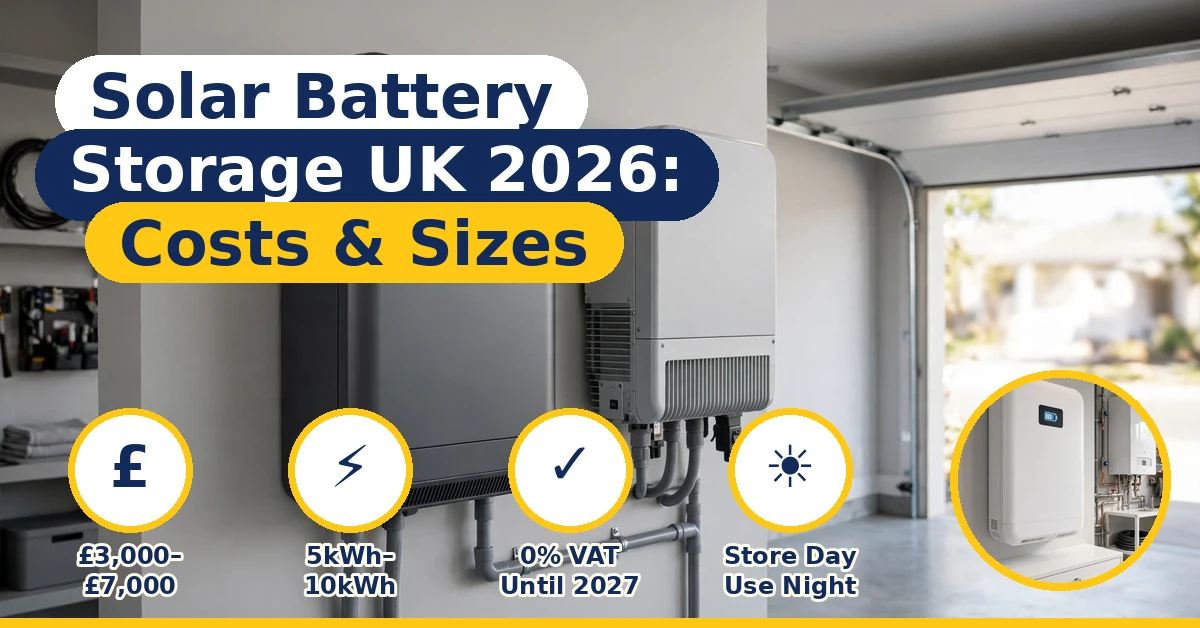
A typical 5kWh home battery costs approximately £3,000 to £5,500 installed, while a 10kWh system generally costs around £4,500 to £7,000. Premium products and complicated installations can cost more.
This guide explains UK solar battery prices, available sizes, potential savings, installation considerations and whether investing in battery storage makes financial sense in 2026.
1. Solar Battery Storage Costs in the UK in 2026

The cost of a home battery depends on its storage capacity, manufacturer, inverter compatibility and installation requirements. Larger batteries usually offer a lower cost per kilowatt-hour, although their total purchase price is higher.
Average Solar Battery Prices
| Battery capacity | Estimated installed cost |
|---|---|
| 3–5kWh | £2,500–£5,500 |
| 5–8kWh | £3,500–£6,000 |
| 8–10kWh | £4,500–£7,000 |
| 10–15kWh | £7,000–£12,000 |
| 15–20kWh | £8,500–£15,000 |
These are indicative 2026 market prices, not fixed quotations. Some suppliers offer lower prices for standard installations, while complex electrical work or premium equipment can increase the cost. Sources: AboutWatts, Less.co.uk and AboutWatts battery price guide.
What Is Included in the Installation Price?
A professionally installed solar battery package may include:
- Battery storage unit and mounting equipment.
- Compatible inverter or hybrid inverter.
- Electrical wiring and protection equipment.
- Installation labour and commissioning.
- System configuration and monitoring setup.
- Relevant electrical certification and network notifications.
Always confirm whether the quotation includes an inverter upgrade, additional electrical work and any required modifications to your existing solar system.
2. Different Solar Battery Sizes Explained
Choosing the right battery capacity is important because household electricity requirements vary. A small battery may be sufficient for a property with low evening consumption, while larger households may benefit from additional storage.
5kWh Solar Battery
A 5kWh battery is a practical option for smaller households or properties with moderate electricity consumption.
Its main advantages include:
- Lower initial installation cost.
- Suitable for storing moderate daytime solar surplus.
- Less physical space required.
- Useful for covering some evening electricity demand.
10kWh Solar Battery
A 10kWh battery is a popular choice for households with higher electricity consumption.
It may suit families using several electrical appliances, particularly when solar panels generate enough surplus electricity to charge it regularly.
15kWh Solar Battery
A 15kWh battery offers greater storage capacity for larger properties, households with electric vehicles or homes using electricity-intensive equipment.
However, installing a larger battery does not automatically mean greater savings. The system must have enough surplus electricity or access to suitable off-peak electricity tariffs to make effective use of its capacity.
3. How Does Solar Battery Storage Work?
A solar battery stores electricity generated by solar panels that is not immediately needed by household appliances.
During daylight hours, solar panels generate electricity. The home uses the electricity it needs, while surplus power can charge the battery. Once the battery is charged, additional electricity may be exported to the national grid.
When sunlight decreases, the battery supplies stored electricity to the property.
Main Operating Stages
- Solar generation: Panels produce electricity from sunlight.
- Household consumption: Appliances use available solar power.
- Battery charging: Surplus electricity is stored for later use.
- Evening discharge: Stored electricity powers household appliances.
- Grid electricity: The property imports electricity when solar and battery output are insufficient.
This process helps households use a greater proportion of their own renewable electricity.
4. How Much Can You Save With Solar Battery Storage?
The amount you save depends on electricity prices, solar generation, battery capacity and household consumption patterns.
Without battery storage, excess solar electricity is usually exported to the grid. A battery allows you to store some of that electricity and use it later instead of purchasing power from your supplier.
Factors That Influence Your Savings
- Electricity tariffs: Higher electricity import prices can increase the value of using stored solar power.
- Household consumption: Homes using more electricity during evenings may benefit from storage.
- Battery efficiency: Energy is lost during charging and discharging, so usable output is lower than the amount initially stored.
- Solar generation: A larger solar installation may provide more surplus electricity to charge a battery.
- Export payments: The amount you receive for exported electricity affects the financial benefit of storing it instead.
Smart Energy Tariffs
Some UK electricity suppliers offer time-of-use tariffs with cheaper electricity during selected periods, often overnight.
Homeowners with compatible batteries can charge them when electricity prices are low and use stored electricity during more expensive periods.
However, check the tariff’s standing charges, peak prices, battery restrictions and export conditions before switching.
5. Is Solar Battery Storage Worth It in 2026?
Whether battery storage is worthwhile depends on your household’s energy requirements and the price you pay for installation.
For households with existing solar panels, a battery can increase self-consumption and reduce the amount of electricity purchased during expensive periods.
Advantages of Installing a Solar Battery
1. Lower Electricity Bills
Using stored electricity can reduce the amount of power you need to purchase from your energy supplier.
2. Better Use of Solar Energy
Instead of exporting all surplus electricity during the day, you can save some for evening consumption.
3. Greater Energy Independence
A battery can reduce reliance on the national electricity grid during normal operation.
4. Flexible Electricity Management
Compatible systems can work with smart tariffs and energy monitoring applications to manage charging and discharging.
5. Support for Renewable Energy
Using more locally generated solar electricity can help reduce reliance on electricity generated from fossil fuels.
Disadvantages to Consider
Battery storage also has some limitations:
- High initial purchase and installation costs.
- Gradual battery degradation over time.
- Limited storage capacity.
- Energy losses during charging and discharging.
- Possible inverter replacement or electrical upgrades.
- Financial savings that vary according to electricity tariffs.
A battery is therefore not automatically the best investment for every homeowner.
6. Solar Battery VAT and Financial Support in the UK
Homeowners can benefit from the UK government’s zero-rated VAT arrangement for qualifying residential battery installations.
As of 2026, qualifying domestic battery storage installations benefit from 0% VAT until 31 March 2027. The relief applies to qualifying standalone battery installations as well as batteries installed alongside solar panels. Sources: GOV.UK, UK Parliament House of Commons Library and UK Government Clean Energy.
Other financial support may be available through local energy improvement programmes.
For example, the Warm Homes: Local Grant may fund suitable home energy improvements for qualifying households in England. However, battery storage should not be assumed to be automatically included. The approved measures depend on programme rules and property assessments.
For official information, visit:
7. How to Choose the Right Solar Battery
Selecting the right battery requires more than comparing prices. You should consider usable capacity, efficiency, warranty and compatibility with your current solar equipment.
Check Usable Battery Capacity
Some manufacturers advertise the total battery capacity, but the amount of electricity available for everyday use may be lower.
Compare usable capacity rather than relying only on the advertised kWh rating.
Compare Battery Chemistry
Lithium iron phosphate (LFP) batteries are commonly used in residential storage because of their thermal stability and cycle-life characteristics. Other lithium-ion technologies are also available.
Review manufacturer specifications and safety certifications before purchasing.
Review Warranty Conditions
Check the warranty period, guaranteed remaining capacity and any energy-throughput limits.
Check Inverter Compatibility
If you already have solar panels, confirm whether your existing inverter supports battery storage. Some systems require an additional battery inverter or replacement with a hybrid model.
8. Steps to Install Solar Battery Storage
Installing a home battery requires proper planning and professional electrical work.
Step 1: Review Your Electricity Bills
Check how much electricity your household uses during daytime and evening hours.
Step 2: Assess Your Existing Solar System
If you already have solar panels, ask an installer to check the inverter, generation capacity and battery compatibility.
Step 3: Choose Suitable Battery Capacity
Select a battery according to your electricity requirements and expected solar surplus.
Step 4: Compare Installation Quotes
Request quotations from multiple qualified installers. Compare equipment, installation charges, warranties and after-sales support.
Step 5: Arrange Professional Installation
Use a suitably qualified installer who can complete the electrical work, commission the battery and handle relevant network notifications.
Step 6: Monitor Battery Performance
Use the manufacturer’s monitoring application to track charging, discharging, electricity consumption and system performance.
Conclusion
Solar battery storage in the UK can help homeowners make better use of renewable electricity and reduce their dependence on the national grid. In 2026, a typical 5kWh battery costs approximately £3,000 to £5,500 installed, while a 10kWh system generally costs £4,500 to £7,000.
The best battery size depends on household electricity consumption, existing solar panel capacity and available energy tariffs. Although battery storage requires an additional investment, it can provide long-term benefits for households that regularly generate surplus solar electricity.
Before purchasing a battery, compare installation quotations, check warranty conditions and calculate potential savings. Choosing a properly sized system can help you get better value from your solar investment.
Frequently Asked Questions
1. How much does a solar battery cost in the UK in 2026?
A typical 5kWh solar battery costs around £3,000 to £5,500 installed. A 10kWh battery generally costs approximately £4,500 to £7,000, depending on the manufacturer and installation requirements.
2. What size solar battery is best for a UK home?
A 5kWh battery may suit smaller households, while a 10kWh battery can be suitable for families with higher electricity consumption. The correct size depends on energy usage and solar generation.
3. Can I install a solar battery without solar panels?
Yes. Some home batteries can charge using electricity from the national grid, particularly when compatible with time-of-use electricity tariffs. This allows homeowners to store cheaper electricity for later use.
4. How long does a home solar battery last?
Many residential batteries come with warranties of approximately 10 years. Actual lifespan depends on battery chemistry, usage, operating conditions and manufacturer specifications.
5. Is solar battery storage worth buying in 2026?
It can be worthwhile for households with significant evening electricity consumption, suitable solar generation or access to competitive off-peak tariffs. However, installation costs and expected savings should be compared before purchasing.
Sources and Further Reading
- Sources: AboutWatts — AboutWatts — home battery storage guide.
- Less.co.uk — Less.co.uk — solar battery storage costs.
- AboutWatts battery price guide — AboutWatts — solar battery price guide.
- Sources: GOV.UK — GOV.UK — 0% VAT on energy-saving products.
- UK Parliament House of Commons Library — House of Commons Library — energy efficiency and VAT research briefing.
- UK Government Clean Energy — UK Government Clean Energy — battery storage information.
- Ofgem — Ofgem — energy regulator and scheme information.
- Energy Saving Trust — Energy Saving Trust — independent energy saving advice.
Prices, scheme details and eligibility rules can change. Always check the latest official guidance before applying or signing a contract.




5 Comments