Article”](https://www.aiprm.com/prompts/seo/writing/1796452522999930880/)*
Introduction
Installing solar panels can help UK households reduce electricity bills, generate renewable energy and become less dependent on traditional energy suppliers. However, upfront installation costs can make the decision difficult, particularly for homeowners on limited incomes.
Several government-backed programmes and local funding opportunities can help eligible households improve their home’s energy efficiency. In 2026, homeowners should understand the changing availability of ECO4, the closure of the Great British Insulation Scheme (GBIS), and newer funding options.
Not every programme provides direct cash payments for solar panels. Some arrange fully or partially funded installations through approved energy companies or local authorities. This guide explains the available options, eligibility requirements and application process.
1. ECO4 Scheme: Solar Panel Support in 2026
The Energy Company Obligation (ECO4) programme was introduced to help households improve energy efficiency and reduce heating costs. It required participating energy suppliers to fund qualifying home improvements for eligible households.
Solar photovoltaic (PV) panels were among the measures that could be supported under ECO4, depending on household eligibility, property suitability and supplier approval.
Main Features of ECO4
- Support for low-income households: The programme targeted households experiencing fuel poverty or struggling with energy costs.
- Energy-efficient upgrades: Eligible properties could receive insulation, heating improvements and certain renewable energy technologies.
- Flexible eligibility: Local authorities could refer some households through ECO4 Flex, including qualifying households that did not meet standard benefit-related criteria.
- Supplier-funded improvements: Participating energy companies arranged and funded approved measures rather than providing a standard cash grant.
Is ECO4 Still Available in 2026?
The government extended ECO4 until 31 December 2026. However, this extension does not introduce additional funding or increase supplier targets. It mainly provides more time to complete existing obligations and remedial work.
Although new applications were technically permitted under the extension, some suppliers stopped accepting applications earlier because of limited capacity and funding commitments. Homeowners should therefore confirm availability directly with participating suppliers before making plans.
ECO4 is not a guaranteed source of new solar funding, and battery storage is not an eligible ECO4 measure. Source: UK Parliament | GOV.UK
2. Great British Insulation Scheme (GBIS)
The Great British Insulation Scheme was designed to make homes warmer and reduce household energy consumption. Unlike ECO4, which followed a broader whole-house improvement approach, GBIS primarily focused on individual insulation measures.
Important GBIS Features
- Insulation assistance: Eligible households could receive support for approved insulation improvements.
- Property-based eligibility: Some households qualified based on their property’s Energy Performance Certificate (EPC) rating and council tax band.
- Energy bill savings: Better insulation helped reduce heat loss and improve household energy efficiency.
- Support for vulnerable residents: The scheme also targeted households facing fuel poverty and challenging living conditions.
Has GBIS Closed?
Yes. GBIS officially ended on 31 March 2026 and is now closed to new installations. It was primarily an insulation programme, not a dedicated solar panel grant. Homeowners should not assume that it will pay for a new solar PV installation in 2026.
People with existing applications should contact their energy supplier for information about outstanding work. Source: Ofgem
3. Warm Homes: Local Grant
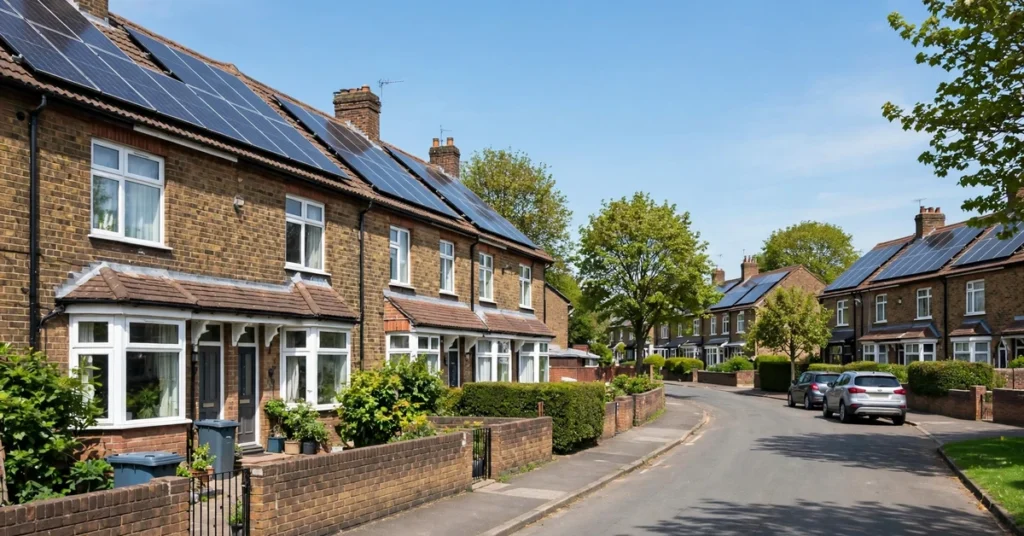
The Warm Homes: Local Grant is an important alternative for eligible households in England. It provides funding through local authorities to improve residential energy performance and support low-carbon heating.
Depending on the property assessment and available funding, improvements can include solar panels, insulation, heating controls and air source heat pumps.
Key Features of the Warm Homes: Local Grant
- Free improvements: Eligible households can receive approved improvements without paying installation costs.
- Solar panel installation: Solar PV panels may be included when the property assessment identifies them as suitable.
- Local authority delivery: Councils coordinate property assessments and arrange approved installation work.
- Support for private homes: Qualifying owner-occupied and privately rented properties can be considered.
Who Can Apply?
Generally, applicants must meet these conditions:
- The property must be located in England.
- It must be privately owned, either by the applicant or a private landlord.
- It should have an EPC rating between D and G.
- Household income must usually be £36,000 or less annually, although certain postcode and benefit-related exceptions apply.
Landlord permission and financial contributions may be required for rented properties.
How to Apply
Visit the Warm Homes: Local Grant application page. Enter the required household and property information to check eligibility. If eligible, your local authority can arrange a home assessment and discuss suitable improvements.
Solar panel installation is subject to technical suitability and local funding availability. Source: GOV.UK
4. Other Regional Solar Funding Opportunities
Solar panel funding is not identical across the UK. Scotland, Wales and Northern Ireland operate different energy support programmes, so homeowners should check the options available in their area.
Scotland: Home Energy Scotland
Homeowners in Scotland can contact Home Energy Scotland for independent advice about renewable energy funding and home improvements.
Its grant and loan programme supports several energy-saving technologies. However, standard solar PV panels are not currently covered by the general grant and loan offer. Certain specialist solar thermal or hybrid solar technologies have different funding rules.
Eligible homeowners may also explore the Warmer Homes Scotland programme and local area-based energy improvement schemes. Source: Home Energy Scotland
Wales: Nest Energy Support Scheme
The Welsh Government’s Nest programme provides free energy advice and home improvements for qualifying households.
Depending on household circumstances and property suitability, improvements may include:
- Solar PV panels.
- Energy-efficient heating systems.
- Home insulation.
- Air source heat pumps.
The scheme primarily supports households experiencing fuel poverty or struggling to maintain a comfortable indoor temperature. Homeowners and eligible private tenants can check their eligibility through the official Welsh Government website. Source: GOV.WALES
Northern Ireland: NISEP Funding
The Northern Ireland Sustainable Energy Programme (NISEP) provides energy efficiency assistance through participating organisations and limited funding opportunities.
Some programmes may support solar PV installations or related renewable energy improvements for qualifying households. Availability depends on the particular programme, eligibility requirements and remaining funding. Contact participating providers to confirm whether solar support is currently available.
5. How to Apply for Solar Panel Funding in 2026
Finding suitable funding is only the first step. Follow a clear application process to avoid delays, unnecessary expenses and misleading offers.
Step 1: Check Your Property Eligibility
Start by checking your property’s EPC rating, ownership status and location. Some funding programmes specifically target properties with lower energy efficiency ratings.
Step 2: Review Household Income Requirements
Check whether your household income or benefit status meets the relevant programme’s requirements. Keep supporting documents available if the application requires proof.
Step 3: Contact Your Local Council
Contact your local authority to ask about current energy improvement funding. Councils can explain whether they participate in the Warm Homes: Local Grant or other local initiatives.
Step 4: Arrange a Property Assessment
An approved professional may inspect your roof, electricity supply and overall property condition. This assessment helps determine whether solar panels are technically suitable.
Step 5: Confirm the Funding Offer
Before agreeing to installation, request written confirmation of the approved improvements, funding amount, installation costs and any contribution you must make.
Step 6: Choose an Approved Installer
Use appropriately certified professionals. For solar PV installations, check the installer’s Microgeneration Certification Scheme (MCS) credentials and relevant consumer protection arrangements.
Step 7: Complete the Installation
Once funding and installation arrangements are approved, the contractor can complete the work. Keep copies of warranties, certificates, invoices and system documentation.
6. Important Things to Consider Before Applying
Although funding can reduce installation expenses, homeowners should understand several important points.
- Funding is limited: Not every council or supplier has available funding throughout the year.
- Solar suitability matters: Roof direction, shading, structural condition and electricity consumption affect installation decisions.
- Avoid misleading advertisements: Be cautious of companies promising guaranteed government grants or demanding upfront payments to secure funding.
- Check installation standards: Verify installer credentials, warranties and electrical safety documentation.
- Understand additional costs: Battery storage, roof repairs and electrical upgrades may not be included in a funding package.
Homeowners who cannot access a grant may also investigate the Warm Homes Loan Scheme, which allows eligible property owners to explore financing for solar PV panels and battery storage. This is a loan, not free grant funding, and lender conditions apply. Source: GOV.UK
7. Preparing Your Application Documents
There is no universal solar panel grant application form for every UK funding programme. Each scheme has its own application process and supporting document requirements.
To prepare your application:
- Visit the official government or local authority website.
- Open the relevant funding programme’s application section.
- Download any available guidance or supporting forms.
- Read the eligibility conditions carefully.
- Prepare proof of income, benefit information and property details where requested.
- Submit your application through the official channel.
- Save your confirmation email and application reference for future communication.
Never download application forms from unfamiliar websites or share financial information with unverified installers. For official guidance, visit GOV.UK and Ofgem.
Conclusion
Solar panel grants UK 2026 can help eligible households reduce the financial burden of installing renewable energy systems. However, funding opportunities have changed considerably, particularly following the closure of GBIS and the extension of ECO4 until December 2026.
The Warm Homes: Local Grant is an important option for qualifying households in England, while Wales and Scotland have their own energy support programmes. Northern Ireland residents can investigate limited NISEP opportunities.
Before applying, check the latest eligibility conditions, contact your local authority and verify the installation provider. Choosing the right funding route can make solar energy more affordable while helping households move towards cleaner and more efficient homes.
Frequently Asked Questions
1. Are solar panel grants available in the UK in 2026?
Yes. Eligible households may access support through programmes such as the Warm Homes: Local Grant in England and the Nest scheme in Wales. Availability and eligibility depend on location, household circumstances and property suitability.
2. Is ECO4 still available for solar panels?
ECO4 has been extended until 31 December 2026, but the extension does not provide additional funding or new supplier targets. Some suppliers have stopped accepting new applications, so availability must be checked directly.
3. Can I get free solar panels through the Warm Homes: Local Grant?
Potentially. Eligible households in England may receive solar panels as part of an approved home improvement package. The decision depends on the property assessment, technical suitability and local funding.
4. Has the Great British Insulation Scheme closed?
Yes. GBIS ended on 31 March 2026 and is closed to new installations. It mainly supported insulation rather than providing a dedicated solar panel grant.
5. How can I check whether I qualify for solar panel funding?
Check your household income, benefit status, property ownership and EPC rating. Then contact your local council or the relevant regional energy support programme to confirm current eligibility and application requirements.
Sources and Further Reading
- Source: UK Parliament — UK Parliament — ECO4 extension and funding position.
- GOV.UK — GOV.UK — consultation on extending the ECO4 end date.
- Source: Ofgem — Ofgem — Great British Insulation Scheme closure.
- Warm Homes: Local Grant application page — GOV.UK — Warm Homes: Local Grant application and eligibility.
- Home Energy Scotland — Home Energy Scotland — independent energy advice for Scotland.
- Source: Home Energy Scotland — Home Energy Scotland — grant and loan programme details.
- Nest programme — GOV.WALES — Nest energy support scheme.
- Source: GOV.WALES — GOV.WALES — free home energy efficiency improvements through Nest.
- Source: GOV.UK — GOV.UK — Warm Homes Loan Scheme eligibility.
- GOV.UK — GOV.UK — official government guidance.
- Ofgem — Ofgem — energy regulator and scheme information.
Prices, scheme details and eligibility rules can change. Always check the latest official guidance before applying or signing a contract.