Introduction
Solar panels can reduce household electricity bills and provide some protection from rising energy prices. However, the upfront cost is an important consideration for homeowners deciding whether to install a system.
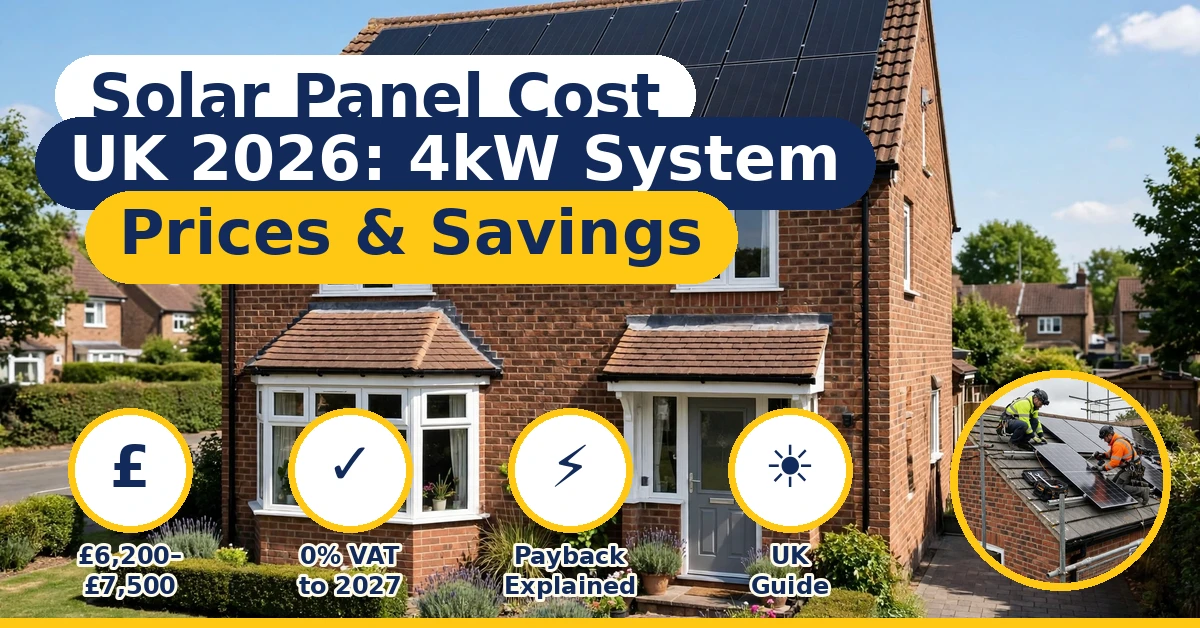
The strongest available benchmark is the UK government’s 2025/26 installation-cost dataset, derived from MCS installation records. It puts the median cost for systems up to 4kW at £1,595 per kW, which works out at approximately £6,400 for a 4kW array. A practical budget for a standard 4kW solar-only installation is therefore around £6,200–£7,500, with some installer guides quoting closer to £8,000 depending on specification and property complexity. Adding a home battery increases the total significantly. These figures are benchmarks, not guaranteed quotes. Source: DESNZ cost data summary and Checkatrade’s 2026 cost guide.
This guide explains typical 4kW solar system prices, what installation includes, how batteries affect the budget, and how to assess potential savings. Prices are planning estimates rather than guaranteed quotations: the only reliable price for a particular property is a written survey-based quote.
How Much Does a 4kW Solar System Cost in the UK in 2026?
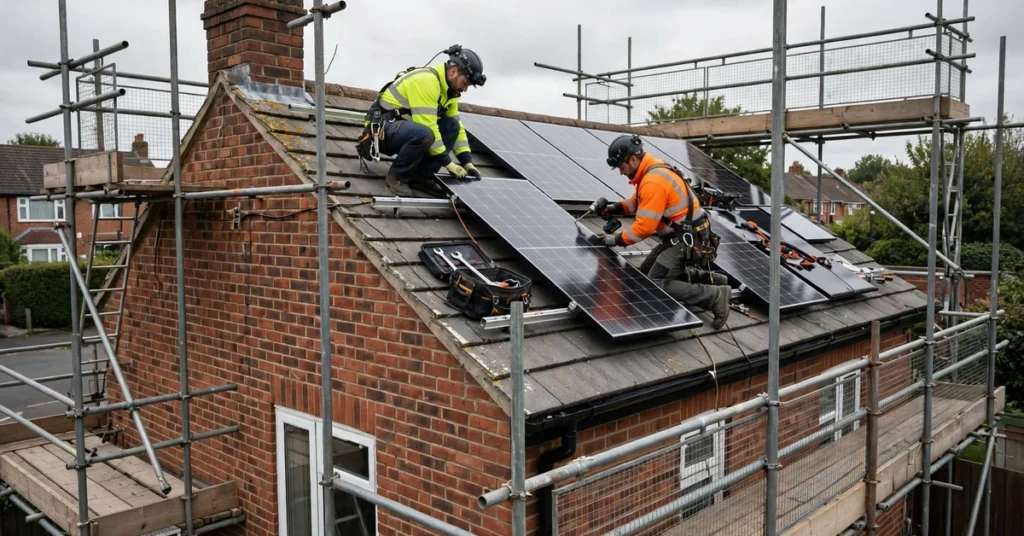
A typical 4kW residential solar installation may cost approximately £5,000–£7,000 before any optional battery storage. A straightforward roof with easy access may be towards the lower end, while a complex roof or premium equipment can push the price higher.
| System or installation | Indicative 2026 budget |
|---|---|
| 4kW solar panels with standard inverter, installed | Around £6,200–£7,500; allow up to about £8,000 for some installations |
| 4kW system with a small home battery | Often around £8,000–£11,000+, depending on battery and installation |
| 4kW system with a larger battery | Can exceed £11,000; obtain a capacity-specific quote |
| Solar-only installation with premium components or complex roof work | May exceed £8,000 |
These are broad budgeting ranges, not fixed market tariffs. Battery capacity, brand, inverter type, installation complexity and regional labour costs can all affect the final price. Ask installers to explain exactly what is included and whether VAT, scaffolding, electrical work, monitoring and commissioning are covered.
What Is Included in a 4kW Solar Panel Installation?
The 2025/26 DESNZ/MCS data reports a median of £1,595 per kW for installations in the 0–4kW band (about £6,400 when multiplied by 4kW). The mean is higher at £1,808 per kW, equivalent to about £7,200 for 4kW. These statistics cover a broad set of installations, so a homeowner’s actual quote can differ. A standard quotation will usually include several key components and services:
- Solar panels: The modules fitted to the roof that convert sunlight into electricity.
- Inverter: Converts the panels’ direct-current electricity into alternating current used by household appliances.
- Mounting system: Rails, brackets and roof fixings that secure the panels.
- Electrical equipment: Cables, isolators, protection devices and other required components.
- Installation labour: Work carried out by the solar installation team.
- Scaffolding and access: Equipment needed to work safely on the roof, where required.
- Testing and commissioning: Checks to confirm the system operates correctly.
- Handover and documentation: System information, warranties and relevant electrical or compliance paperwork.
Not every quote includes the same items. Check whether bird protection, consumer-unit upgrades, meter work, export-meter arrangements or roof repairs are excluded or priced separately.
4kW Solar Panel System Price Breakdown
The total cost is made up of equipment, labour and property-specific work. Installers may bundle these into one price, so the following categories are useful when comparing quotations.
Solar Panels
Panels are a major part of the system cost. The number required depends on the wattage and physical dimensions of the modules selected. For example, a system rated at approximately 4kW might use around 9–11 panels rated between roughly 370W and 450W.
Higher-efficiency or premium panels may cost more, but they can be useful where roof space is limited. Compare product warranties, performance warranties, efficiency and independent product information rather than choosing solely by panel wattage.
Inverter
The inverter manages the electricity produced by the panels and converts it for household use. A conventional string inverter is often a cost-effective option for a simple roof with similar panel orientations.
Microinverters or power optimisers may be considered where panels face different directions or are affected by partial shading. These options can add cost, so ask the installer to explain the expected benefit for your roof.
Mounting and Electrical Equipment
Roof type, pitch and condition influence the mounting equipment and installation work required. Slate, tile and flat roofs may need different approaches. Longer cable runs, difficult access or electrical upgrades can also increase the quote.
Labour, Scaffolding and Installation
Labour costs vary by region, installer, project complexity and the time required on site. Scaffolding may be a significant additional item if it is not included in the advertised package price.
A low headline price is not necessarily the cheapest complete installation. Compare the final, VAT-inclusive price for the same system specification.
How Much Does a 4kW Solar System Cost With a Battery?
A battery stores surplus solar electricity so it can be used later, such as in the evening when the panels are no longer generating much power. It can increase the amount of solar electricity a household uses directly, but it also increases the initial investment.
For a 4kW system, a battery-inclusive project may fall broadly within £7,000–£11,000 or more, depending on battery capacity, brand, inverter compatibility and installation requirements.
Small Battery vs Large Battery
A smaller battery may be suitable for a household that uses a modest amount of electricity after sunset. A larger battery can store more surplus generation, but it may not be financially worthwhile if the household does not regularly use enough stored electricity.
Consider these questions before choosing capacity:
- How much electricity does the household use after sunset?
- How much surplus solar generation is likely to be available?
- Does the battery support the desired charging and export arrangements?
- What is the usable capacity, rather than only the advertised nominal capacity?
- What are the battery’s warranty terms and expected operating conditions?
Ask for a comparison of the solar-only and solar-plus-battery options. The installer should explain the estimated annual bill savings for each, the assumptions used and the additional cost of storage.
Is a Solar Battery Worth the Extra Cost?
A battery may improve self-consumption, particularly where a household uses most of its electricity in the evening. However, a battery does not automatically make a solar installation more economical.
The financial case depends on the purchase price, usable capacity, electricity import and export rates, charging strategy, battery efficiency and how often it is cycled. Request a calculation based on your actual electricity tariff and usage pattern.
What Affects the Cost of a 4kW Solar System?
Two homes can receive very different quotes for systems with the same nominal capacity. The following factors are especially important.
Roof Size, Type and Condition
A suitable roof needs enough usable space and a structure that can safely support the installation. Roof repairs may be necessary before panels are fitted. If repairs are needed, it is usually sensible to address them before installation rather than removing and reinstalling panels later.
Roof Direction and Angle
South-facing roofs often provide strong annual generation in the UK, but east- and west-facing systems can also be effective. The best arrangement depends on the roof and when the household uses electricity.
A less-than-ideal orientation does not automatically make solar unsuitable. Ask for a property-specific generation estimate that accounts for direction, pitch and shading.
Shading
Trees, chimneys, neighbouring buildings and other obstructions can reduce output. Shading can also influence the type of inverter or module-level electronics recommended. A survey should identify shading throughout the day and, where possible, across the year.
Equipment Quality and Warranty
Different panel and inverter brands have different prices, product warranties and performance specifications. Review the warranty provider, exclusions, product availability and installer support arrangements.
Location and Installer
Labour and scaffolding costs can vary across the UK. The distance an installer travels, local demand and the complexity of the property may also influence the price. Obtain multiple comparable quotations rather than assuming one national average will apply to every home.
How Much Electricity Can a 4kW Solar System Generate?
The amount of electricity produced depends on location, roof orientation, pitch, shading, equipment and weather. A useful broad planning estimate for many UK homes is around 3,200–3,700kWh per year, although an individual property may generate less or more.
A 4kW system’s output is not constant. It typically generates more electricity during long, brighter summer days and much less during short winter days.
Estimated Monthly Solar Generation
The following table is an illustrative example totalling 3,400kWh over a year. It is not a guaranteed forecast for every UK location.
| Month | Illustrative generation |
|---|---|
| January | 90kWh |
| February | 150kWh |
| March | 270kWh |
| April | 380kWh |
| May | 450kWh |
| June | 470kWh |
| July | 460kWh |
| August | 390kWh |
| September | 290kWh |
| October | 190kWh |
| November | 130kWh |
| December | 130kWh |
| Annual total | 3,400kWh |
A professional proposal should use a recognised modelling method and the property’s actual roof details. Treat generic monthly tables as examples only.
How Much Money Can a 4kW Solar System Save?
Savings depend on how much generated electricity the household uses directly and how much surplus electricity it exports. Electricity used in the home can reduce the amount bought from the grid. Exported electricity may earn a payment under an eligible export tariff.
For a simple illustration, if a home uses 1,700kWh of its solar generation itself and its avoided import price is 25p per kWh, the avoided electricity cost would be:
1,700kWh × £0.25 = £425 per year.
This is an example calculation, not a prediction of a typical household’s savings. The actual import rate, self-consumption and export payment may differ. Standing charges generally remain payable even when solar panels reduce grid electricity use.
What Is the Smart Export Guarantee?
The Smart Export Guarantee (SEG) is a UK scheme under which eligible electricity suppliers offer tariffs for electricity exported to the grid by qualifying small-scale generators. The rate and terms depend on the supplier and tariff.
Before signing an installation contract, check current SEG eligibility requirements and compare available export tariffs. Ask the installer what documentation and metering arrangements you will need.
How to Increase Solar Savings
You may be able to use more of your own solar generation by shifting flexible electricity use into daylight hours.
Practical examples include:
- Running the washing machine or dishwasher when the panels are generating.
- Charging an electric vehicle during the day when practical.
- Scheduling hot-water heating to use surplus solar electricity, where the system supports it.
- Using smart controls to coordinate appliances with solar output.
- Reviewing whether a battery makes financial sense for your usage and tariff.
Do not run appliances unnecessarily just to use solar electricity. The aim is to move electricity use that you already need into periods when solar generation is available.
How Long Does It Take for a 4kW Solar System to Pay for Itself?
The payback period is the time it takes for the financial benefits to equal the initial installation cost. It varies with the purchase price, self-consumption, electricity prices, export payments, maintenance and system performance.
A simple payback calculation is:
Payback period = installed system cost ÷ estimated annual financial benefit
For example, if a system costs £6,000 and produces an estimated combined annual benefit of £600, the simple payback calculation is 10 years. This example excludes financing, degradation, maintenance, changes in tariffs and the time value of money.
Ask installers to show the assumptions behind their payback estimates. Be cautious of claims that promise a guaranteed payback period or savings without reviewing your property and electricity bills.
Are There Grants or VAT Savings for Solar Panels in 2026?
The support available depends on the property, household circumstances, installation type and current government rules. Do not assume that every homeowner qualifies for a grant.
0% VAT on Qualifying Energy-Saving Materials
Qualifying solar panel installations in residential accommodation are currently zero-rated until 31 March 2027 under the applicable rules. The exact treatment can depend on the location and circumstances of the installation, particularly in Northern Ireland. The government says qualifying installations in Great Britain receive 0% VAT, while Northern Ireland has specific eligibility conditions.
Check the current HMRC guidance or ask the installer to confirm the VAT treatment in writing. Make sure the quotation clearly states whether VAT is included and the rate applied. The House of Commons Library’s September 2026 briefing also describes the zero-rate period ending on 31 March 2027: https://commonslibrary.parliament.uk/research-briefings/cbp-8602/.
Government and Local Support
Some schemes may support eligible households or particular property types, but availability and eligibility can change. Check official government and local-authority information before relying on a grant when planning your budget.
Avoid companies that claim a grant is guaranteed before checking your circumstances. A genuine installer should be able to explain the scheme, eligibility criteria and any customer contribution.
Is a 4kW Solar System the Right Size for Your Home?
A 4kW system can be a practical option for some homes, but the right capacity depends on annual electricity consumption, roof space, daytime usage, future plans and budget.
A household that uses more electricity during the day may benefit from a system that matches that demand. A home with an electric vehicle, heat pump or plans to add one may need a more detailed assessment.
Ask for a design that compares expected generation with your electricity consumption. A larger system is not automatically better if it produces a lot of surplus electricity that receives a relatively low export payment.
How to Compare 4kW Solar Panel Quotes
Get at least three written quotations where possible. Make sure each installer is quoting for a comparable system so you can judge the real difference in price.
Use this checklist:
- System capacity: Confirm the total panel capacity in kWp.
- Panel specification: Record the manufacturer, model, wattage and warranty.
- Inverter: Check the brand, model, capacity and warranty.
- Battery: Confirm whether one is included, its usable capacity and total extra cost.
- Generation estimate: Ask for annual generation and the assumptions behind it.
- Savings forecast: Check the import tariff, export rate and self-consumption assumptions.
- Installation inclusions: Confirm scaffolding, VAT, electrical work and commissioning.
- Certification and compliance: Ask what relevant certificates and handover documents will be supplied.
- Installer credentials: Verify current accreditation, insurance and customer references.
- Aftercare: Understand who handles faults, warranty claims and system monitoring.
Do not choose an installer on price alone. A detailed quotation, suitable equipment and reliable aftercare can be more valuable than a small upfront discount.
Common Mistakes to Avoid When Buying Solar Panels
Choosing the Cheapest Quote Without Comparing Specifications
A cheaper quote may include lower-capacity equipment, fewer services or important exclusions. Compare the complete system and final installed price.
Assuming the System Will Produce the Same Amount Every Month
Solar generation changes throughout the year. A realistic forecast should show seasonal variation rather than presenting one monthly figure as a year-round expectation.
Overestimating Savings
Savings depend on when electricity is used and the rates paid for imported and exported electricity. Ask for conservative, clearly explained assumptions.
Buying a Battery Without Checking Its Financial Value
A battery can improve self-consumption, but its additional cost may extend the payback period. Compare the financial results with and without storage.
Ignoring Roof Repairs and Shading
A roof in poor condition or heavily shaded may require extra work or a different design. Resolve these issues before agreeing to the installation.
Frequently Asked Questions
1. How much does a 4kW solar system cost in the UK in 2026?
A broad planning estimate is around £5,000–£7,000 for a standard installed 4kW system without a battery. The final cost depends on equipment, roof conditions, access, labour and the installer. Request a property-specific quotation.
2. How many solar panels are needed for a 4kW system?
It depends on the wattage of each panel. For example, 10 panels rated at 400W each provide a nominal capacity of 4kW. The installer should confirm the exact panel count and total system capacity.
3. Is a battery included in the price of a 4kW solar system?
Not usually in a standard solar-only price. Battery storage is commonly quoted as an optional extra. Ask for separate prices for the solar system and the battery-inclusive package.
4. Can a 4kW solar system power a whole house?
It can supply a significant amount of household electricity over the year, but generation varies by season and time of day. Most homes remain connected to the grid, especially at night and during periods of low solar output.
5. Do solar panels work in winter in the UK?
Yes. Solar panels still generate electricity in winter, but shorter daylight hours and lower sun angles usually reduce output compared with summer. A system should be assessed using annual and seasonal generation estimates.
6. How can I get an accurate installation price?
Arrange a survey and request a written quotation that lists the panels, inverter, battery options, installation work, VAT, warranties and estimated generation. Compare at least three like-for-like quotes if possible.
Conclusion
A 4kW solar panel system in the UK may cost approximately £5,000–£7,000 installed in 2026, before optional battery storage. A battery can raise the total to around £7,000–£11,000 or more, depending on its capacity and the equipment selected.
The best value depends on more than the headline price. Roof suitability, shading, equipment quality, household electricity use and export rates all affect the financial result. Compare detailed quotations, check current government and VAT rules, and use a property-specific generation estimate before making a decision.
Sources and Further Reading
For current rules, technical estimates and consumer guidance, consult authoritative sources:
- DESNZ/MCS installation cost data summary – 2025/26 — median and mean installed costs derived from government statistics.
- Checkatrade – Solar panel installation cost guide, 2026 — additional market pricing context.
- Energy Saving Trust – Solar panels
- Ofgem – Smart Export Guarantee
- HMRC – VAT on energy-saving materials
- MCS – Find an installer and consumer information
- European Commission – Photovoltaic Geographical Information System (PVGIS)
Prices in this article are indicative budgeting ranges informed by 2025/26 installation data and 2026 cost guides, not live installer quotes. Confirm current prices, VAT treatment, tariffs and scheme eligibility before purchasing.