Solar panels can help homeowners reduce electricity bills and generate renewable energy. Before arranging an installation, it is important to check whether planning permission is required. In many cases, standard roof-mounted solar panels are classed as permitted development, meaning a planning application is not needed. However, exceptions apply to some listed buildings, conservation areas, flats and installations that exceed permitted limits.
The rules differ between England, Scotland, Wales and Northern Ireland. Homeowners should check the guidance for their part of the UK before work begins.
Do You Need Planning Permission for Solar Panels in the UK?

Most homeowners do not need planning permission to install conventional roof-mounted solar panels if the system meets the relevant permitted development conditions. These rights allow certain home improvements to proceed without a full planning application.
This exemption is not automatic for every property. Local restrictions may remove permitted development rights, while protected buildings and locations can have additional requirements. Ground-mounted systems and panels on outbuildings may also have different limits.
Solar Panel Planning Permission Rules in England
In England, domestic solar photovoltaic (PV) and solar thermal equipment can generally be installed under permitted development rights. The rules are set out in Part 14 of Schedule 2 to the Town and Country Planning (General Permitted Development) (England) Order 2015.
The domestic solar rules were updated on 27 August 2026. A 12-month transitional period runs until 27 August 2027, allowing eligible projects to follow either the previous or updated rules.
Under the updated rules for a typical house:
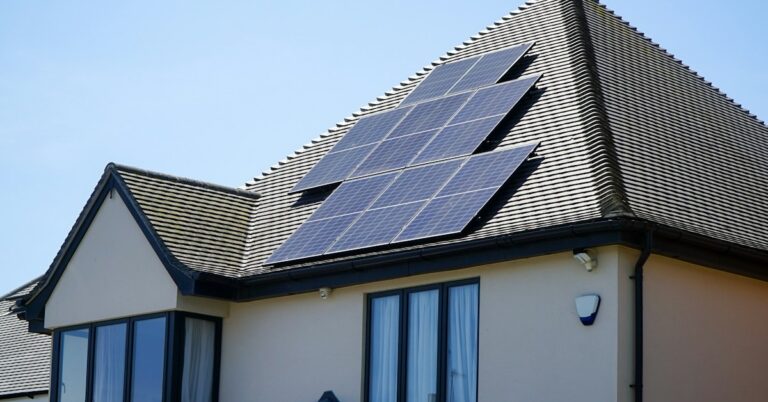
- On a pitched roof, panels must not extend above the highest part of the roof, excluding the chimney.
- Panels on a pitched roof must not project more than 200mm from the roof slope.
- On a flat roof, the equipment must not be more than 600mm above the highest part of the roof, excluding the chimney.
- Panels should be positioned to minimise their effect on the building’s appearance and the surrounding area.
- Equipment that is no longer needed must be removed as soon as reasonably practicable.
Extra limits apply to panels on walls, balconies and roof enclosures. Rules for blocks of flats differ from those for individual houses. Leaseholders may also need consent from a landlord, freeholder or management company.
Do Solar Panels Need Planning Permission in Scotland?
Scotland has separate permitted development rules. Under Class 6HA, panels on a dwelling must not protrude more than one metre from the relevant external surface. Outbuilding systems generally have a 500mm projection limit and the building must not be in the home’s front curtilage. Restrictions apply to listed buildings, World Heritage Sites and some conservation-area elevations. Check the Scottish Government guidance and ask the council if unsure.
Solar Panel Planning Permission Rules in Wales
In Wales, panels on many single dwelling houses are permitted development if they minimise visual impact, remain below the roof ridgeline and generally project no more than 200mm from the roof or wall. Flat roofs have extra edge and height limits. Listed buildings, conservation areas, World Heritage Sites and flats need closer checks. Standalone garden systems have limits on number, height, size and position.
Do You Need Planning Permission in Northern Ireland?
Northern Ireland has a separate planning system. Some domestic installations are permitted development, but restrictions can relate to panel projection, height, road visibility and ground-array size or position. Extra controls apply around listed buildings, conservation areas and World Heritage Sites. Check with the local planning office before installation; nidirect warns that obtaining permission afterwards can be difficult and costly.
When Is Planning Permission Required for Solar Panels?
A planning application or another form of consent may be needed in the following situations.
Listed Buildings
Listed buildings are protected because of their architectural or historic importance. Solar panels may affect their appearance or historic fabric. Planning permission and listed building consent may be required, including for some structures within the grounds. Contact the LPA before commissioning work.
Conservation Areas
Conservation areas protect places with special architectural or historic character. Panels may still be allowed, but restrictions can apply to visible roof slopes, front elevations or walls facing a road. An Article 4 direction can also remove permitted development rights.
Ground-Mounted Solar Panels
Ground-mounted systems have different conditions from roof installations. In England, a small domestic array may qualify as permitted development, but limits apply to its number, area, height and position. The relevant domestic class includes a maximum array area of nine square metres. Larger systems or installations in sensitive locations may need permission.
Removed Permitted Development Rights
A council may remove permitted development rights through a planning condition or an Article 4 direction. Check the planning register rather than assuming that rules applying to a neighbouring home also apply to the property.
Installations Outside the Limits
Panels that project too far from a roof, exceed the allowed height or occupy a restricted position may not qualify as permitted development. Ask the LPA whether a planning application or prior approval is required.
Do Solar Panels on a Garage or Outbuilding Need Permission?
Panels on a garage, shed or other outbuilding may be permitted development if the building is within the property’s grounds and the installation meets the relevant limits. Position, height, planning status, boundary distance and visibility from a road can all matter. Check with the LPA before installing a large system.
How to Check Whether Planning Permission Is Needed
Before booking an installer, homeowners should check whether the property is listed or in a protected area, review the council planning register for Article 4 directions, confirm the panel type and dimensions, and read the guidance for their UK nation. If uncertain, ask the LPA whether planning permission, prior approval or listed building consent is required. Confirm that permissions are in place before work starts.
Do You Need Building Regulations Approval for Solar Panels?
Planning permission and building regulations are separate. A permitted development installation must still meet relevant structural and electrical safety requirements. The roof must support the panels’ weight and wind loading, and electrical work must be completed safely. Ask the installer about structural checks, testing and certificates.
Final Thoughts
Most UK homeowners can install standard roof-mounted panels without planning permission if they meet the rules for their property. Listed buildings, conservation areas, flats, ground-mounted arrays and homes with restricted rights need closer attention. England’s rules changed on 27 August 2026, so checking current national guidance and contacting the LPA can help prevent delays and enforcement problems.
Frequently Asked Questions
Can solar panels be installed without planning permission in the UK?
Yes, if the system meets permitted development conditions and no property-specific restrictions apply.
Do solar panels need planning permission in a conservation area?
Not always. Restrictions may apply to visible roof slopes or elevations facing a road; ask the LPA.
Can solar panels be installed on a listed building?
Possibly. Planning permission and listed building consent may be required.
Do ground-mounted solar panels need planning permission?
Small systems may be permitted development, but size, height and location limits apply.
Should the installer arrange planning permission?
Some can, but agree this in advance and confirm all required consents are in place.
Official Sources
- Planning Portal: Solar panels mounted on a house or block of flats
- UK legislation: General Permitted Development Order, Part 14
- Scottish Government: Householder permitted development rights
- Welsh Government: Planning permission for solar panels
- nidirect: Photovoltaic panels
Disclaimer: This article provides general information, not legal or planning advice. Rules can change and local restrictions may apply. Confirm requirements with the relevant planning authority before starting work.