
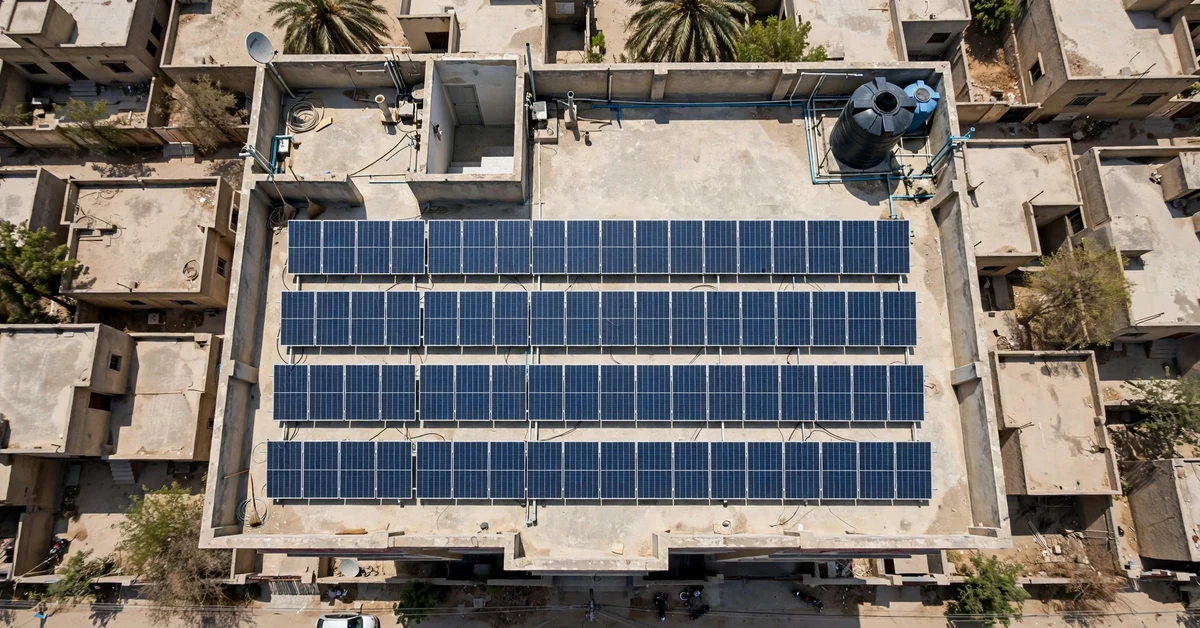
Every solar dealer in Pakistan has a favourite trick: ask you “how many rooms?” and quote a system size from thin air. A 3-bedroom house with one AC uses half the electricity of a 3-bedroom house with three. The only number that matters is your actual electricity consumption — and your electricity bill already contains it. This guide shows you how to read it, convert it into the right system size, and turn that into an exact panel count, with worked examples for small, medium and large homes.
Step 1: Find Your Monthly Units (Not the Rupee Amount)
Pull out your last 6 to 12 electricity bills — LESCO, MEPCO, K-Electric, whichever DISCO you pay. Look for “units consumed” or “kWh used”, not the bill total. Use your highest-consumption months (May to July, when air conditioners run) rather than the average, because that is the load your system actually needs to cover.
If your summer bill shows 450 units and winter shows 250, size for 450. A system that only covers the winter load leaves you buying expensive grid power all summer — exactly when solar production is at its best.
Step 2: Convert Monthly Units to Daily Need
Solar systems are sized by what they produce each day. Divide your monthly units by 30:
Daily need (kWh) = Monthly units ÷ 30
Example: 450 units ÷ 30 = 15 kWh (units) per day. That is the target your panels must generate daily.
Step 3: Account for Pakistan’s Peak Sun Hours
Most Pakistani cities get 4 to 5.5 peak sun hours per day. Using a safe average of 4.5 hours:
System size (kW) = Daily kWh ÷ 4.5
Example: 15 kWh ÷ 4.5 = 3.3 kW. Then multiply by a loss factor of 1.15–1.2 to cover dust, heat derating, panel ageing and inverter conversion losses — real-world factors that keep panels below their lab rating:
Final size = 3.3 kW × 1.15 = 3.8 kW → round to a 4–5kW system.
Step 4: Turn Kilowatts into Panel Count
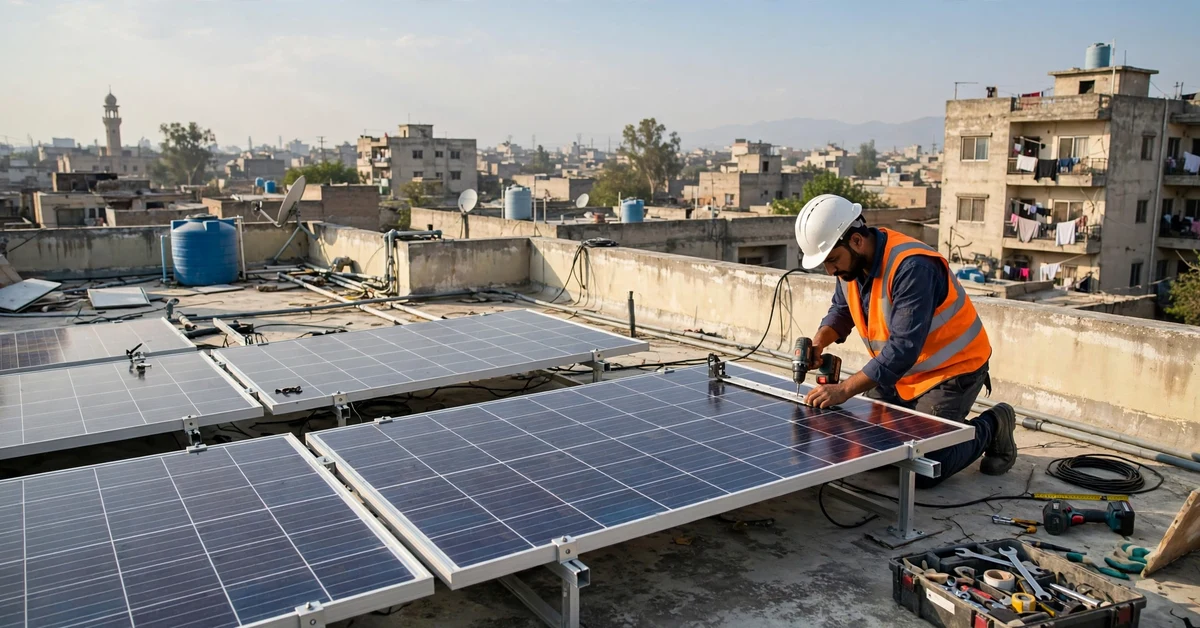
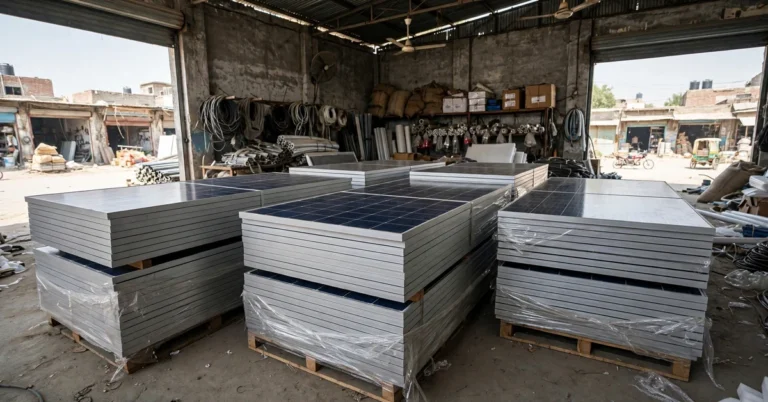
Modern panels sold in Pakistan are commonly 550W, 585W or 645W. Divide your target system watts by the panel wattage and round up — you cannot install half a panel:
Number of panels = System watts ÷ Panel wattage
For our 3.8kW example with 550W panels: 3800 ÷ 550 = 6.9 → 7 panels (about 3.85kWp). With 585W panels: 3800 ÷ 585 = 6.5 → 7 panels (4.1kWp). Fewer, higher-wattage panels also save roof space.
Quick Reference Table
| Monthly units | Daily units | Suggested system | Panels (550W) | Panels (585W) |
|---|---|---|---|---|
| 150 | 5 | 1.5 – 2 kW | 3 – 4 | 3 |
| 300 | 10 | 3 – 3.6 kW | 6 – 7 | 6 |
| 450 | 15 | 4 – 5 kW | 8 – 10 | 7 – 9 |
| 600 | 20 | 5 – 6 kW | 10 – 11 | 9 – 11 |
| 800 | 27 | 7 – 8 kW | 13 – 15 | 12 – 14 |
| 1,000+ | 33+ | 10 – 12 kW | 19 – 22 | 18 – 21 |
Worked Examples: 1, 2 and 3-Bedroom Homes
Example 1 — Small home (2 rooms, no AC): 4 ceiling fans (70W each), 6 LED bulbs (10W each), 1 refrigerator (150W) and 1 LED TV (100W), running 6–8 hours a day. Daily use ≈ 5 kWh → 150 monthly units → 1.5–2kW system → 3–4 panels of 550W. Our 3kW system price guide shows what a slightly larger setup costs if you want headroom.
Example 2 — Medium home (3–4 rooms, 1 inverter AC): 6 fans, 10 LED bulbs, 1 fridge, 1 freezer, 1 ton inverter AC (1200W, 6 hours/day) and a washing machine (500W). Daily use ≈ 15 kWh → 450 monthly units → 4–5kW system → 8–10 panels of 550W.
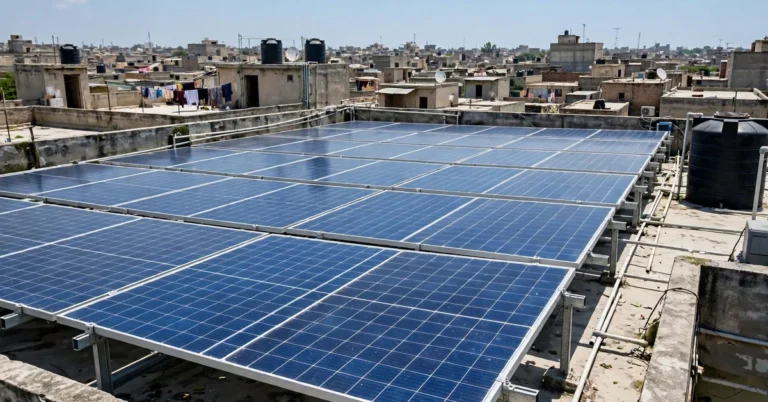
Example 3 — Large home (2 inverter ACs, heavy load): 10 fans, 14 LED bulbs, 2 fridges, 1 freezer, 2 inverter ACs, 1 water motor (750W) and a washing machine. Daily use ≈ 27 kWh → 800 monthly units → 7–8kW system → 13–15 panels of 550W. A 645W panel is about 2.3m × 1.1m, so 14 of them need roughly 35–40 square metres of clear, shade-free roof — measure the genuinely usable area, not the plot size.
Do Not Forget the Inverter
Panels are only half the equation. Your inverter must handle your simultaneous running load plus motor surges from AC compressors and the water pump. A common and costly mistake is buying an inverter sized exactly to the panel array with no headroom for growth. Before you buy, work through our inverter sizing guide — and if your area has load-shedding, a hybrid system with correctly sized battery backup matters as much as the panel count.
Should You Oversize? The Net Metering Factor
If you are going net-metered, many homeowners deliberately size 10–20% above their current bill to cover rising tariffs and future loads — a second AC, an electric geyser, an EV one day. Exported surplus offsets what you import at night, though export credits are valued below the retail tariff (see our net metering guide). One caution: confirm the current distributed-generation rules with your DISCO before oversizing, since sanctioned-load limits and net metering regulations have changed before.
Common Appliance Wattages (Pakistan)
| Appliance | Typical wattage |
|---|---|
| Ceiling fan | 60 – 80W |
| LED bulb | 9 – 12W |
| LED TV (43″) | 80 – 120W |
| Refrigerator | 120 – 200W |
| Deep freezer | 150 – 250W |
| Washing machine | 400 – 600W |
| Water motor (1 HP) | 750W |
| Inverter AC (1 ton) | 900 – 1,200W |
| Inverter AC (1.5 ton) | 1,200 – 1,800W |
| Iron | 1,000W |
Frequently Asked Questions
How many solar panels do I need for a 3-bedroom house in Pakistan?
A typical 3-bedroom house uses 15–20 units a day. That means a 4–6kW system — roughly 8 to 11 panels of 550W, or 7 to 10 panels of 585W, depending on AC usage.
How many panels are needed for a 1.5 ton AC?
A 1.5 ton inverter AC draws 1,200–1,800W. Running it 8 hours needs about 3kW of panels dedicated to it alone; a safe figure is 4kW of array for the AC plus your other loads.
Does 1kW of solar really produce 4–5 units a day?
Yes, in most of Pakistan — roughly 4–5 units per kW per day across the year. Expect closer to 6 in summer and 4 in winter. Lahore buyers can check our Lahore panel price guide alongside their sizing.
Should I use 550W or 585W panels?
Both work. Higher-wattage panels mean fewer panels, less mounting structure and less roof space for the same output — useful on small roofs. On a large roof, cheaper 550W panels can be better value per watt. Compare current models in our best solar panels comparison for 2026.
My roof is small — what are my options?
Three honest choices: higher-wattage panels (585W or 645W) to fit more capacity, a smaller system covering part of your load, or accepting the site cannot support the target. An installer who promises to “fit it somehow” without a shading survey is selling future disappointment.
Size from the bill, not from the bedroom count — and you will buy exactly the solar you need, nothing you do not.
If you would rather sanity-check the panel count from the array side, use this Pakistan sizing guide for how many panels you need.

2 Comments