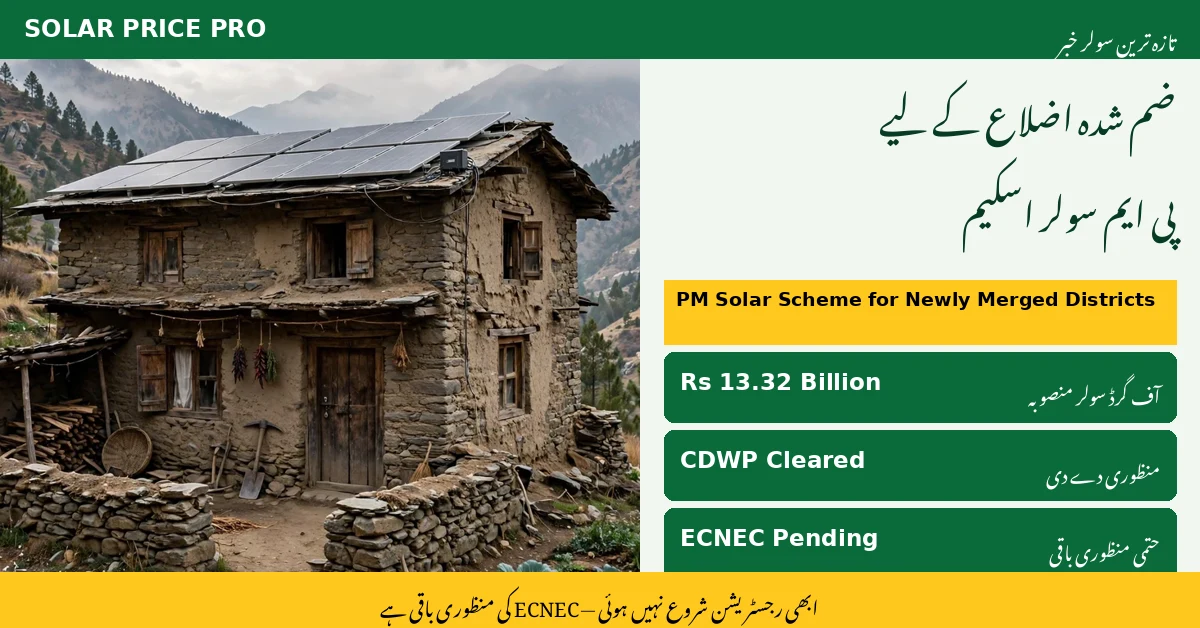
The federal government has taken a major step towards bringing off-grid solar power to households in Khyber Pakhtunkhwa’s newly merged districts. The Central Development Working Party (CDWP) has cleared the Prime Minister’s Solar Scheme for Newly Merged Districts, valued at Rs 13.323 billion, and referred it to the Executive Committee of the National Economic Council (ECNEC) for final approval. The decision was reported on 27 October 2026 by Dawn, The Express Tribune, Business Recorder and ProPakistani, following a CDWP meeting chaired by Planning Minister Ahsan Iqbal.
The key point for readers is the stage the scheme has reached. CDWP clearance is not the same as final approval, and it is not an open registration window. The scheme has been approved in principle and sent to ECNEC, which must approve it before implementation can begin. Anyone claiming that applications are already open, or asking for money to secure a system under this scheme, is getting ahead of the official process as reported so far.
What the CDWP Decided
According to the reporting, the CDWP recommended three large projects to ECNEC and approved ten smaller schemes valued at Rs 40.915 billion at the same meeting. The solar scheme was one of the referrals: approved in principle, at Rs 13,323 million, to provide off-grid solar energy solutions to households in the newly merged districts. The other referrals reported alongside it were climate-resilient irrigation projects in Khyber Pakhtunkhwa and in Dera Ghazi Khan and Rajanpur in Punjab, co-financed by the Asian Development Bank.
In the power sector, the same CDWP meeting also approved in principle a pilot Battery Energy Storage System (BESS) at the 220 kV Jhimpir-I Grid Station, valued at Rs 4,394.720 million, to support grid stabilisation and renewable integration. That is a separate project from the merged-districts solar scheme, but it shows the direction of the meeting: storage and off-grid solar were both treated as part of the same energy transition, rather than as competing ideas.
ProPakistani reports that the solar scheme was among 14 development projects considered at the meeting, with a combined estimated cost of Rs 226.48 billion, and describes it as one of three major development projects for Khyber Pakhtunkhwa in the government’s latest infrastructure and development plans. The scheme will still require ECNEC’s approval before it can proceed to the next stage, and no implementation date has been announced in the CDWP reporting.
What Is an Off-Grid Solar Solution?
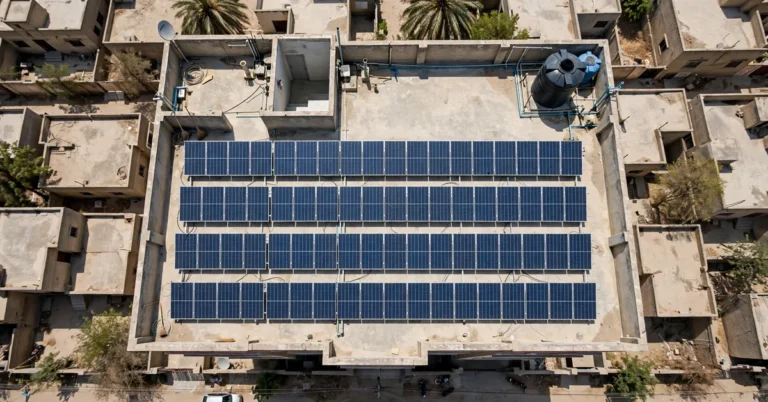
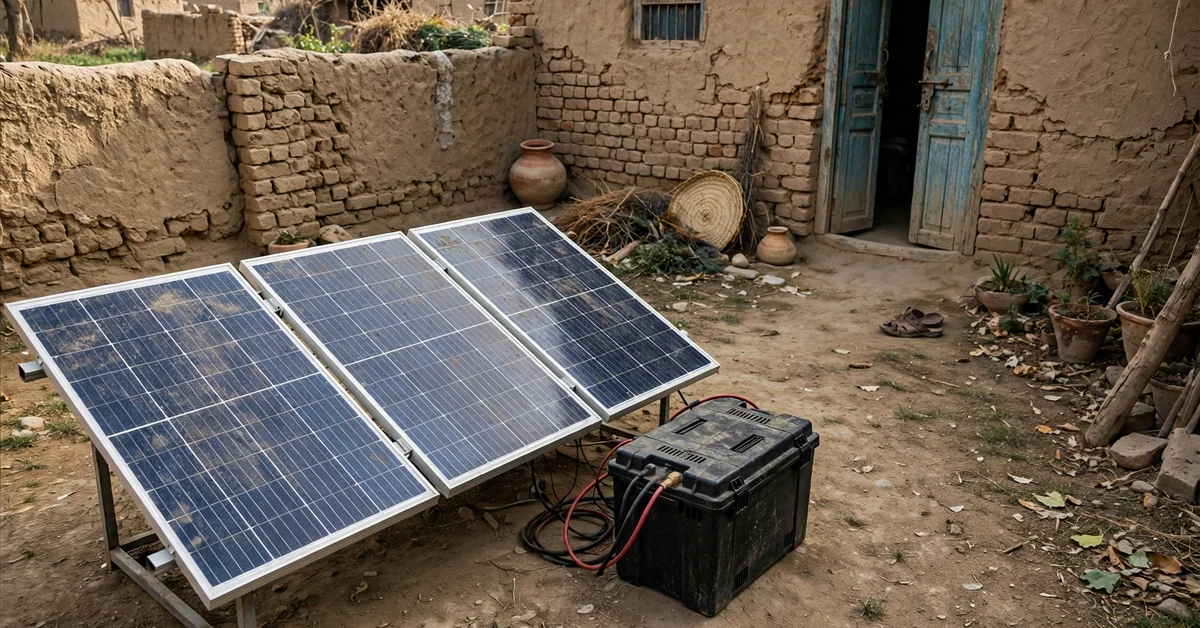
An off-grid solar system works independently of the national grid. In its simplest form, it has solar panels that generate electricity during the day, a battery that stores surplus power for the evening, an inverter that converts the panels’ direct current into the alternating current used by household appliances, and a charge controller that protects the battery. Larger off-grid homes may add more panels and battery capacity, but the principle is the same: the home generates, stores and uses its own power, rather than drawing from a distribution company.
That independence is the point in areas where grid supply is unreliable, distant or expensive to extend. A grid connection requires poles, wires, transformers and ongoing maintenance across difficult terrain, and the cost of extending the grid to a scattered settlement can exceed the cost of a standalone solar system many times over. An off-grid system avoids that infrastructure altogether, but it also means the household has no grid to fall back on. System size therefore matters more than it does for a grid-connected home: an undersized battery means lights out early in the evening, while an oversized system wastes money on capacity that is rarely used.
For that reason, the most important details of any off-grid scheme are the ones that have not yet been published for this one: how many households will be covered, what system size each household will receive, whether the system is fully funded or part-funded, who will install and maintain it, and how batteries will be replaced when they reach the end of their life. None of those details appear in the CDWP reporting published on 27 October. Until ECNEC approves the scheme and an implementing agency publishes its rules, any figure circulating on social media for household numbers, system sizes or subsidies should be treated as unverified.
Why the Newly Merged Districts?
The newly merged districts are the former tribal areas that were merged into Khyber Pakhtunkhwa, where access to reliable electricity has long been a development challenge. Mountainous terrain, scattered settlements and security and logistical constraints have all made grid extension slower and more expensive than in the province’s settled districts. Solar power, by contrast, can be deployed house by house, without waiting for a feeder to arrive, and it works best in exactly the kind of sunny, high-altitude conditions found across much of the region.
That context also explains why this scheme is different from the solar programmes most readers in Punjab and Sindh will be familiar with. The CM Punjab free solar panel scheme, for example, was aimed at grid-connected domestic consumers using up to 200 units, with small 550W and 1,100W systems intended to offset part of a household’s bill. An off-grid scheme for the merged districts is aimed at households that cannot rely on the grid at all, so the system must stand alone, with storage, rather than simply reducing a monthly bill. The two programmes solve different problems, and eligibility for one says nothing about eligibility for the other.
Khyber Pakhtunkhwa has already been moving in this direction on a smaller scale. The provincial government has, for example, launched a survey to convert registered seminaries to solar energy, covered in our report on KP seminaries converting to solar. The federal merged-districts scheme, if approved by ECNEC, would be a much larger, household-level programme, and it would sit alongside, not replace, those provincial efforts.
What CDWP and ECNEC Approval Actually Mean
For readers unfamiliar with the planning process, the two bodies play different roles. The CDWP, chaired by the Planning Minister and Deputy Chairman of the Planning Commission, appraises development projects and either approves smaller ones itself or recommends larger ones to ECNEC. ECNEC, the Executive Committee of the National Economic Council, gives final approval to the largest projects. A project that has been “approved in principle” by the CDWP and referred to ECNEC has therefore passed its first major scrutiny, but it has not yet received the final go-ahead, funding release or implementation orders.
That sequence is worth understanding because it protects against a common scam pattern. In past solar schemes, fake registration forms and agents demanding advance payments have circulated long before any official application process existed. The same caution applies here: the CDWP reporting contains no application link, no registration deadline and no list of eligible households. A genuine application process, when it comes, will be announced through official government channels, not through a forwarded WhatsApp message or a Facebook advertisement. Until then, the only verified facts are the scheme’s name, its Rs 13.323 billion estimated cost, its off-grid household purpose, and its current status: cleared by the CDWP, awaiting ECNEC.
What to Watch Next
The first thing to watch is ECNEC’s decision. If ECNEC approves the scheme, the next announcements to look for are the implementing agency, the number of households and districts covered, the system specification, the funding model, and the timeline for procurement and installation. If ECNEC asks for revisions, the cost or scope may change, and the scheme may return to the CDWP. Either outcome will be newsworthy, and we will update this coverage when it happens.
For households elsewhere in Pakistan considering solar now, rather than waiting for a government scheme, the starting point is different: a grid-connected or hybrid system sized to actual daytime use. Our guide to solar panels for home in Pakistan explains the sizing basics, while the province’s own public-building solar drive, including Punjab’s shift of 256 higher secondary schools to solar power, shows how public institutions are approaching the same calculation at scale. Farmers, meanwhile, can compare the merged-districts model with Punjab’s solar tube-well programme, covered in our guide to the CM Punjab solarization of tube wells.
Frequently Asked Questions
Has the PM Solar Scheme for Newly Merged Districts been approved?
It has been cleared in principle by the CDWP and referred to ECNEC for final approval. It has not yet received ECNEC approval, so it is not yet a fully approved, implementable scheme.
How much is the scheme worth?
Rs 13.323 billion, as reported by Dawn, The Express Tribune, Business Recorder and ProPakistani from the CDWP meeting.
Who will benefit?
Households in Khyber Pakhtunkhwa’s newly merged districts, through off-grid solar energy solutions. The number of households has not been published in the CDWP reporting so far.
Can I apply now?
No application process has been announced in the CDWP reporting. Do not pay anyone claiming to register you for this scheme until an official government announcement is published.
What does off-grid mean?
The system works independently of the national grid, using panels and battery storage to power the home. It is designed for areas where grid supply is unreliable or unavailable.
The bottom line is one of cautious optimism. Rs 13.323 billion for off-grid solar in the merged districts is a significant commitment, and CDWP clearance is a real step forward. But the step that matters most, ECNEC approval, is still to come, and the details that will decide whether households actually get reliable power have yet to be published. We will follow both.
Source: NEPRA — National Electric Power Regulatory Authority