Pakistan’s power sector circular debt has risen again. The Power and Petroleum Divisions informed the National Assembly on Monday that the power sector’s circular debt increased by Rs 34 billion to Rs 1,675 billion by 30 June 2026, while liabilities in the gas sector surged by Rs 344 billion to Rs 3,631 billion over the same period.
The figures, presented during question hour in the National Assembly, underline a stubborn problem: despite years of reform promises, the energy chain still cannot pay for itself — and ordinary consumers keep footing the bill through surcharges layered onto their electricity bills.
The Numbers at a Glance
| Sector | End of FY2024-25 | 30 June 2026 | Increase |
|---|---|---|---|
| Power sector circular debt | Rs 1,641 billion | Rs 1,675 billion | Rs 34 billion |
| Gas sector liabilities | Rs 3,287 billion | Rs 3,631 billion | Rs 344 billion |
Why the Debt Keeps Growing
The Power Division told the House that the rise was driven primarily by the non-payment for electricity supplied from the national grid to K-Electric. Recovery of those outstanding dues is stuck in litigation: the case over K-Electric’s tariff is sub judice, and a court decision is still awaited.
But K-Electric is only one symptom of a deeper structural issue. The core of circular debt is the gap between what it costs to generate and deliver electricity and what is actually collected from consumers. Unpaid bills, line losses, delayed tariff decisions and expensive take-or-pay contracts with independent power producers (IPPs) have all fed the pile-up over the years. Capacity payments alone — the fixed charges paid to power plants whether they generate or not — rose 46% to PKR 1.9 trillion in FY2024, according to recent research.
CPEC Power Plants: Rs 498 Billion in Unpaid Dues
The crisis is now visibly straining Pakistan’s flagship energy investments. Chinese power producers operating under the China-Pakistan Economic Corridor are demanding the immediate clearance of Rs 498 billion in overdue payments owed by the state-run Central Power Purchasing Agency-Guarantee (CPPA-G).
The hardest-hit baseload assets include two massive 1,320 MW coal-fired plants. Port Qasim Electric Power Company (PQEPC), operator of one of them, escalated the matter after waiting more than six months for its arrears. In a letter dated 29 September, PQEPC chief executive Wang Dongfeng warned the finance, planning and energy ministers that “continued delays could disrupt the project’s financial sustainability and lead to defaults under loan agreements and the government’s sovereign guarantee.” The company’s outstanding receivables had reached Rs 79 billion (about $285.4 million) by the end of September, and the issue has now been raised with the Prime Minister’s Office.
When CPPA-G cannot pay generators on time, the whole chain tightens — from fuel suppliers to grid operators — and the risk premium on Pakistan’s energy sector keeps rising.
What the Government Says It Is Doing
The Power Division outlined several measures to contain the debt:
- Terminating expensive IPP contracts and moving from the old take-or-pay model to a hybrid take-and-pay arrangement, cutting fixed capacity obligations.
- Waiving late-payment interest on some dues and reducing the interest rate on future contracts.
- Capping rupee devaluation and annual inflation in tariff indexation formulas, so exchange-rate shocks flow less directly into tariffs.
- Refinancing high-cost debt through a six-year arrangement under the Circular Debt Settlement Plan to cut financing costs.
- Strict DISCO targets for loss reduction, recovery and operational efficiency, with enhanced accountability, plus timely release of government subsidies to distribution companies.
The government is also pursuing a broad tariff overhaul — ten distribution companies are currently before NEPRA seeking their 2027 tariff determinations, with prior-year adjustment claims totalling over Rs 415 billion, and CPPA-G’s proposed power purchase price of Rs 27.31 per unit for 2027 goes to a NEPRA hearing on 3 November. Read our coverage of the Rs 2.56 fuel adjustment hitting November bills for what these moving parts mean in practice.
Why This Matters for Your Electricity Bill
Circular debt is not an abstract number — it is collected from consumers. Research by the Pakistan Institute of Development Economics found that average effective electricity tariffs rose from about Rs 12.5 per kWh in 2015 to Rs 34.45 per kWh in 2025, driven mainly by debt-servicing charges layered onto bills rather than genuine increases in generation cost. For the poorest households, nearly 37% of the electricity bill is now made up of circular-debt-related surcharges.
In short: as long as the debt pile keeps growing, the pressure to keep tariffs high — or add new surcharges like the Rs 1.11 fuel charge on October bills — will not go away. Grid electricity is unlikely to get cheaper any time soon.
And What It Means for Solar
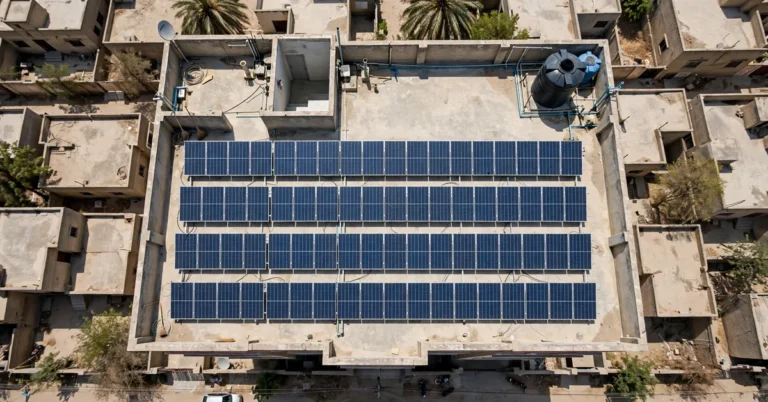
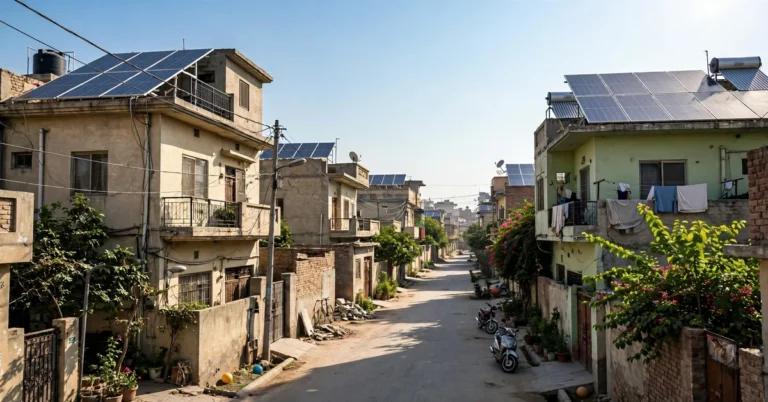
Paradoxically, the debt crisis is one of the strongest arguments for rooftop solar. Every tariff hike and surcharge shortens the payback period of a home system, because solar replaces grid units that cost Rs 40-plus with units that cost a fraction of that over the system’s life. It is no coincidence that Pakistan imported over 50 GW of solar panels between 2021 and 2025 while grid sales stagnated.
That said, the relationship cuts both ways. Researchers warn of a “utility death spiral”: as more paying customers defect to solar, the fixed costs of the grid (including those capacity payments) are spread over fewer units, pushing per-unit tariffs even higher for those who remain — mostly households that cannot afford solar. Policymakers will eventually have to decide how the grid’s fixed costs are shared fairly. For now, though, the arithmetic for households is clear: with tariffs near Rs 34-40 per unit and net billing crediting exports at roughly Rs 10-11, maximising self-consumption under net billing remains the winning strategy — see our October 2026 solar panel price guide before you buy.
Cleaning up that debt in the long run also means changing the generation mix itself, since one recent study shows how Pakistan could cut power sector emissions by 63% by 2035 with solar in the lead.
FAQs
Q: What is circular debt?
A: It is the accumulated shortfall in Pakistan’s power supply chain — the difference between the cost of generating and delivering electricity and the revenue actually collected — which keeps rolling forward as unpaid dues between generators, CPPA-G, distribution companies and fuel suppliers.
Q: How much is Pakistan’s circular debt now?
A: Rs 1,675 billion in the power sector and Rs 3,631 billion in the gas sector, as of 30 June 2026, according to figures presented in the National Assembly.
Q: Why do consumers care about circular debt?
A: Because it is recovered through surcharges on electricity bills. Debt-related charges now make up a large share of what households pay per unit, which is a key reason tariffs have roughly tripled since 2015.
Q: Will the debt be eliminated soon?
A: The government’s Circular Debt Management Plan targets zero accumulation of new debt, and IPP contract renegotiations should help. But court cases, K-Electric dues and CPPA-G’s liquidity crunch mean the stock of old debt will take years to clear.
Q: Does circular debt affect solar users?
A: Indirectly, yes — high tariffs driven partly by debt servicing make solar more attractive and shorten payback periods. But large-scale grid defection also raises questions about who pays for the grid’s fixed costs, which is why NEPRA is reworking tariff structures for 2027.
With debt-driven surcharges set to keep tariffs high, the case for a rooftop system that earns back its own cost only gets stronger — see what net metering really costs in Pakistan in 2026 and how fast it pays back.

One Comment