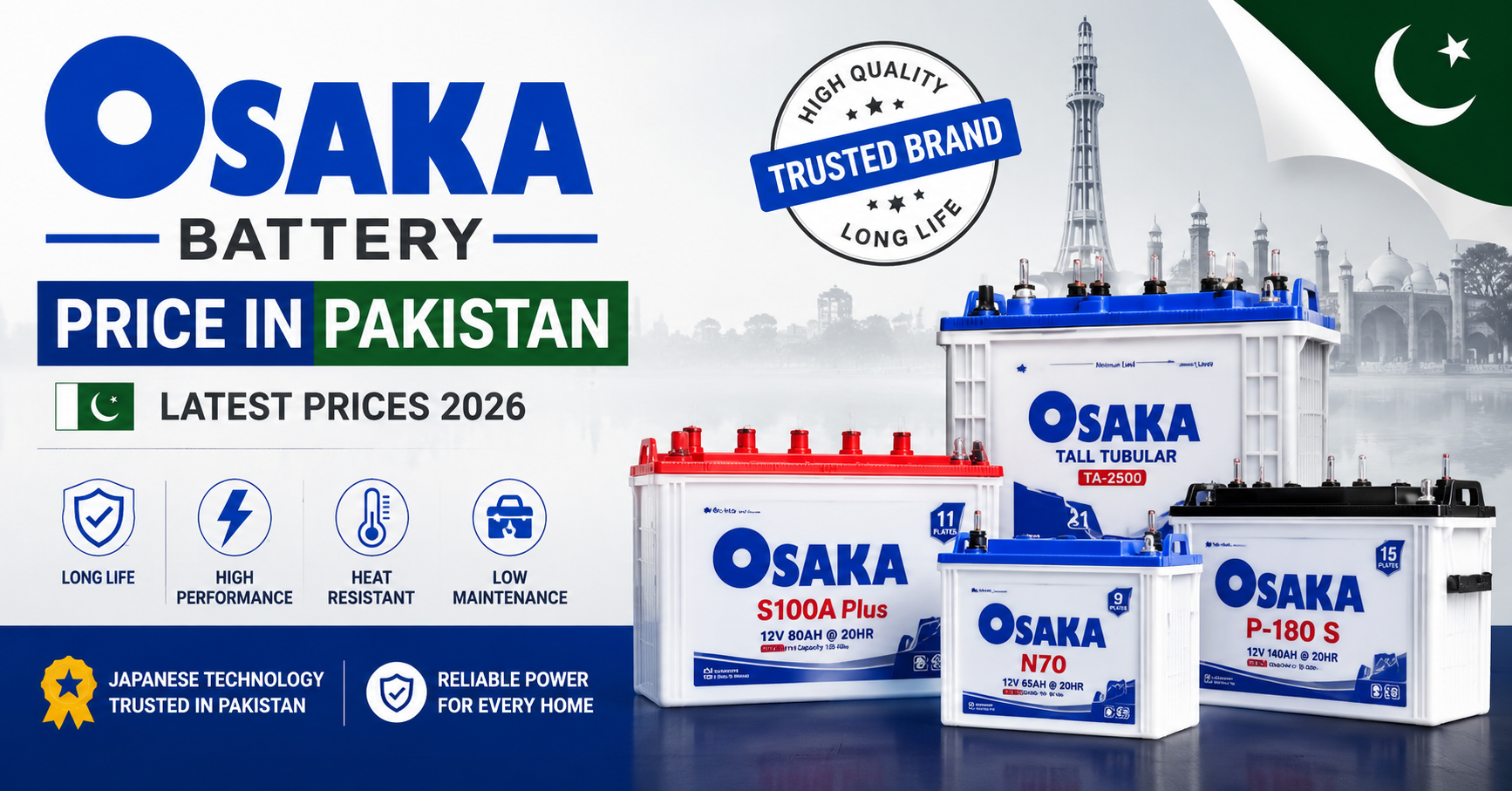
Load shedding hasn’t gone away, and neither has the question everyone in Pakistan keeps typing into Google: what’s the real OSAKA Battery price in Pakistan this month? The short answer anywhere from Rs. 990 for a small motorcycle battery to roughly Rs. 88,000 for a heavy-duty tubular unit. The long answer depends on what you’re powering: a car, a home UPS, or a full solar setup.
Osaka is manufactured locally by Pakistan Accumulators (Pvt.) Ltd. (PAL), a company with more than 25 years of experience building batteries specifically for Pakistani conditions high heat, long outages, and constant charge-discharge cycles. That local manufacturing base is a big part of why Osaka batteries stay competitively priced even when the dollar rate pushes lead and other raw material costs up.
This guide walks through the current OSAKA battery price in Pakistan, model by model, so you’re not guessing before you walk into a shop.
Solar Panels for Home in Pakistan: 2026 Price and Buying Guide
Latest OSAKA Battery Price in Pakistan
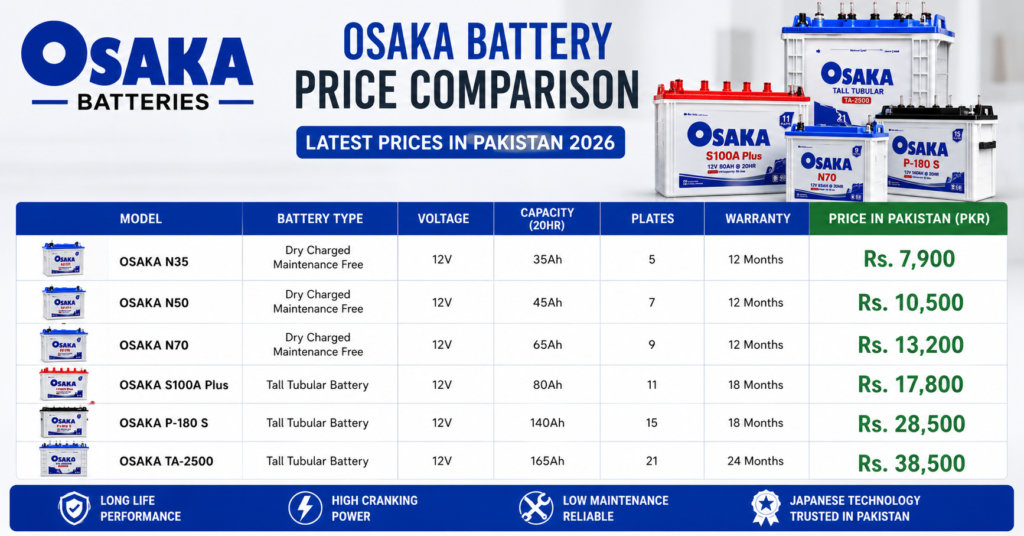
Prices move with the dollar rate, lead prices, and dealer margins, so treat the numbers below as a realistic mid-2026 range rather than a fixed price list. Always confirm with an authorized dealer before buying.
| Battery Category | Price Range (PKR) |
|---|---|
| Motorcycle batteries | 990 – 3,000 |
| Car / automotive batteries | 12,499 – 26,999 |
| Home UPS (IPS series) | 33,600 – 43,700 |
| Solar tubular batteries (HT/TA series) | 35,000 – 88,000 |
The tubular solar range carries the widest spread because it includes everything from a compact 185Ah HT-1800 up to the largest 280Ah-plus TA-3000 models built for bigger off-grid setups.
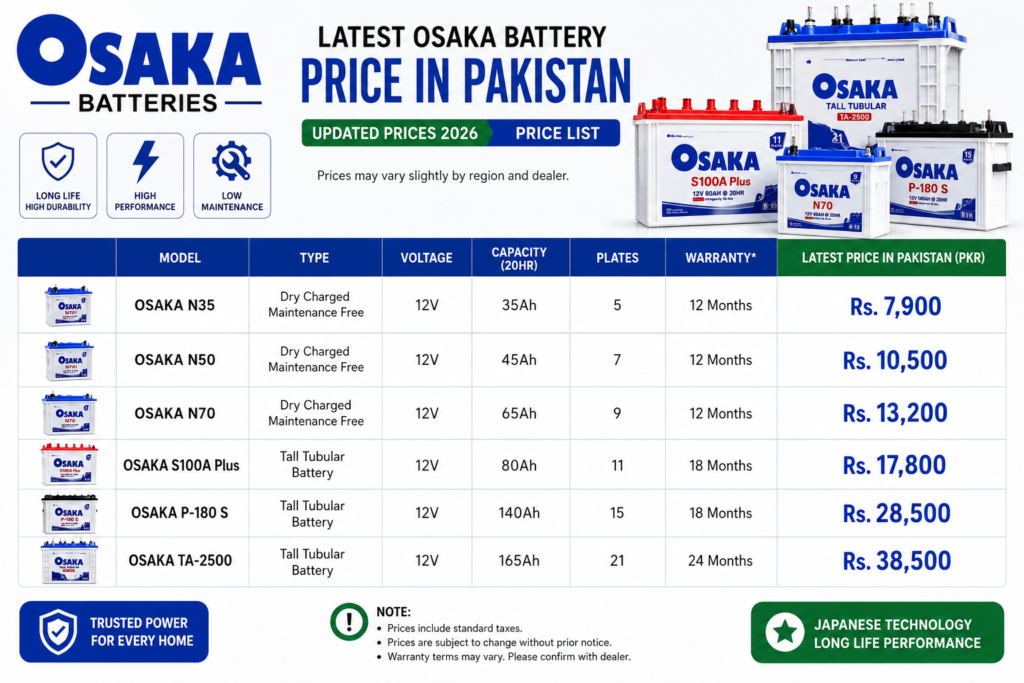
Popular Osaka Battery Models and Price Comparison
For solar and UPS buyers specifically, three models come up again and again:
- HT-1800 (185Ah) — around Rs. 35,000–42,000, the standard starting point for a 3kW solar system
- HT-2000 (200Ah) — around Rs. 48,000–49,000
- HT-2500 (250Ah) — around Rs. 54,000–78,000, commonly paired or run in parallel for 5kW systems
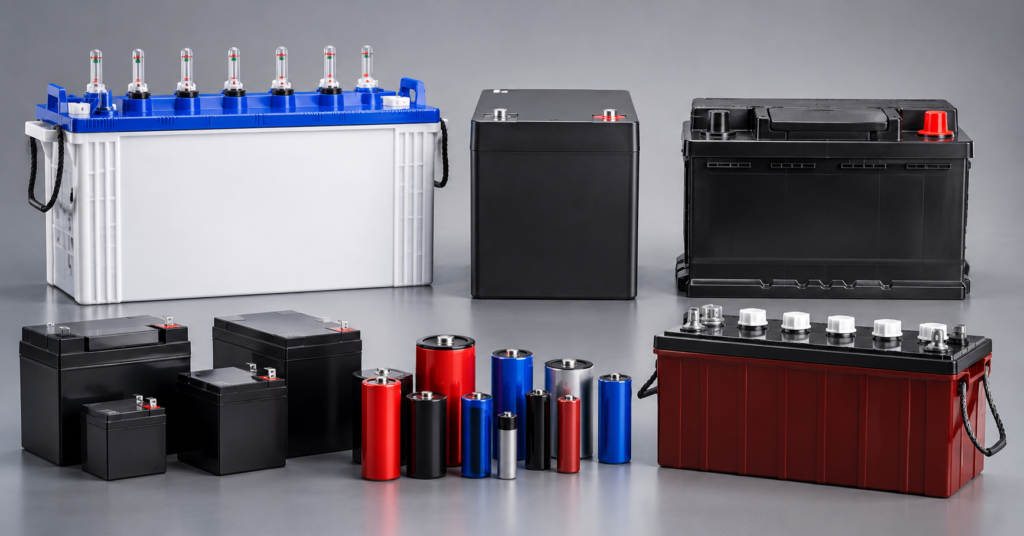
OSAKA Battery Types
Osaka builds five main battery categories, and picking the wrong one for your use case is the single most common (and expensive) mistake buyers make.
Tubular Batteries
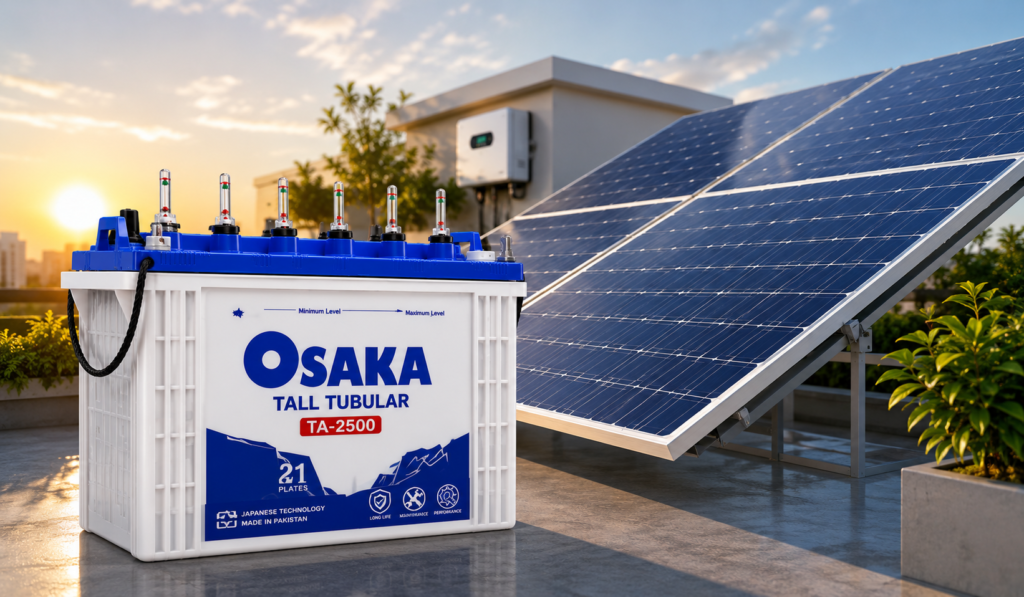
Osaka’s HT and TA tubular series are built for deep-cycle, daily charge-discharge use — exactly what solar and heavy-duty UPS systems demand. They need occasional distilled water top-ups but reward that maintenance with a much longer service life than flat-plate alternatives.
UPS Batteries
The IPS series sits in the Rs. 33,600–43,700 bracket and is designed for standard household inverter setups running fans, lights, and a few appliances through an outage.
Automotive Batteries
Car batteries such as the CR65 and CR70 fall in the Rs. 12,499–26,999 range, built for high cranking power rather than deep-cycle backup.
Dry Batteries
Maintenance-free (MF series) batteries eliminate water top-ups entirely, trading a bit of price for convenience — a good fit for buyers who don’t want to think about their battery until it needs replacing.
Solar Panels Explained: Benefits, Costs, Types & Installation
Deep Cycle Batteries
These overlap heavily with the tubular range and are the correct choice anywhere a battery is discharged and recharged daily, rather than sitting on float charge like a car battery.
Most Popular Osaka Battery Models
A handful of models dominate actual buyer searches and dealer sales:
- Osaka CR65 — a maintenance-friendly 40Ah automotive battery built for reliable cold-weather cranking
- Osaka CR70 — a step up in capacity for larger engines and vehicles with more electrical load
- Osaka MF-100L — an 80Ah, 13-plate sealed maintenance-free battery with an eye indicator to show charge status, a common upgrade pick for car owners who want to skip water top-ups entirely
- Osaka P-180-S — a mid-capacity option positioned between standard car batteries and small UPS units
- Osaka TA Series — the brand’s largest tubular line, aimed at bigger off-grid and industrial solar installations, running up toward Rs. 88,000 for the top-end TA-3000
The Complete Solar Panel Guide for Homeowners
Features of Osaka Batteries
A few features explain why Osaka keeps showing up as a default recommendation in Pakistan:
- Long lifespan — tubular models in particular are built for repeated deep discharge without rapid capacity loss
- Maintenance options — buyers can choose flooded (needs distilled water) or sealed maintenance-free (MF) depending on how hands-on they want to be
- Fast charging — designed to recover quickly once grid power or a generator kicks back in
- High performance — strong cold cranking and consistent output even in Pakistan’s summer heat
- Warranty coverage — most Osaka batteries carry a 6 to 12 month replacement warranty depending on the model and dealer
Factors Affecting OSAKA Battery Prices
If you’ve noticed the same model priced differently at two shops, it’s usually one of these:
- Market demand — prices tend to climb in summer when load shedding and solar installs both spike
- Lead prices — lead is the core raw material, and global price swings feed directly into battery costs
- Currency exchange rate — even for a locally manufactured battery, imported components and machinery costs are dollar-linked
- Dealer pricing — authorized dealers set their own margins, so shopping around by a few thousand rupees is worthwhile on bigger tubular batteries
- Warranty coverage — longer or more comprehensive warranty terms typically come with a slightly higher sticker price
8kW Solar Panel Price in Pakistan (2026) – Complete Installation & Cost Guide
Osaka Battery Price Comparison
Osaka vs AGS
AGS is Osaka’s closest domestic competitor on price. Both brands manufacture locally, and their tubular ranges land in similar price brackets — the deciding factor for most buyers ends up being dealer warranty terms and local service availability rather than a big price gap.
Osaka vs Phoenix
Phoenix tubular batteries typically carry a noticeably higher price tag than the equivalent Osaka HT model for the same Ah rating, without a proportional jump in backup time — one reason Osaka is often cited as the better value pick for solar buyers on a budget.
Osaka vs Volta
Volta is also produced by Pakistan Accumulators, the same parent company behind Osaka, so the two brands sit close together on both pricing and build quality. The choice between them often comes down to which model range is in stock at your local dealer.
How to Choose the Right Osaka Battery
- Home UPS — go with the IPS series sized to your inverter’s rated load
- Solar system — HT-1800 for smaller 3kW setups, HT-2500 or paired HT-1800 units for 5kW and above
- Car battery — match the CR or MF series model number to your vehicle’s factory battery specification
- Commercial use — larger TA-series tubular batteries handle the daily deep cycling that commercial backup demands
Tips to Increase Battery Life
- Charge fully and avoid leaving a battery in a partially discharged state for long periods
- Check and top up distilled water regularly on flooded (non-MF) models
- Avoid deep discharge below the manufacturer’s recommended cutoff
- Store in a cool, ventilated spot away from direct heat when not in daily use
Where to Buy Genuine Osaka Batteries
Buy only from authorized Osaka dealers, verify the hologram sticker on the battery casing, and keep the warranty card. Genuine Osaka batteries are available through:
- Authorized Osaka dealers in major cities (Lahore, Karachi, Islamabad, Faisalabad)
- Established online marketplaces and battery retailers
- Local battery and auto-parts shops carrying official Osaka stock
Frequently Asked Questions
1. What is the latest OSAKA price in Pakistan?
As of mid-2026, Osaka batteries range from roughly Rs. 990 for small motorcycle batteries to about Rs. 88,000 for the largest tubular solar models, depending on capacity and series.
2. Which Osaka battery is best for home UPS?
The IPS series, priced around Rs. 33,600–43,700, is built specifically for standard household inverter setups.
3. What is the price of Osaka tubular batteries?
Osaka tubular batteries generally range from Rs. 35,000 to Rs. 88,000, depending on the Ah rating and whether it’s the HT or larger TA series.
4. Which Osaka battery is best for solar systems?
The HT-1800 (185Ah) is the standard choice for 3kW systems, while the HT-2500 (250Ah) or paired HT-1800 units suit 5kW systems.
5. How long does an Osaka battery last?
With proper charging and water maintenance, Osaka tubular batteries typically last several years under daily deep-cycle use, while automotive batteries usually last 3 or more years under normal conditions.
6. Does Osaka provide a warranty on batteries?
Most Osaka batteries come with a 6 to 12 month replacement warranty, varying by model and authorized dealer.
7. What factors affect Osaka battery prices in Pakistan?
Market demand, lead prices, currency exchange rate, dealer pricing, and warranty coverage all influence the final price you’ll see in shops.
8. Where can I buy genuine Osaka batteries in Pakistan?
Buy from authorized Osaka dealers, verified online marketplaces, or local battery shops always check the hologram sticker and warranty card.
9. What is the difference between Osaka UPS and tubular batteries?
UPS (IPS series) batteries are built for standard inverter loads like fans and lights, while tubular batteries are deep-cycle units designed for daily solar charging and heavier, longer backup demands.
10. How do I choose the right Osaka battery for my needs?
Match the battery type to your use case: IPS for home UPS, HT/TA tubular for solar, and CR/MF series for vehicles then size the Ah rating to your actual power draw.
Final Thoughts
Osaka’s OSAKA price in Pakistan spread from under Rs. 1,000 motorcycle batteries to Rs. 88,000 industrial tubular units covers nearly every budget and use case. The real decision isn’t really about price at all; it’s about matching the right series (IPS, HT/TA, or CR/MF) to what you’re actually powering. Do that correctly, buy from an authorized dealer, and check the warranty card before you leave the shop.