Compare lithium battery prices in Pakistan by exact model and stored energy, not by an inverter-size label. The dated supplier examples below include 5kWh-class units from Rs. 180,000 to Rs. 280,000 and larger 14–16kWh-class units from Rs. 532,000 to Rs. 605,000. These are selected equipment-only listings checked on 11 October 2026, not a complete national minimum or maximum. Older broad ranges elsewhere in the guide remain planning estimates requiring a new quote.
Dated supplier lithium battery price comparison
Supplier price review: 11 October 2026. Kamal Solar battery listings provide the reference prices below. Prices are equipment-only public listings, not a nationwide fixed rate or a binding quotation. Confirm stock, the full model code, warranty, taxes and delivery with the seller. Capacities refer to nominal or marketed energy, not guaranteed usable output; compare exact model datasheets.
| Battery model | Nominal/marketed energy | Supplier listing (PKR) |
|---|---|---|
| Fronus Platinum | 5.12kWh | 180,000 |
| Livoltek 51.2V 100Ah | 5kWh class | 200,000 |
| Knox Powerwall 6.0 LED | 5.12kWh | 223,000 |
| Itel IPL-51100 | 5.12kWh | 224,000 |
| BYD LV5.0+ | 5kWh class | 280,000 |
| Dyness PowerBrick | 14.3kWh | 532,000 |
| Itel IPL-51314H | 16kWh class | 605,000 |
A battery’s kWh rating measures stored energy; the inverter’s kW rating measures power. A “5kW battery” sales label is not enough to establish capacity or runtime. Check voltage, nominal and usable kWh, current limits, inverter compatibility and the warranty. Read the Itel battery model guide for the distinction between model codes and the lithium battery buying guide for selection considerations.
Why Lithium Batteries Are Taking Over in Pakistan
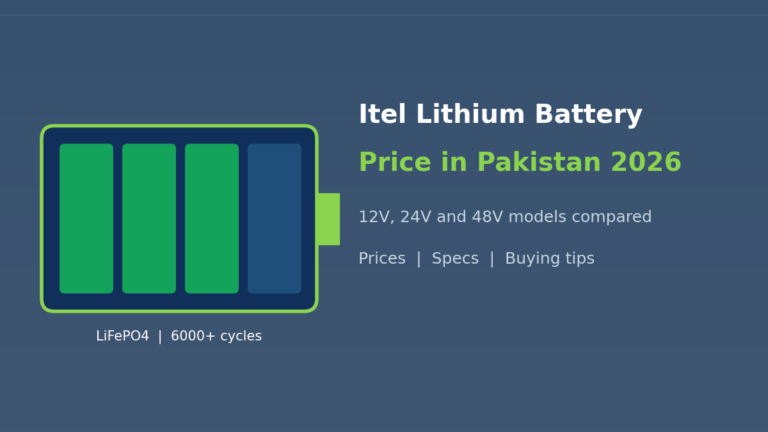
For years, most Pakistani households relied on lead-acid or tubular batteries for UPS and solar backup. That’s changing fast. Lithium (specifically LiFePO4) batteries offer a longer lifespan, faster charging, deeper discharge capability, and far less maintenance than traditional batteries. While the upfront cost is higher, the total cost per cycle usually works out lower over the battery’s lifetime a 10-year lithium battery can easily outlast three or four lead-acid replacements.
With load-shedding still a daily reality in many cities and electricity tariffs continuing to climb, more homeowners are pairing solar panels with lithium storage to get reliable backup power without relying on the grid.
Lithium Battery Price in Pakistan by Capacity
Here’s a breakdown of typical 2026 market pricing across common battery sizes:
Small 12V Batteries (Entry-Level)
- Price range: PKR 15,000 – 100,000
- Used for small UPS setups, basic backup, or light loads like fans, lights, and Wi-Fi routers.
- Not suitable for running full household appliances or large solar systems.
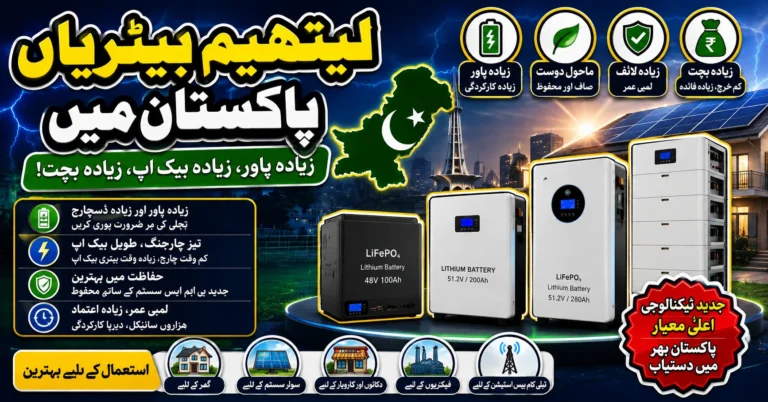
48V/51.2V 100Ah Batteries (Most Popular for Solar)
- Price range: PKR 180,000 – 280,000
- The standard choice for homes running 5kW to 10kW hybrid inverters.
- Delivers around 5.12kWh of usable capacity — enough for fans, lights, a refrigerator, Wi-Fi, and a TV during a 6–8 hour outage.
- Brands like Narada, Knox, Inverex, Dyness, and Crown dominate this segment.
5kWh Residential Batteries
- Budget options (HiselPower, MustPower): PKR 200,000 – 310,000
- Mid-range (Crown CLB): PKR 240,000 – 285,000
- Premium (Dyness DL5.0, GoodWe Lynx): PKR 285,000 – 370,000
- Premium models typically include better IP ratings for heat resistance, higher cycle counts, and longer warranties — factors worth paying extra for in Pakistan’s climate.
High-Capacity Batteries (14–16kWh and Above)
- Price range: PKR 420,000 – 780,000+
- Designed for larger homes, commercial use, or off-grid setups that need extended backup during long outages.
- Often built as expandable systems, letting you add extra battery packs later without replacing the inverter.
What Affects Lithium Battery Prices in Pakistan
- Voltage and Ah/kWh capacity: Higher voltage (48V/51.2V) and higher amp-hour ratings cost more but deliver more usable energy.
- Brand and origin: Fully imported units from established brands cost more but offer proven reliability. Locally assembled options can save 15–20%, though warranty support varies.
- BMS quality: A good Battery Management System protects against overcharging, overheating, and deep discharge — cheaper batteries often cut corners here.
- Cycle count and warranty: Batteries rated for 6,000+ cycles with 10-year warranties cost more upfront but offer better long-term value per cycle.
- Dollar exchange rate: Since lithium cells and BMS components are largely imported, currency fluctuations have a direct and fairly immediate effect on retail prices — even a small rise in the dollar rate can add several percentage points to costs within weeks.
- Communication compatibility: Make sure the battery’s BMS has a communication cable (CAN or RS485) that’s compatible with your specific solar inverter — mismatched batteries can cause charging and monitoring issues.
Popular Lithium Battery Brands in Pakistan
Several brands have built strong reputations in the Pakistani solar and UPS market:
- Narada – One of the top-selling brands, known for reliability at a competitive price point.
- Dyness – Recognized for high IP ratings, strong heat tolerance, and long warranties, making it a solid fit for Pakistan’s summers.
- Pylontech – Popular for expandable battery architecture, allowing users to scale storage capacity over time.
- Inverex – A widely available local option with a strong dealer network.
- Crown – Offers a range of capacities from entry-level to premium, with competitive mid-range pricing.
How to Choose the Right Battery Capacity
A simple way to estimate your needs: multiply your expected load (in watts) by the number of backup hours you want, then add roughly 20% for BMS overhead.
Example: If your fans, lights, Wi-Fi, and a small refrigerator draw about 800W combined, and you want 6 hours of backup, that’s 4.8 kWh — meaning a 5.12kWh battery would comfortably cover a typical WAPDA outage.
For larger loads — such as running an air conditioner overnight — you’ll need either a much bigger single battery or an expandable system that lets you add capacity later.
Lithium vs Traditional Batteries: Is the Extra Cost Worth It?
If your budget is strictly under PKR 100,000 and you only need backup for a few fans and lights, a good-quality tubular or lead-acid battery may still make more financial sense in the short term. But for most homes running a solar system, lithium batteries pay off through:
- Significantly longer lifespan (often 15–20 years vs 3–5 years for lead-acid)
- Faster charging and deeper usable discharge
- Zero watering or maintenance requirements
- Better performance in high summer temperatures when paired with a well-rated BMS

Tips Before You Buy
- Compare price per kWh per cycle, not just the upfront sticker price a slightly more expensive battery with double the cycle life is often cheaper in the long run.
- Confirm BMS communication compatibility with your existing or planned inverter before purchasing.
- Check the warranty terms in writing, including what’s covered and for how long.
- Ask about expandability if you think you might need more storage later this can save you from replacing the entire system.
- Buy from authorized dealers to ensure genuine cells and valid warranty support, especially for higher-cost premium brands.
Final Thoughts
Lithium battery prices in Pakistan in 2026 span a wide range from PKR 15,000 for small backup units to over PKR 700,000 for high-capacity solar storage. For most households pairing a battery with a 5kW–10kW solar system, a 48V/51.2V 100Ah or 5kWh battery in the PKR 180,000–370,000 range covers typical load-shedding needs. Focus on BMS quality, cycle life, and warranty terms rather than price alone, since these factors determine how much value you actually get over the battery’s lifespan.
FAQs
What is the price of a lithium battery in Pakistan in 2026?
Prices range from around PKR 15,000 for small 12V models to over PKR 570,000 for high-capacity batteries, with most residential 48V/51.2V solar batteries falling between PKR 180,000 and 280,000.
Which lithium battery is best for solar systems in Pakistan?
LiFePO4 (Lithium Iron Phosphate) batteries are considered the best choice for solar use, offering thousands of charge cycles, long lifespans, and strong safety performance in Pakistan’s climate.
How much does a 5kWh lithium battery cost in Pakistan?
Selected 5kWh-class listings checked on 11 October 2026 range from Rs. 180,000 to Rs. 280,000 in the dated comparison above. This is not a guaranteed price band for every product. Confirm usable capacity, taxes, delivery, installation, warranty and inverter compatibility for the exact model.
Is a lithium battery better than a lead-acid battery for load shedding?
Yes, for most households. Lithium batteries charge faster, last significantly longer, and require no maintenance, though they cost more upfront than lead-acid alternatives.
Can I add more lithium batteries later to increase capacity?
Many brands, including Dyness and Pylontech, support expandable battery architecture, letting you add extra units later without replacing your inverter.
What size lithium battery do I need for my home?
Multiply your expected load in watts by the number of backup hours needed, then add about 20% for BMS overhead. A typical Pakistani home needs a 5kWh battery to cover 6–8 hours of basic backup.
7 Comments