Ask most homeowners what “earthing” means on their solar system, and you’ll get a shrug. Ask an installer, and you’ll get a two-hour lecture. Neither response is very useful when you just want to know whether your rooftop array is actually safe.
Here’s the short version: earthing gives fault current somewhere safe to go, keeps every metal part of your system at the same electrical potential, and protects both people and equipment when something goes wrong. Get it wrong, and you’re looking at shock hazards, damaged inverters, or worse. faulty DC connectors, overheated inverters, damaged cabling, and poor grounding are among the most commonly cited root causes in solar-related electrical fires , and grounding shows up on that list more often than most people realize.
SUMMARY
Table of Contents
What Is Earthing in a Solar System?
Earthing, grounding, and bonding get used almost interchangeably, but they mean slightly different things. grounding ties the electrical system to earth through a grounding electrode, establishing a voltage reference and a route for fault current, while bonding links metal equipment parts together so they share the same electrical potential and reduce shock and fire risk.
In practice, “earthing” is the term used more often outside the US (particularly under IEC standards), while “grounding” dominates US code language under the National Electrical Code (NEC). They’re describing the same underlying safety principle: nothing metal on your system should ever become energized in a way that can hurt someone.
Why does this matter more for solar than for a typical household circuit? Because a PV array is a live power source even when it’s disconnected from the grid. Sunlight keeps hitting the panels, and the panels keep generating voltage, whether or not anyone flipped a breaker. That’s exactly why the grounding path has to be reliable at every point in the system, not just at the main panel.
How Does the Earthing System Actually Work?
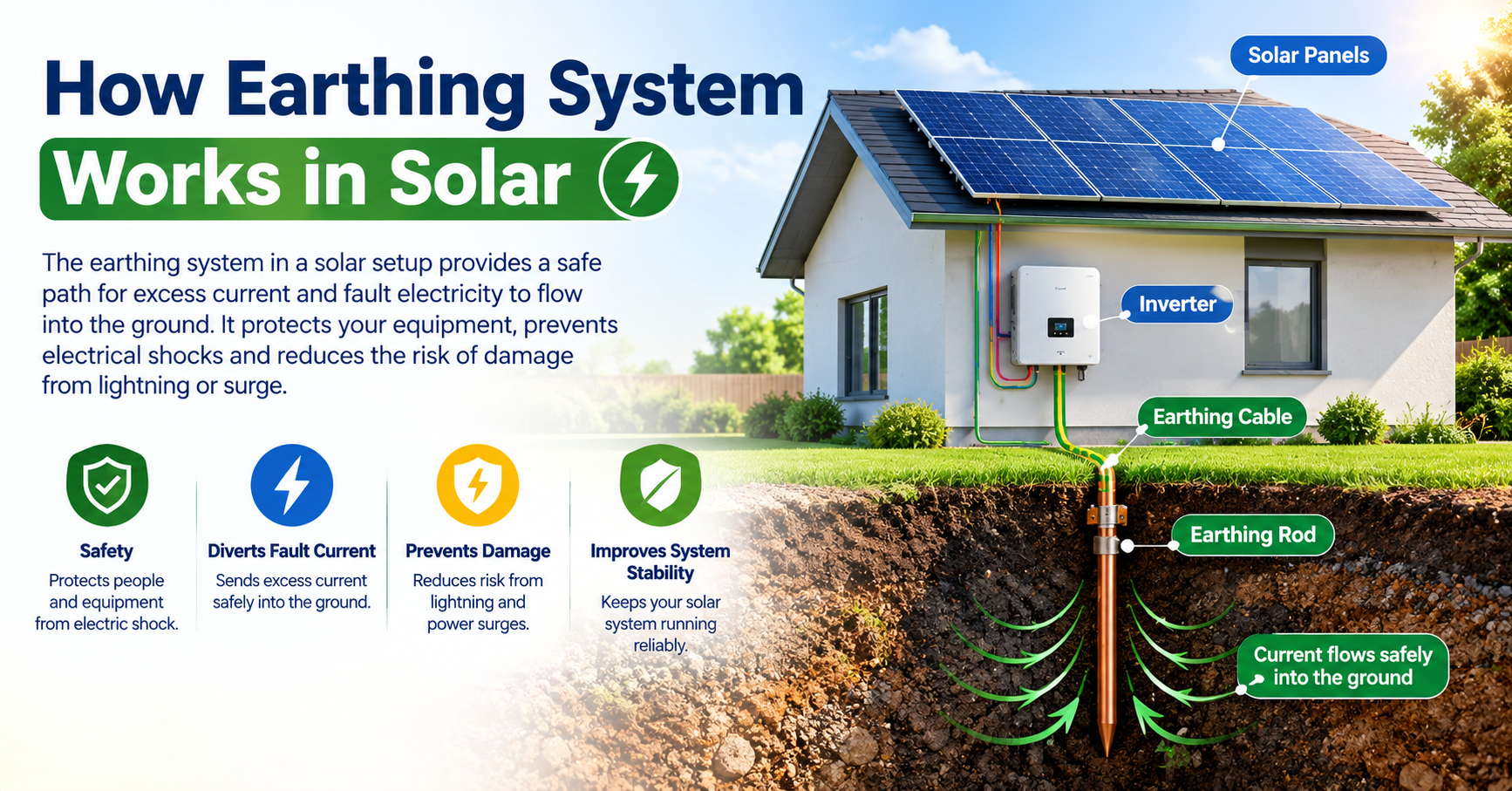
Picture a fault: a wire insulation fails, and a live conductor touches a metal panel frame or a mounting rail. Without a proper ground path, that frame becomes energized, and anyone who touches it completes the circuit. With proper grounding, the fault current instead flows through a low-resistance path back to its source, tripping a breaker or fuse almost instantly.
Two components do most of the work:
- Equipment Grounding Conductor (EGC): a low-resistance path that carries fault current back toward its source, tying the metal parts of the array and equipment into the grounding system so breakers and fuses can do their job.
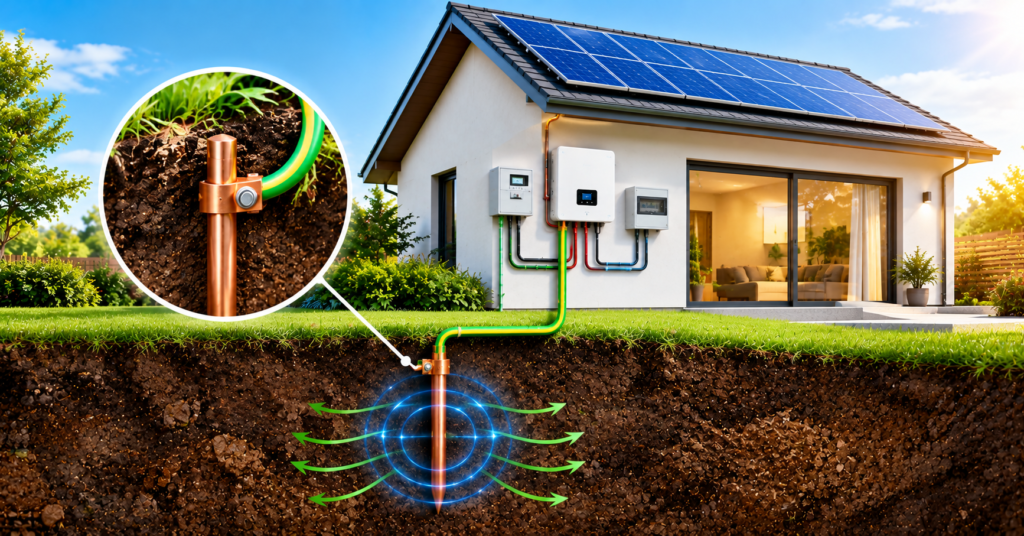
- Grounding Electrode Conductor (GEC): connects the whole electrical system to a physical grounding electrode buried in the earth, establishing that all-important reference voltage.
many newer grid-tied installations now pair ungrounded PV arrays with transformerless inverters, which build a functional ground reference electronically and lean on ground-fault detection instead of a hard-wired system ground. That’s a meaningful shift from older designs, and it’s worth knowing which type your installer used, since the maintenance and troubleshooting steps differ.
Types of Grounding Electrodes Used in Solar
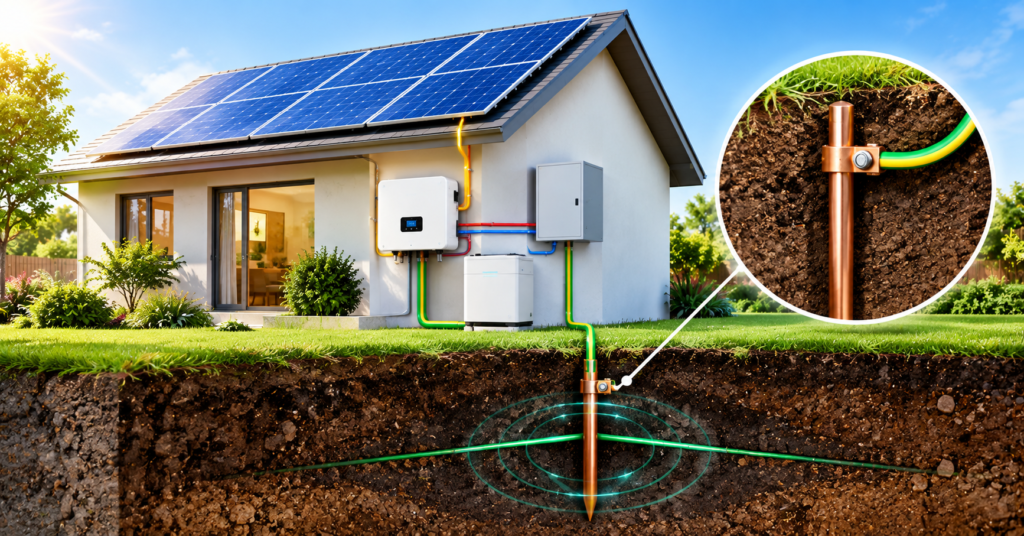
The NEC lays out several acceptable grounding electrode types, and most solar installations use one or a combination of them. Best practice calls for burying electrodes below the permanent moisture line of the soil wherever possible since dry soil conducts poorly.
| Electrode Type | Description |
|---|---|
| Ground rod | The most common residential option; NEC calls for a minimum 3/8-inch diameter and 8-foot buried length |
| Metal underground water pipe | A metal pipe in continuous earth contact for at least 10 feet |
| Concrete-encased electrode (Ufer) | Steel rebar (½ inch minimum, 20 feet long) or bare copper (4 AWG minimum, 20 feet long), set at least 2 inches into concrete |
| Ground ring | A loop of bare copper conductor, 2 AWG or larger, at least 20 feet long, buried around the structure |
One detail trips up a lot of DIY installers: aluminum conductors aren’t allowed as grounding electrode conductors under the NEC, largely because aluminum corrodes faster than copper when it sits in contact with earth and moisture. Copper is the standard for a reason — it holds up over decades of underground exposure.
Grounded vs. Ungrounded PV Arrays
Not every solar array uses a traditional hard ground. Two broad approaches exist:
- Grounded arrays tie one current-carrying conductor directly to the grounding system, giving a stable voltage reference and helping clear certain faults automatically.
- Ungrounded arrays, common with transformerless string inverters, skip the hard ground connection and instead rely on continuous electronic monitoring to detect ground faults and shut the system down if one appears.
Neither approach is inherently “better” — they’re different engineering strategies for the same safety goal, and the right choice usually comes down to the inverter technology your installer selected.
Why Proper Earthing Matters (Safety and Lightning)
Grounding isn’t a box-ticking exercise. It’s one of the few defenses standing between a wiring fault and a serious safety event. The 2026 Solar Risk Assessment from kWh Analytics found that equipment-driven faults, not wildfires, account for the large majority of PV fire events and grounding sits squarely in that equipment category.
Lightning adds another layer of urgency. Vaisala Xweather data cited in a 2026 pv magazine report shows a sharp year-over-year jump in US wind turbines struck by repeated lightning strokes, a trend the report ties to renewable assets broadly which makes robust grounding and surge protection more relevant than ever for rooftop and ground-mount systems alike. A well-designed earthing system gives that lightning energy a controlled path to dissipate, rather than letting it arc through your wiring or your roof.
Cable damage compounds the risk over time, too. Sun exposure, moisture, rodents, roof pressure, and weak grounding all gradually wear down cable insulation, raising the odds of a short circuit down the line which is exactly why grounding connections deserve a periodic inspection, not a one-time install-and-forget approach.
Common Earthing Mistakes to Avoid
A handful of mistakes account for most grounding failures in the field:
- Using aluminum for the grounding electrode conductor. It’s not code-compliant, and it corrodes faster underground than copper.
- Skipping the moisture check. An electrode driven into dry, rocky soil won’t conduct as reliably as one below the permanent moisture line.
- Loose or corroded bonding connections. Bonding jumpers and lugs need periodic re-torquing and inspection, especially on rooftop arrays exposed to thermal cycling.
- Ignoring cable wear. Weather and rodents can quietly compromise insulation over years, so a five-minute visual check during routine maintenance goes a long way.
Frequently Asked Questions
Is earthing the same as grounding?
Functionally, yes. “Earthing” is the term more common under IEC standards internationally, while “grounding” is the standard NEC term in the US. Both describe connecting a system to the earth to provide a safe fault-current path.
Can I use aluminum wire for solar grounding?
No. Aluminum is not permitted as a grounding electrode conductor under the NEC, mainly because it corrodes faster than copper when buried.
Do all solar systems need a ground rod?
Most do, but some modern transformerless inverter systems use an ungrounded array design with electronic ground-fault detection instead of a traditional grounding electrode. Check your system’s design documentation to confirm which approach was used.
How often should grounding connections be inspected?
Annually is a reasonable baseline for most residential systems, with additional checks after major storms or lightning activity in your area.
Conclusion
Earthing might be the least glamorous part of a solar installation, but it’s doing quiet, constant work to keep the system safe. It gives fault current a predictable path home, keeps metal components at a shared electrical potential, and gives lightning somewhere to go besides your wiring. If your installer glosses over grounding details, that’s worth a second question not because it’s exotic, but because it’s foundational. A system that generates power beautifully but grounds poorly is still a system with a real safety gap.
If you’re evaluating a quote or reviewing an existing install, ask specifically what grounding electrode type was used and whether the array is grounded or ungrounded. It’s a two-minute question that tells you a lot about how carefully the rest of the system was designed.