Do You Pay VAT on Solar Panels in the UK?
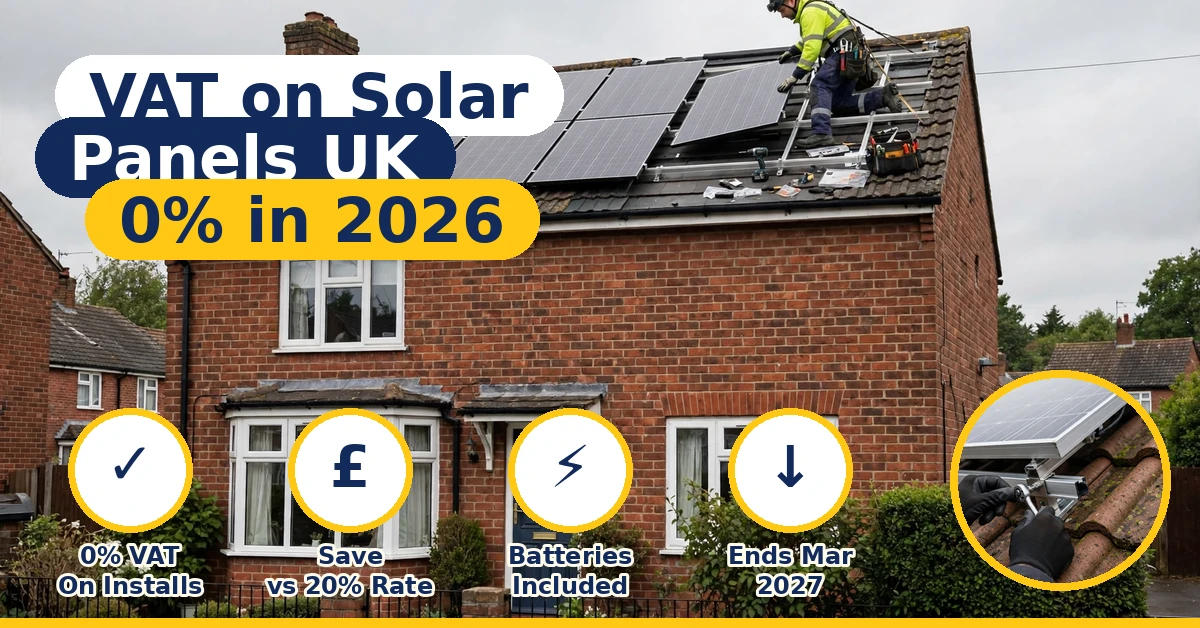
In most cases, no. If you have solar panels installed on your home by an installer in 2026, the installation is charged at 0% VAT. This applies across the whole UK, including Northern Ireland. The zero rate covers both the panels and the installation work, as long as the same business supplies and installs them in residential accommodation.
The 0% rate is temporary. It applies to installations carried out before 1 April 2027, after which the VAT rate on qualifying installations is scheduled to return to the reduced rate of 5%. If you are planning solar in 2026, the VAT treatment is one of the clearest cost advantages of installing sooner rather than later, although it should not be the only factor in your decision.
How the 0% VAT Rule Works
The zero rate was introduced on 1 April 2022 for the installation of energy-saving materials (ESMs) in residential accommodation in England, Scotland and Wales. It replaced the previous 5% reduced rate for these installations. Following a later agreement between the UK and the EU, the zero rate was extended to Northern Ireland from 1 May 2023, so the same treatment now applies UK-wide.
The relief is set out in Group 23 of Schedule 8 to the VAT Act 1994, and HMRC explains the detailed rules in VAT Notice 708/6, “Energy-saving materials and heating equipment”. The key condition is that the supply must be an installation: the zero rate applies when a business supplies the energy-saving materials and installs them in a home. It is the date the installation is carried out that matters, not simply the date you book or pay a deposit.
Residential accommodation includes houses and flats, and it can also cover care homes, student accommodation, self-catering holiday lets, and caravans or houseboats lived in as a permanent home. Hotels, hospitals and prisons are not residential accommodation for this relief. Since 1 February 2024, buildings used solely for a relevant charitable purpose can also qualify.
What Qualifies for 0% VAT?
Solar panels are one item on a closed list of energy-saving materials set by HMRC. Anything not on the list is taxed as usual. The main items relevant to homeowners are:
- Solar panels (photovoltaic and solar thermal)
- Electrical storage batteries (added from 1 February 2024)
- Air-source, ground-source and water-source heat pumps
- Insulation for walls, floors, ceilings, roofs, lofts, water tanks and pipes
- Draught stripping for windows and doors
- Central heating and hot water system controls, including thermostatic radiator valves
- Wind turbines and water turbines
- Smart diverters (added from 1 February 2024)
- Micro combined heat and power units
- Boilers designed to be fuelled solely by wood, straw or similar vegetal matter
When an installer supplies and installs qualifying materials, the zero rate can also cover work that is ancillary to the installation, such as the wiring and fittings needed to make the system work. Work that is not part of the energy-saving installation — for example, a general roof replacement or unrelated building work — remains standard-rated at 20% and should be shown separately on the quote.
Does 0% VAT Apply to Solar Batteries?
Yes. Electrical battery storage was added to the list of qualifying materials from 1 February 2024. Before that date, a battery could only qualify in narrower circumstances, typically when installed at the same time as a solar system. The 2024 change widened the relief in three ways that matter for homeowners:
- A battery installed at the same time as solar panels qualifies.
- A battery retrofitted to an existing solar, wind or water turbine system qualifies.
- A standalone battery that stores electricity from the grid, with no solar panels at all, also qualifies.
This means that adding battery storage to an existing solar installation in 2026 can be zero-rated, provided an installer supplies and fits it in your home. As with panels, buying a battery yourself without installation is a supply of goods and is standard-rated at 20%.
When You Still Pay 20% VAT
The zero rate has clear boundaries. You should expect to pay the standard 20% rate in these situations:
- Buying equipment only: If you buy panels, an inverter or a battery yourself and arrange fitting separately, the purchase is standard-rated. The relief is for installation, not for buying materials on their own.
- Non-residential buildings: Installations in commercial premises, hotels, hospitals and similar buildings do not qualify under this relief.
- Non-qualifying work: Roof repairs, structural work or general electrical upgrades that are not part of the energy-saving installation are standard-rated, even if done at the same time.
- Repairs and maintenance: Servicing or repairing an existing system is not an installation of energy-saving materials, so normal VAT rules apply.
If your project mixes qualifying and non-qualifying work, the installer should apportion the price and show the VAT treatment of each part on the quote. This is one reason to ask for an itemised quote when comparing installation costs.
VAT Rates at a Glance
| Situation | VAT rate in 2026 |
|---|---|
| Solar panels supplied and installed in a home | 0% |
| Solar panels + battery installed together | 0% |
| Battery retrofitted to existing solar panels | 0% |
| Standalone home battery (no solar) | 0% |
| Panels or battery bought without installation | 20% |
| Installation in a commercial building | 20% |
| Non-qualifying building work in the same project | 20% on that part |
How Much Does 0% VAT Save You?
The saving depends on the size of your system. Take a typical domestic installation priced at £8,000 before VAT as an illustration. At the current 0% rate, the VAT added is £0, so you pay £8,000. If the same installation were carried out after the zero rate ends, at the scheduled 5% reduced rate the VAT would be £400, taking the total to £8,400. At the standard 20% rate — which applies to buying equipment without installation — the VAT on £8,000 of equipment would be £1,600.
These figures are illustrative only, because every quote is different. The practical point is that the zero rate removes a cost that would otherwise be added to your installation costs, and it applies to the whole supply-and-install price, including the panels, inverter, mounting kit and labour. Larger systems, and systems with battery storage, therefore see a larger cash saving.
What Happens After 31 March 2027?
Under current legislation, the zero rate ends on 31 March 2027. From 1 April 2027, qualifying installations of energy-saving materials are scheduled to return to the reduced rate of 5% — not the full 20% standard rate. As of late 2026, the government has not announced an extension of the zero rate, so homeowners should plan on the basis that installations completed on or after 1 April 2027 will carry 5% VAT unless the law changes.
Because it is the installation date that counts, an installation booked in 2026 but carried out after the deadline would be taxed at the new rate. If you are close to the deadline, confirm the scheduled installation date with your installer in writing.
How to Make Sure You Get 0% VAT
A short checklist will help you avoid surprises:
- Use an installer who supplies and installs the system as one job, rather than buying the kit yourself.
- Check that the quote shows 0% VAT on the solar panels, battery and installation labour.
- Ask for any non-qualifying work, such as roof repairs, to be itemised separately.
- Confirm the installation will be carried out before 1 April 2027.
- Keep the final invoice, which should show the VAT treatment applied.
If you are also considering heat pumps or insulation, the same zero-rate rules can apply to those installations in your home, and combining projects with one installer can simplify the paperwork.
Conclusion
VAT on solar panels in the UK in 2026 is 0% for installations in homes, thanks to the temporary zero rate on energy-saving materials. It covers panels, batteries (including retrofits and standalone batteries since February 2024), heat pumps and other listed materials when an installer supplies and fits them. Buying equipment without installation still costs 20% VAT, and the zero rate is due to end on 31 March 2027, when the rate returns to 5%. Checking that your quote applies the zero rate correctly is a simple way to keep your solar project as cost-effective as possible.
Frequently Asked Questions
1. Is there VAT on solar panels in the UK in 2026?
For a typical home installation, no. Solar panels supplied and installed in residential accommodation are zero-rated for VAT until 31 March 2027. Buying panels without installation is standard-rated at 20%.
2. Does the 0% VAT rate apply in Northern Ireland?
Yes. The zero rate applied in England, Scotland and Wales from 1 April 2022 and was extended to Northern Ireland from 1 May 2023. It now applies UK-wide until 31 March 2027.
3. Can I get 0% VAT on a battery added to existing solar panels?
Yes. Since 1 February 2024, batteries retrofitted to existing solar systems and standalone batteries both qualify for the zero rate, as long as an installer supplies and fits them in your home.
4. When does the 0% VAT rate on solar panels end?
The zero rate is scheduled to end on 31 March 2027. From 1 April 2027, qualifying installations return to the reduced rate of 5% unless the government changes the law.
5. Do I pay VAT if I buy solar panels and fit them myself?
Yes. The relief covers installations by a business that supplies and installs the materials. Buying panels or a battery on their own, without installation, is standard-rated at 20%.
Sources and Further Reading
- GOV.UK — VAT Notice 708/6: Energy-saving materials and heating equipment — HMRC VAT Notice 708/6 — energy-saving materials and heating equipment.
- MCS — Certified renewable installers — MCS — certified renewable energy installers.
Prices, scheme details and eligibility rules can change. Always check the latest official guidance before applying or signing a contract.