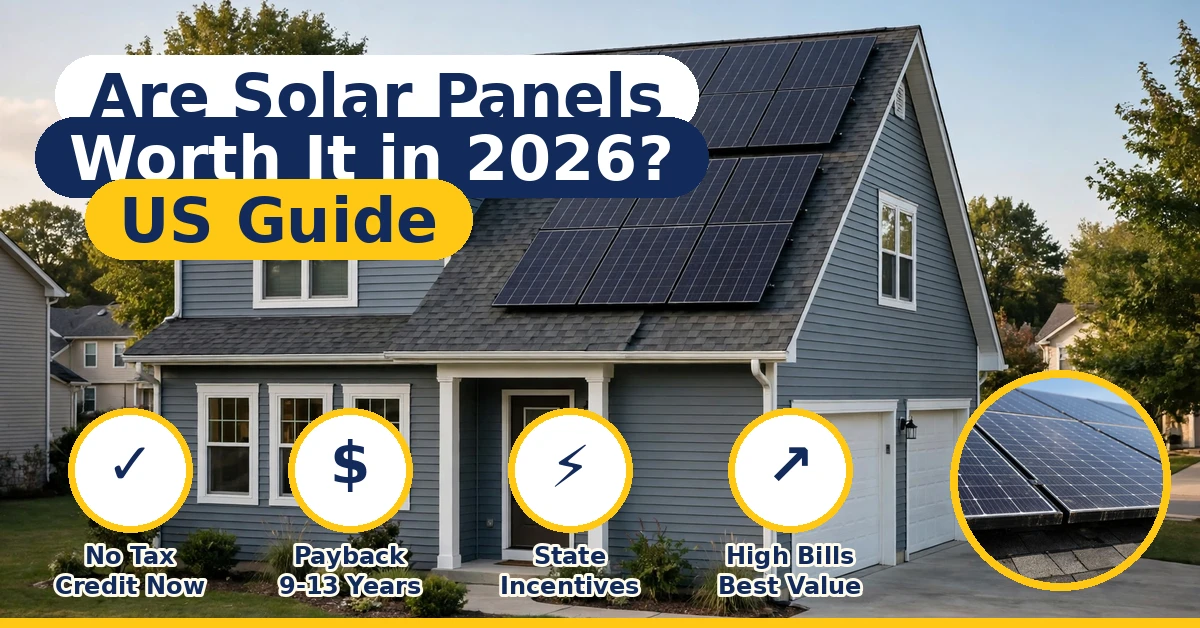
Are Solar Panels Still Worth It in 2026?
For many US homeowners, yes — but the math is tighter than it was in 2025. The 30% federal tax credit for homeowner-owned solar ended for systems installed after December 31, 2025, so a system you buy in 2026 costs the full sticker price. At current average prices of roughly $2.60 per watt, a typical system now takes around 9 to 13 years to pay for itself through electricity savings, compared with roughly 7 to 9 years when the credit was available.
Whether solar is worth it for your home depends mainly on three things: your electricity rate, your state’s net metering or export rules, and how long you plan to stay in the home. Homeowners in high-rate states such as California, Hawaii, Massachusetts, New York and Connecticut can still see payback in roughly 6 to 10 years. In low-rate states with weak export compensation, payback can stretch well beyond 12 years, and the case is weaker.
What Happened to the Federal Solar Tax Credit?
For more than two decades, homeowners who bought rooftop solar could claim a federal tax credit worth 30% of the system cost. The Inflation Reduction Act of 2022 had scheduled that credit, the Residential Clean Energy Credit (Section 25D), to run through 2032. The One Big Beautiful Bill Act, signed on July 4, 2025, ended it early: the credit does not apply to expenditures made after December 31, 2025.
The IRS treats an expenditure as made when the original installation is completed. In practice, that means a system whose installation was finished by December 31, 2025 could still claim the credit on a 2025 tax return, while a system installed in 2026 cannot — even if it was paid for in 2025. The same law also ended the related credit for home battery storage bought by homeowners.
One part of the federal incentive survives. The business-side Clean Electricity Investment Credit (Section 48E) still applies to companies that own solar equipment, which is why leases and power purchase agreements (PPAs) are still offered in 2026. For solar, that business credit has its own deadline: systems generally need to be placed in service by December 31, 2027, unless construction began by July 4, 2026.
How Much Do Solar Panels Cost Without the Tax Credit?
Solar is priced per watt of capacity. In 2026, marketplace averages put residential solar at about $2.60 per watt before incentives, with a typical range of roughly $2.50 to $3.50 per watt depending on system size, state and installer. Larger systems usually cost less per watt because fixed costs such as permitting and design are spread over more capacity.
| System size | Approx. cost at $2.60/W | What the expired credit was worth (30%) |
|---|---|---|
| 6 kW | $15,600 | $4,680 |
| 8 kW | $20,800 | $6,240 |
| 10 kW | $26,000 | $7,800 |
| 12 kW | $31,200 | $9,360 |
These figures are illustrative, based on national average pricing. Your actual installation cost will depend on your roof, equipment choices, local labor rates and whether you add a battery. The key point is that the sticker price of solar barely changed in 2026 — what changed is that buyers no longer get 30% of it back at tax time.
Payback Period Without the Tax Credit
Payback is the time it takes for electricity savings to cover the system cost. A simple example shows how the numbers work. An 8 kW system producing about 1,350 kWh per kW per year generates roughly 10,800 kWh annually. At an average residential electricity rate of about 18 cents per kWh, that is around $1,940 of electricity per year if every unit offsets power you would otherwise buy. Against a $20,800 system cost, simple payback is roughly 11 years — before accounting for rate increases, export payments, maintenance or financing costs.
| Your situation | Typical payback without the credit |
|---|---|
| High electricity rates (e.g. CA, HI, MA, NY, CT) | About 6–10 years |
| Average US rates (~18¢/kWh) | About 9–13 years |
| Low electricity rates (e.g. parts of TX and the Southeast) | 12+ years |
Panels are commonly warranted for 25 years, so even an 11-year payback leaves well over a decade of low-cost electricity. Electricity prices also tend to rise over time, which shortens real payback compared with a simple first-year calculation. On the other hand, if you finance the system with a loan, interest costs lengthen payback, and if your utility pays little for exported power, savings will be lower than the example above.
State Incentives That Still Help
The federal credit is gone for buyers, but state and utility programs still exist in many places. Depending on where you live, these can include:
- State tax credits or rebates: A handful of states still offer their own solar credits or cash rebates, though amounts and eligibility vary and programs change often.
- Net metering: Many states still credit exported solar electricity at or near the retail rate, which protects the value of your generation. Others, such as California under its net billing rules, pay much less for exports, making self-consumption and batteries more important.
- Solar renewable energy credits (SRECs): In some states you can earn and sell credits for the electricity your system generates.
- Property and sales tax exemptions: Many states exempt solar equipment from sales tax or exclude the added value from property tax assessments.
Because these programs are state-specific and change frequently, check what applies in your state before signing a contract. A good installer should itemize every incentive in your quote.
Buying vs. Leasing in 2026
The end of the homeowner credit changed the balance between buying and third-party ownership. If you buy with cash or a loan in 2026, there is no federal credit. If a company owns the system on your roof under a lease or PPA, that company can still claim the business credit and reflect part of its value in your monthly payment or rate.
That does not automatically make leasing the better deal. Owning a system usually delivers the largest long-term savings and can add to your home value, while a lease or PPA offers little or no upfront cost but lower total savings and a contract that must be transferred if you sell. Compare the total cost over 20 to 25 years, not just the first-year payment. Our guide to a solar lease or PPA versus buying breaks down the trade-offs in detail.
When Solar May Not Be Worth It
Solar is not the right move for every home in 2026. It is likely a poor fit if:
- Your electricity rate is very low and your utility pays little or nothing for exports.
- Your roof is heavily shaded, faces mostly north, or needs replacement soon.
- You plan to move within a few years and cannot capture the savings.
- Your roof is small, so fixed installation costs are spread over very little capacity.
- You would need expensive electrical or structural upgrades before installing.
In those cases, waiting, improving energy efficiency first, or considering a lease with no upfront cost may make more sense than buying.
How to Decide: A Simple Checklist
- Check your average electricity rate from a recent bill, including delivery charges.
- Confirm your utility’s export rules — full net metering, reduced export rates, or no compensation.
- Get at least three itemized quotes and compare the price per watt, not just the total.
- Ask each installer for a payback estimate that shows its assumptions.
- Check state and utility incentives and confirm they are included in the quote.
- Compare buying against a lease or PPA on total 20-year cost.
- Make sure your roof has at least 10 to 15 years of life left, or budget for re-roofing first.
Conclusion
Solar panels can still be worth it in the US in 2026 without the federal tax credit, but the decision is more location-dependent than before. At around $2.60 per watt and average electricity rates, most purchased systems pay back in roughly 9 to 13 years, faster in high-rate states and slower where power is cheap. The credit’s end removed about 30% of the old subsidy for buyers, while leases and PPAs can still pass through business-side credit value. Run the numbers for your own rate, roof and state rules — and get itemized quotes — before deciding.
Frequently Asked Questions
1. Is there still a federal solar tax credit in 2026?
Not for homeowners who buy their system. The 30% Residential Clean Energy Credit ended for installations completed after December 31, 2025. Companies that own systems under leases or PPAs can still claim a business credit, subject to a December 31, 2027 deadline for solar.
2. How long does solar take to pay for itself without the tax credit?
Roughly 9 to 13 years at average US electricity rates and prices, based on current estimates. High-rate states can see payback in about 6 to 10 years, while low-rate states may take longer.
3. How much does an 8 kW solar system cost in 2026?
At the national average of about $2.60 per watt, an 8 kW system costs roughly $20,800 before any state or utility incentives. Actual quotes vary by state, roof and equipment, commonly within about $2.50 to $3.50 per watt.
4. Can I still claim the credit if I paid in 2025 but installed in 2026?
No. The IRS treats the expenditure as made when the original installation is completed. If installation was completed after December 31, 2025, the homeowner credit cannot be claimed, even if payment was made earlier.
5. Is a solar lease better than buying now that the credit is gone?
It depends. A lease or PPA can still include business-side credit value in its pricing and needs little upfront cost, but owning usually saves more over 20 to 25 years. Compare total long-term cost, contract terms and how long you plan to stay in the home.
Sources and Further Reading
- IRS — Residential Clean Energy Credit — IRS — Residential Clean Energy Credit.
- Energy.gov — Homeowner’s Guide to Going Solar — U.S. Department of Energy — homeowner guide to going solar.
Prices, scheme details and eligibility rules can change. Always check the latest official guidance before applying or signing a contract.