What Is a Solar Export Tariff?

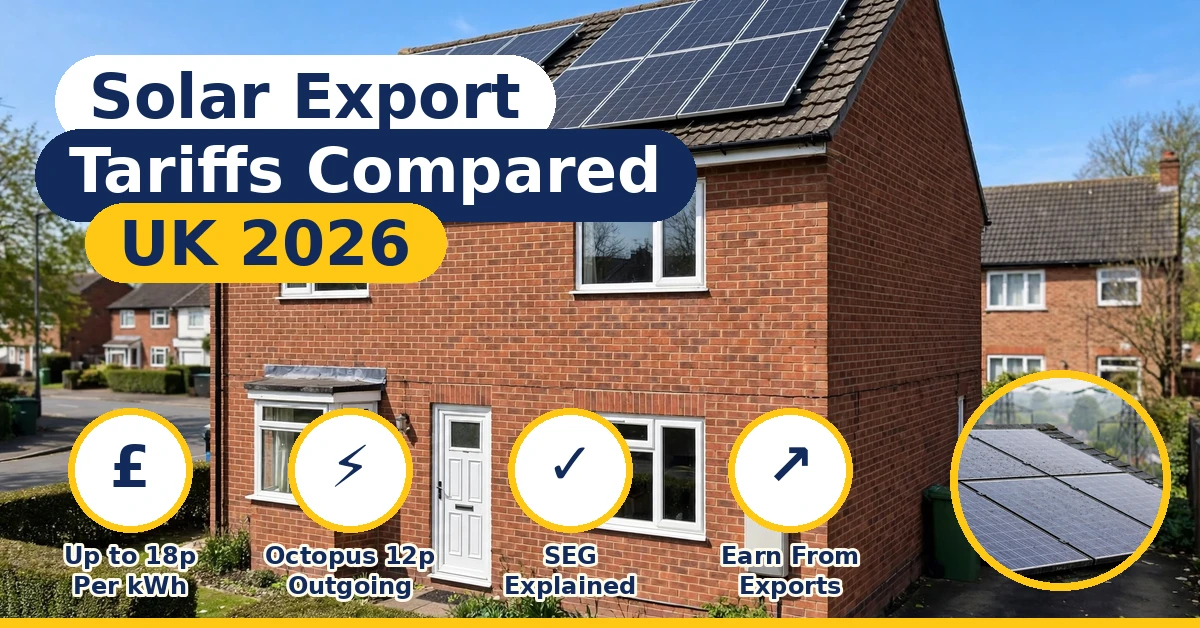
A solar export tariff pays households for electricity their solar panels generate but do not use themselves and send to the electricity grid. In the UK, the Smart Export Guarantee (SEG) provides a framework through which eligible generators can receive payments for exported electricity from participating suppliers. The rate you receive depends on the supplier, tariff, system eligibility and whether you also buy your electricity from that company. Some tariffs are available to customers regardless of their import supplier, while higher rates may be linked to a particular supply tariff, installation package, or battery arrangement.
Solar export payments are increasingly important to households with rooftop solar. During bright periods, panels can generate more electricity than a home needs, especially when occupants are away or when appliances are not running. That surplus can be exported and measured by a suitable meter. Instead of letting excess generation go uncompensated, an export tariff can turn it into a regular source of income or bill credit. However, the rate is only one part of the financial picture: using solar electricity in your home can often save more than exporting it, because self-consumption reduces the amount of electricity you need to buy.
This guide compares export options from Octopus Energy, British Gas and EDF using publicly available tariff comparisons and rate information located in November 2026. Rates and eligibility can change, and some comparisons may reflect different tariff versions or checking dates. Treat the figures below as a snapshot and verify the live offer, terms and rate with the supplier before switching.
How the Smart Export Guarantee Works
The Smart Export Guarantee is a UK scheme requiring eligible licensed electricity suppliers above the relevant threshold to offer payment for exported electricity from eligible small-scale renewable generators, subject to the scheme’s rules. Solar photovoltaic installations are a common example. The scheme replaced the original Feed-in Tariff for new applicants, but it is not a single nationwide export price: suppliers set their own tariff rates and conditions. That is why two households with similar solar systems may receive different payments for the same quantity of exported electricity.
To qualify for a typical SEG tariff, a household generally needs an eligible renewable installation, appropriate metering that can measure exported electricity, and evidence of certification or installation standards where required. Many domestic solar installations use an MCS certificate or equivalent accepted documentation, although supplier requirements can vary, particularly for older installations or installations completed under different arrangements. Suppliers may also require the export meter to be configured correctly and the customer to provide readings or account details during onboarding.
Export payments are calculated by multiplying the amount of eligible electricity exported by the tariff rate, or by applying the tariff’s time-based or variable pricing structure. If you export 1,000 kilowatt-hours (kWh) at 12p per kWh, the simple payment calculation is £120. If a tariff has different rates at different times, your export value depends on when electricity is sent to the grid. Always read the tariff terms to understand how export volumes are measured, when payments are made, and whether the rate can change.
Octopus Energy Solar Export Tariffs
Octopus Energy is known for offering multiple solar export options, including a flat export rate, standalone SEG arrangements and time-based tariffs for certain solar-and-battery setups. The availability and value of each product can depend on the customer’s import tariff, meter configuration, battery, and whether the customer meets specific eligibility conditions. Its tariff range can be attractive to households that want a simple export rate as well as those willing to manage battery charging and exporting around different time windows.
Outgoing Octopus
Outgoing Octopus is a commonly discussed export tariff for customers who also take their electricity supply from Octopus. Public tariff trackers in late 2026 report a 12p/kWh rate for this product, although rates can change and eligibility should be checked directly with Octopus before applying. Under a flat-rate arrangement, the same published rate is applied to eligible exported units regardless of the time they are exported, subject to the tariff’s terms. This can make it relatively easy to estimate export income.
For example, if your household exports 2,000 kWh over a year at 12p/kWh, the gross export payment would be £240. If you export 3,000 kWh, the simple calculation would be £360. These examples assume the rate remains unchanged and all stated export units are eligible. Your actual export volume may be affected by weather, system size, household usage, battery operation and seasonal variation.
Octopus SEG and Time-of-Use Options
Octopus also has a standalone SEG option reported at approximately 4.1p/kWh in late-2026 comparisons for eligible customers whose import supply is with another provider. This can be useful if you want an export arrangement without moving your import electricity account, but its rate is lower than some supplier-linked offers. Check the official terms for metering, eligibility, payment and rate-change rules.
Octopus offers time-of-use export products as well, including options intended for customers with compatible batteries. Such tariffs can offer higher export rates during selected periods, but they may also pay lower rates at other times. Battery capacity, control settings, import prices and household usage all influence whether the arrangement makes financial sense. Don’t compare a peak export rate with another supplier’s all-day rate without considering how many units you can realistically export during the higher-paying period.
British Gas Solar Export Tariffs
British Gas offers export arrangements for eligible solar households, including supplier-linked export products and a standalone SEG option. Public tariff comparisons in late 2026 commonly show Export Premium at around 12p/kWh for eligible British Gas electricity customers, while its standalone Export SEG rate is reported at around 3p/kWh. Product names, rates and availability can change, so confirm the current terms directly with British Gas.
The supplier-linked offer may be more attractive than the standalone rate if you are willing and eligible to take your import supply from British Gas. However, it is important to compare the import tariff too. A higher export rate does not automatically mean lower total energy costs if the import tariff is more expensive than an alternative. Calculate the expected import cost, export income, standing charges and any other relevant terms together.
British Gas’s export arrangements may also include different options or eligibility requirements for particular customers or installations. Check whether the tariff is open to new applicants, whether your solar system size falls within the permitted range, whether your meter can measure export, and whether the tariff is variable. Ask for the export payment schedule and whether any minimum or maximum conditions apply.
EDF Solar Export Tariffs
EDF offers several export arrangements, including standalone SEG and export tariffs for eligible EDF electricity customers. Late-2026 comparisons report EDF’s standalone export tariff at around 3p/kWh, an import-customer variable value rate at around 5.6p/kWh, and some supplier-linked fixed or exclusive offers at higher rates. One comparison reports an eligible 12-month Export 12m tariff around 13p/kWh, while an installation-linked Export Exclusive offer may reach 18p/kWh for qualifying customers. These offers are not interchangeable: each has its own eligibility requirements and terms.
EDF’s higher rates may be connected to purchasing a solar or battery installation through EDF or a qualifying partner, or to having an EDF electricity supply. A customer who already owns solar panels should not assume they can access an installer-exclusive tariff. Read the offer’s qualification rules, including purchase dates, installation requirements, import-supply conditions and contract length.
When comparing EDF with Octopus or British Gas, look at the rate you can actually access—not the highest rate shown in a headline. If an 18p tariff requires a qualifying new installation, it may not be available to a household with existing panels installed independently. If you are already an EDF customer, confirm whether you qualify for a higher export option than its standalone SEG rate and whether any fixed-term commitment applies.
Octopus vs British Gas vs EDF: Rates Compared
The table below summarises selected rates reported in public comparison sources during late 2026. These are illustrative snapshots, not guaranteed live offers. Suppliers can update tariff terms, and eligibility differences can make headline comparisons misleading.
| Supplier | Tariff or option | Indicative export rate | Typical qualification noted in comparisons |
|---|---|---|---|
| Octopus Energy | Outgoing Octopus | 12p/kWh | Generally linked to Octopus import supply; confirm eligibility |
| Octopus Energy | Standalone SEG | 4.1p/kWh | Available to eligible customers without Octopus import supply |
| British Gas | Export Premium | 12p/kWh | Typically linked to British Gas electricity supply |
| British Gas | Export SEG | 3p/kWh | Standalone export option |
| EDF | Export Variable Value | 5.6p/kWh | EDF import customer; variable |
| EDF | Export 12m | 13p/kWh | Eligible EDF customers; check tariff conditions |
| EDF | Export Exclusive | Up to 18p/kWh | Specific qualifying installation/customer conditions may apply |
| EDF | SEG Export Variable | 3p/kWh | Standalone export option |
The table shows why it is worth checking eligibility before deciding. Octopus and British Gas both appear around 12p/kWh on their supplier-linked flat export options in some late-2026 comparisons. EDF has several reported rates, including options that may be higher for eligible customers, but the highest offer may require conditions that do not apply to every solar owner.
A useful comparison should include the import tariff, export tariff, standing charge, payment arrangements, eligibility, contract duration and flexibility. If switching your import supply is required, estimate the cost of electricity you buy as well as the money you receive for electricity you export. This can prevent a high export rate from masking a less competitive overall energy deal.
How Much Could You Earn From Exporting Solar?
Your export income depends on the quantity of electricity sent to the grid and the rate paid for those units. The following examples use simple flat-rate calculations and assume the rate remains unchanged throughout the year. They do not account for tariff eligibility, changes in rates, taxes or other contract terms.
| Annual exported electricity | At 3p/kWh | At 5.6p/kWh | At 12p/kWh | At 13p/kWh | At 18p/kWh |
|---|---|---|---|---|---|
| 1,000 kWh | £30 | £56 | £120 | £130 | £180 |
| 2,000 kWh | £60 | £112 | £240 | £260 | £360 |
| 3,000 kWh | £90 | £168 | £360 | £390 | £540 |
| 4,000 kWh | £120 | £224 | £480 | £520 | £720 |
This table makes the rate difference easy to see. A household exporting 3,000 kWh a year would receive £90 at 3p/kWh but £360 at 12p/kWh, assuming the rates and export quantity remain constant. Yet the household may not be able to access both tariffs, and moving to a different supplier could affect import costs. Use your own meter data and the tariff you qualify for to estimate a realistic outcome.
Exporting more is not necessarily the best way to maximise solar savings. Running appliances when panels are generating, charging an eligible battery, or adjusting electric vehicle charging may increase self-consumption. Electricity used at home can avoid buying a unit at the retail import rate, which is often higher than the export payment. Your best strategy depends on your import rate, export rate, battery efficiency and usage patterns.
Which Export Tariff Is Best for Homes With Batteries?
A battery changes how a solar household manages electricity. Instead of exporting surplus generation immediately, the battery can store some of it for later use. This can reduce imports during evening hours when solar production is low. A battery may also allow participation in tariffs that offer different export rates across time windows, although the battery’s capacity, losses, control settings and tariff rules all matter.
Time-of-use export tariffs can reward customers for exporting at selected hours, but a high peak rate is only useful if you can deliver eligible electricity during that period. Some battery tariffs may involve charging from the grid at particular times, so the overall import and export strategy must be considered. Review the tariff’s rules carefully, particularly if it involves automated battery control or specific device compatibility.
Do not purchase a battery solely because a tariff advertises a high export rate. Estimate the battery’s cost, expected cycles, usable capacity, efficiency, warranty and likely savings. Compare the financial value of storing solar for your own use with the value of exporting it. A battery can offer backup or convenience benefits in some systems, but those benefits should be considered separately from export income.
Eligibility, Smart Meters and MCS Certificates
Eligibility is one of the most important parts of a solar export tariff comparison. Suppliers may require an eligible renewable generator, appropriate export measurement, installation documentation and account information. MCS certification is commonly requested for domestic solar installations, although requirements for older systems and other installation circumstances can vary. Check the supplier’s documentation requirements before applying rather than assuming your system will qualify automatically.
A smart meter or other approved meter arrangement must be able to record exported electricity in a way accepted by the supplier. Not every meter setup is configured or commissioned for export measurement. If your meter needs an upgrade or configuration change, ask your supplier or installer how this is handled and whether there is a cost. The meter data is important because it determines how much electricity your tariff pays for.
Keep copies of installation documents, commissioning details, meter information, system specifications and any MCS certificate. If you have a battery, the supplier may ask for additional details. Confirm whether the tariff has system-size limits, battery requirements, restrictions on grid-charged battery exports, or other conditions. Documentation and eligibility checks can help prevent delays when switching.
How to Switch Solar Export Tariffs
Switching export tariffs can be straightforward if your installation and meter meet the supplier’s requirements. Begin by reviewing your current tariff, payment history and export data. Gather your meter details, installation certificate or other accepted documentation, and recent export readings if requested. Then compare the tariffs that are genuinely open to your system and address.
Before applying, check whether the new export tariff requires you to switch your import electricity supply as well. If it does, compare the import unit rate and standing charge against your current deal. Consider whether the export tariff is fixed, variable or time-based, and whether it has a minimum term or cancellation conditions. Make sure the tariff’s payment method and schedule suit you.
After the application, follow the supplier’s instructions for meter readings and account setup. Keep a record of the date the tariff begins and verify that exported units are being credited correctly. If your old supplier and new export supplier need to coordinate meter details, allow time for the process and ask for confirmation if payments do not appear as expected. Do not cancel an existing export arrangement until you understand the transition and any remaining credit balance.
Common Mistakes When Comparing Export Rates
One common mistake is comparing headline rates without checking eligibility. A tariff advertised at 18p/kWh may be available only to customers who bought a qualifying solar or battery installation through the supplier or its partner. A lower flat rate may be more accessible to a household with an existing system. The practical comparison is the rate you can obtain today, not the most attractive number in an advertisement.
Another mistake is ignoring the import tariff. Some export deals require customers to take electricity from the same supplier. If the import tariff is less competitive, the household may lose more on imported electricity than it gains through export payments. Compare the full annual bill estimate rather than looking at export income in isolation.
Customers also sometimes assume that every exported unit will receive the advertised rate. Time-of-use tariffs may pay different amounts at different times, and variable tariffs can change. Metering, eligibility, export limits and tariff terms can affect payments. Read the contract, ask questions and keep your own records so that your decision is based on realistic assumptions.
Conclusion
Octopus Energy, British Gas and EDF all offer solar export options in the UK, but the best tariff depends on your eligibility, import supplier, installation details, export volume and whether you have a battery. Late-2026 comparison sources report supplier-linked rates around 12p/kWh for Octopus Outgoing and British Gas Export Premium, while EDF has several options ranging from lower standalone rates to higher offers for eligible customers. These rates and conditions can change, so verify the exact tariff before signing up.
For a fair comparison, calculate the net value of your export payments and consider the cost of imported electricity if switching suppliers is required. Check smart-meter requirements, MCS or other accepted documentation, tariff eligibility, fixed or variable terms and payment arrangements. A higher headline export rate is not automatically the best deal for every household.
The most effective approach is to use your own export data, compare offers you qualify for, and review both import and export costs together. With careful comparison, you can make your solar system work more efficiently and earn a more competitive return from surplus electricity.
Frequently Asked Questions
1. Which is better for solar exports, Octopus, British Gas or EDF?
It depends on which tariff you qualify for and whether you need to switch your import supply. Public late-2026 comparisons report around 12p/kWh for some Octopus and British Gas supplier-linked options, while EDF offers several tariffs with different conditions and rates. Verify the current offers directly.
2. How much does Octopus pay for solar exports in 2026?
Late-2026 comparisons report Outgoing Octopus at around 12p/kWh for eligible customers, and its standalone SEG option at around 4.1p/kWh. Rates, availability and conditions can change, so confirm the current terms with Octopus.
3. What is the British Gas solar export rate?
Public comparisons in late 2026 commonly list British Gas Export Premium around 12p/kWh for eligible British Gas electricity customers and its standalone Export SEG around 3p/kWh. Check the current supplier terms before applying.
4. Does EDF pay 18p per kWh for exported solar electricity?
EDF’s higher export offers have been reported at up to 18p/kWh for eligible customers under specific conditions, including qualifying installation or purchase arrangements. This rate is not necessarily available to every existing solar-panel owner. Confirm the tariff eligibility and terms with EDF.
5. Can I use one supplier for electricity and another for solar exports?
In many cases, yes. The SEG framework allows eligible customers to seek an export tariff from a supplier that is different from their import supplier, subject to the tariff’s requirements. Standalone rates may be lower than supplier-linked rates, so compare the total cost and benefit.
Sources and Further Reading
- Ofgem — Smart Export Guarantee — Ofgem — Smart Export Guarantee scheme.
- Octopus Energy — Outgoing Octopus — Octopus Energy — Outgoing Octopus export tariff.
- GOV.UK — Smart Export Guarantee — GOV.UK — Smart Export Guarantee.
Prices, scheme details and eligibility rules can change. Always check the latest official guidance before applying or signing a contract.