
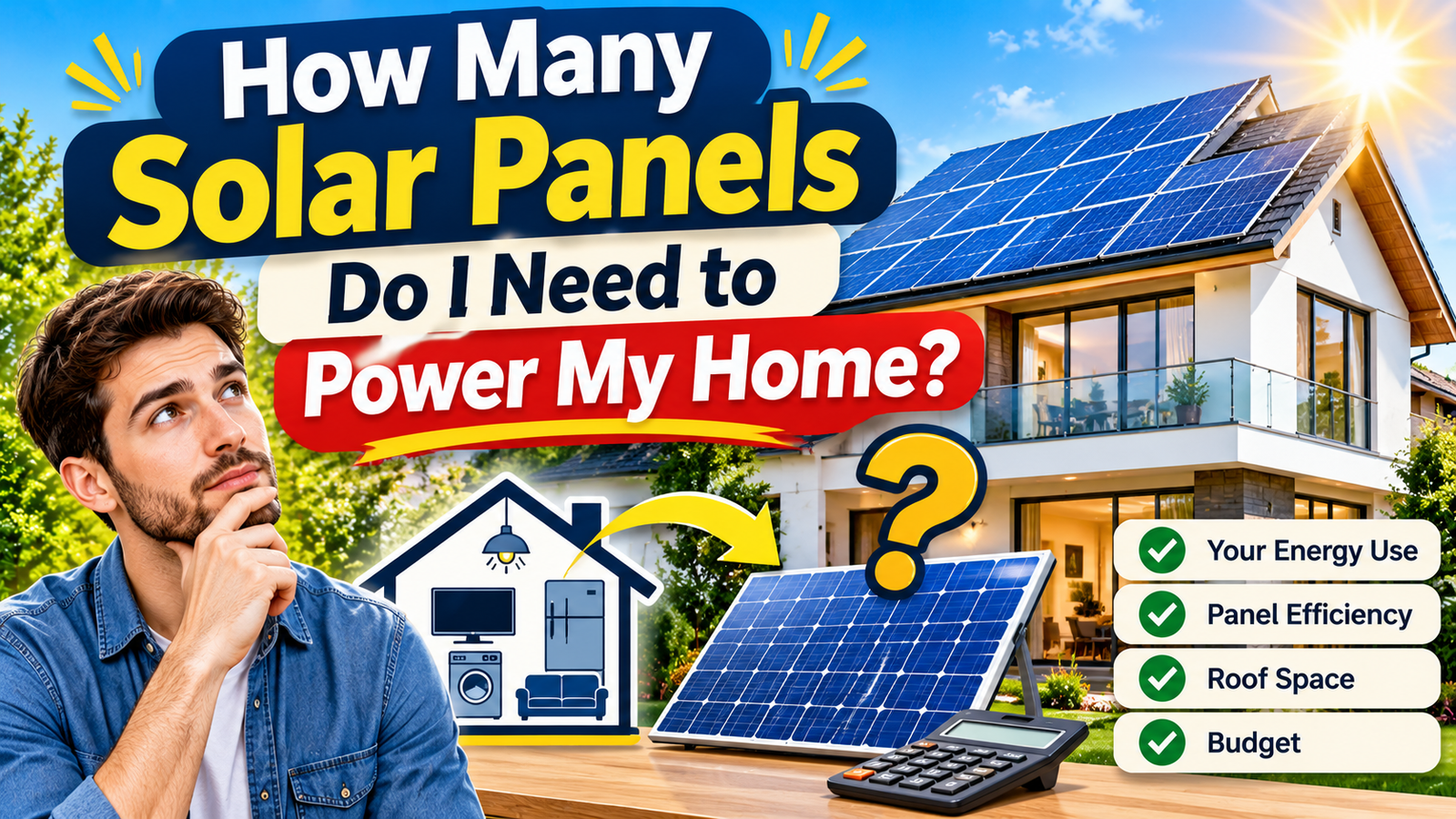
The short answer: how many solar panels do I need to power my home depends on your electricity use, your location’s sunlight, and the wattage of the panels you choose. An average US home uses roughly 900 kWh a month and needs about 18 to 22 solar panels (400 W each). Your own number could be much lower or higher, so it is worth calculating it properly.
The Quick Formula
To learn how to calculate how many solar panels you need, use this simple formula:
Number of panels = (Monthly kWh ÷ 30 ÷ peak sun hours) × 1,000 ÷ panel wattage ÷ 0.8
- Monthly kWh: from your utility bill
- Peak sun hours: about 4 to 6 per day in most of the US
- Panel wattage: typically 350 to 450 W today
- 0.8: accounts for real-world losses from heat, wiring, dirt, and the inverter
A 400 W panel with 5 peak sun hours makes about 1.6 kWh a day after losses, or roughly 48 kWh a month. Divide your monthly usage by 48 and you have a solid starting estimate.
Step-by-Step: How to Calculate Solar Panels for Home Electricity Usage
- Find your usage. Add up 12 months of bills and divide by 12. Annual averages work better than a single month.
- Find your peak sun hours. Sunny states like California and Arizona get 5 to 6 hours, while cloudier areas get 3.5 to 4.5.
- Pick a panel wattage. Higher-wattage panels mean fewer panels on the roof.
- Run the formula and round up.
- Check your roof space. Each panel needs about 17 to 20 square feet, so 20 panels need roughly 350 to 400 square feet of usable roof.
Most people use a how many solar panels do I need calculator from an installer, but the formula above gives nearly the same answer.
How Many Solar Panels by Home Size
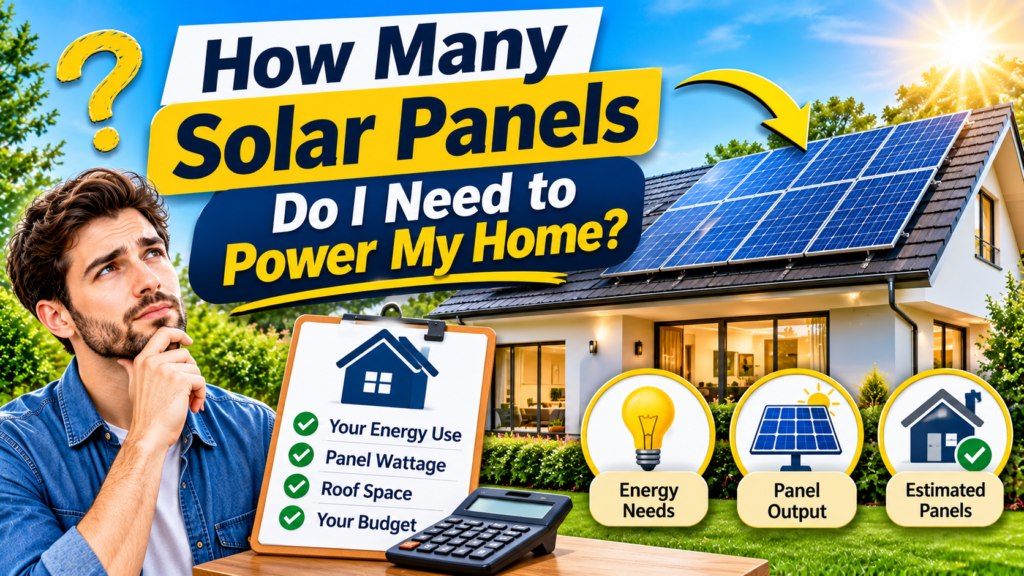
Square footage is only a rough guide, because usage depends on occupants, appliances, and climate. These estimates assume 400 W panels and 5 peak sun hours:
| Home size | Typical use | Panels needed |
|---|---|---|
| 1,000 sq ft | 500 to 600 kWh/month | 11 to 13 |
| 1,200 sq ft | 600 to 700 kWh/month | 13 to 15 |
| 1,500 sq ft | 700 to 800 kWh/month | 15 to 17 |
| 2,000 sq ft | 900 to 1,000 kWh/month | 19 to 21 |
| 3,000 sq ft | 1,300 to 1,500 kWh/month | 27 to 31 |
So how many solar panels to run a 2,000 sq ft house? About 20 on average. How many solar panels do I need for a 3000 sq ft home? Around 30, more if you have a pool, electric heating, or an electric vehicle. A 1,500 sq ft house usually needs about 16, and a 1,000 sq ft home about 12.
How Many Solar Panels by Monthly Usage
If you know your bill, this is more accurate than square footage:
- 500 kWh/month: about 10 to 11 panels
- 1,000 kWh/month: about 21 panels
- 1,500 kWh/month: about 31 panels
- 4,000 kWh/month: about 83 panels, a system of roughly 33 kW, which usually suits very large homes, farms, or small businesses
So how many solar panels do I need for 4,000 kWh per month? Around 80 or more, and you would likely need ground-mounted space too.
Common System Sizes
If your installer quotes a system size in kilowatts, here is how it converts to panels:
- 5 kW system: about 13 panels, producing roughly 600 kWh a month
- 10 kW system: about 25 panels, producing roughly 1,200 kWh a month
A 5 kW system fits a small to medium home. A 10 kW system suits larger homes or those with high electric loads.
How Many Solar Panels for Specific Homes
3-bedroom house: Usually 15 to 20 panels, depending on appliances and climate.
4-bedroom house: Typically 20 to 28 panels, since larger homes tend to use more power.
Small house: Often 8 to 12 panels.
Average home: About 18 to 22 panels in most of the US.
Appliances That Change the Number
Central air conditioning: A typical central AC can add 300 to 600 kWh a month in summer, meaning roughly 6 to 12 extra panels.
Refrigerator and basic appliances: A fridge uses about 1 to 2 kWh a day, so it needs only one or two panels’ output.
Electric heating or a heat pump: This can add several hundred kWh a month in winter, so it raises your panel count noticeably.
Electric vehicle: Charging one adds about 250 to 400 kWh a month for average driving, or 5 to 8 panels.
Panels at Night, With Batteries, and Off-Grid
Panels do not produce power at night. If you stay connected to the grid, net metering lets you export surplus daytime power and draw it back later, so the panel count stays about the same.
With a battery backup, add roughly 10 to 15 percent more capacity to cover charging losses. A battery stores daytime energy, which lets you run your house at night, but it must be sized for your evening and overnight use.
Off-grid systems need much more. You must size for your worst winter month and add batteries and often a backup generator, so panel counts can be 1.5 to 2 times higher than for a grid-tied home. The same goes for an off-grid cabin, though cabins often have much lower loads.
State Differences: California and Texas
Sunlight changes the answer. In California, with about 5.5 to 6 peak sun hours, you may need fewer panels than in cloudier regions for the same usage. In Texas, around 5 to 5.5 sun hours and heavy summer air-conditioning use mean systems often run 20 to 30 panels for typical homes. Always use your local sun hours for the best estimate.
What Does It Cost?
Costs vary by installer and location, but whole-house systems commonly run about $2.50 to $3.50 per watt before incentives. On that basis, an 8 kW system for a 2,000 sq ft house might cost roughly $20,000 to $28,000 before incentives. A 3-bedroom house system often falls near the lower end. Incentives and tax credit rules change, so check current programs and get several quotes before you decide.
How to Size a System to Eliminate Your Electric Bill
To eliminate your electric bill, aim to offset 100 percent of your annual usage. Many people add a small buffer of 10 to 15 percent to cover future needs such as an EV or heat pump. Keep in mind that you will usually still pay small fixed utility fees.
Tips for Choosing the Right Size
- Start with efficiency upgrades, since cutting usage reduces the panels you need.
- Choose higher-wattage panels if roof space is limited.
- Consider roof direction, shade, and tilt, which can cut production by 10 to 30 percent.
- Ask installers to show their production estimate and assumptions.
- Compare at least three quotes.
Frequently Asked Questions
How many solar panels do I need to power my home?
Most average homes need about 18 to 22 panels of 400 W, but your own number depends on usage and sunlight.
How many solar panels to run a 2,000 sq ft house?
Roughly 20 panels for typical use of 900 to 1,000 kWh a month.
How many solar panels do I need for 1,000 kWh per month?
About 21 panels of 400 W with 5 peak sun hours.
How many solar panels do I need for a 5 kW system?
About 13 panels of 400 W.
How many solar panels do I need for a 10 kW system?
About 25 panels of 400 W.
How many solar panels do I need to run central air conditioning?
A typical central AC may need 6 to 12 panels’ worth of extra production in summer, depending on size and climate.
Can solar panels run my house at night?
Not directly. You need net metering with the grid or a battery to use stored daytime power at night.
How many solar panels to eliminate my electric bill?
Enough to offset your full annual usage, plus a small buffer if you expect your usage to grow.
How many solar panels are needed for an off-grid cabin?
Often 4 to 15 panels, depending on loads, plus batteries sized for your longest cloudy stretch.
Conclusion
The number of solar panels you need comes down to three things: how much electricity you use, how much sun you get, and how powerful your panels are. Most homes land between 15 and 30 panels, with 20 as a common figure for a 2,000 sq ft house. Use your yearly usage, apply the formula, and add extra if you plan to add an EV, heat pump, or battery. A professional site assessment will confirm roof space, shading, and the best system size for your budget.
Source: U.S. Department of Energy — solar energy guidance



One Comment