Introduction
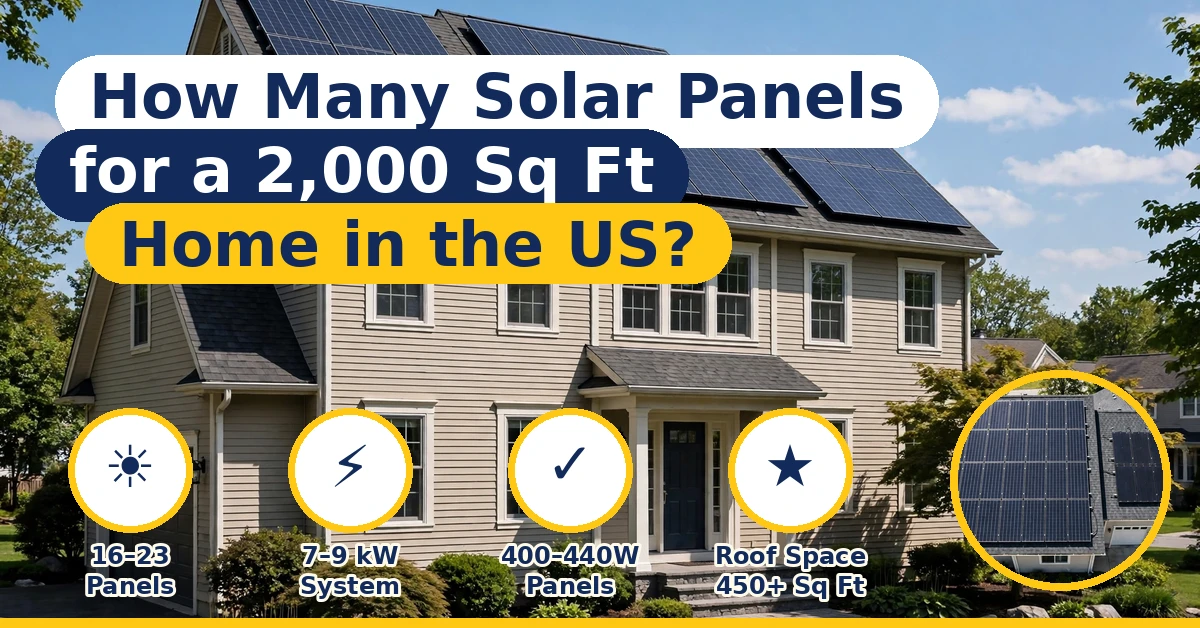
A typical 2,000-square-foot home in the United States may need around 16 to 23 solar panels, using modern panels rated at approximately 400–440 watts. Some homes may need fewer or more, because electricity consumption, local sunlight, roof conditions and panel wattage matter more than floor area alone. EnergySage’s 2026 guide estimates about 15 panels for a 2,000 sq ft home under its stated assumptions, while other estimates using different electricity-use and sunlight assumptions produce higher counts.
For example, a household using about 10,000–11,000kWh per year might need roughly a 7–9kW system, depending on local solar production. That could mean around 16–23 panels rated at 400–440 watts. A home with electric heating, heavy air-conditioning use, a pool or an electric vehicle may need a larger system.
This guide explains how to estimate the number of panels for a 2,000 sq ft home, what affects system size, how much electricity a system may generate and how to get a more accurate estimate.
How Many Solar Panels Does a 2,000 Sq Ft Home Need?
As a broad planning range, many 2,000 sq ft homes may need about 16 to 23 panels when using 400–440W modules. A lower-use home in a sunny area may need fewer; a high-use home or one in a lower-sun region may need more.
The panel count depends on three main factors:
- Annual electricity use: A home that uses more kilowatt-hours needs a larger system.
- Panel wattage: Higher-wattage panels produce more electricity per panel, reducing the number required.
- Local solar conditions: Sunlight, roof direction, shading and weather affect annual production.
For example, a 7kW system made with 400W panels requires about 18 panels. A 10kW system made with the same panels requires 25 panels.
Example Solar Panel Requirements
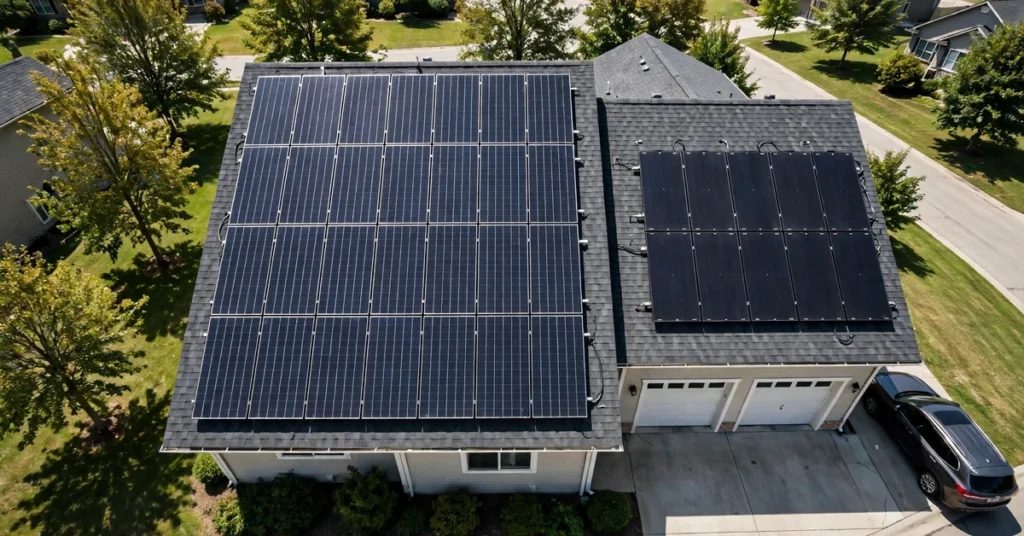
The following examples show how annual electricity consumption affects system size. They are illustrative estimates, not a site-specific design.
| Annual electricity use | Example system size | Number of 400W panels |
|---|---|---|
| 8,000kWh | 5.5–6.5kW | 14–17 |
| 10,000kWh | 6.5–8kW | 17–20 |
| 12,000kWh | 8–9.5kW | 20–24 |
| 14,000kWh | 9–11kW | 23–28 |
| 16,000kWh | 10.5–12.5kW | 27–32 |
Actual system size should be calculated using a location-specific production estimate. The same system can produce different amounts of electricity in Arizona, California, Texas, Florida, New York or Washington.
How to Calculate the Number of Solar Panels
You can estimate your panel requirement using a simple process.
Step 1: Find Your Annual Electricity Use
Look at your electricity bills and add up the kilowatt-hours (kWh) used over the last 12 months. If your utility account provides an annual usage summary, use that figure.
Do not use the dollar amount of the bill for this calculation. Electricity rates differ, so the kWh figure is a more reliable measure of energy demand.
Step 2: Estimate the Required Solar System Size
A simplified formula is:
System size (kW) = annual electricity use (kWh) ÷ annual production per kW
For example, if your home uses 10,000kWh per year and a local solar estimate suggests that each installed kW produces 1,400kWh annually:
10,000 ÷ 1,400 = 7.14kW
This suggests a system of approximately 7.1kW before considering design choices, shading, future electricity use and the desired percentage of bill offset.
Step 3: Divide by Panel Wattage
Convert the system size into watts and divide by the wattage of the panel you plan to use.
For a 7.14kW system using 400W panels:
7,140 ÷ 400 = 17.85
You would need approximately 18 panels. The installer may recommend a slightly different configuration to fit the roof and available equipment.
Does a 2,000 Sq Ft Home Always Need the Same Number of Panels?
No. Two homes with the same floor area can have very different electricity consumption.
A home with gas heating, efficient appliances and limited air-conditioning use may consume much less electricity than a home with electric heating, a pool pump, multiple refrigerators, an electric vehicle and heavy air-conditioning demand.
Important factors include:
- Number of people living in the home
- Heating and cooling equipment
- Electric water heating
- Pool or hot tub equipment
- Electric vehicle charging
- Appliance efficiency
- Work-from-home electricity use
- Local climate and seasonal demand
The most accurate starting point is your actual annual kWh consumption, not square footage alone.
How Many Panels Are Needed With Different Panel Wattages?
Solar panel wattage affects the number of modules needed to reach a target system size.
| Target system size | 350W panels | 400W panels | 450W panels |
|---|---|---|---|
| 6kW | 18 | 15 | 14 |
| 7kW | 20 | 18 | 16 |
| 8kW | 23 | 20 | 18 |
| 9kW | 26 | 23 | 20 |
| 10kW | 29 | 25 | 23 |
| 12kW | 35 | 30 | 27 |
Panel counts are rounded up to the next whole panel. The final array size may be slightly above the target because panels are installed in whole units.
Higher-wattage panels do not automatically make a system more cost-effective. Compare panel efficiency, physical dimensions, warranty, degradation rate and installed price.
How Much Roof Space Do You Need?
A modern residential solar panel often occupies approximately 18 to 22 square feet, although dimensions vary by manufacturer and model.
For a rough illustration:
- 18 panels may require around 325–400 sq ft of panel area.
- 25 panels may require around 450–550 sq ft.
- 30 panels may require around 540–660 sq ft.
These estimates cover approximate module area, not the full roof layout. Setbacks, fire-access pathways, roof obstructions, spacing, roof shape and local code requirements can reduce the usable area.
A roof with multiple sections, dormers, chimneys or shade may not fit the same number of panels as a large, unobstructed roof.
Which Roof Direction Is Best for Solar Panels?
In the United States, south-facing roof sections often provide strong annual solar production, but east- and west-facing roofs can also be suitable. The best layout depends on location, roof pitch, shading and when the household uses electricity.
A roof that receives morning or afternoon sun may still support a productive system. A clear roof with a less ideal direction can sometimes outperform a south-facing roof that is heavily shaded.
Ask the installer to provide a production estimate for the proposed panel layout rather than relying on roof direction alone.
How Much Electricity Can Solar Panels Generate?
A residential solar system’s annual output varies by location and design. As a broad illustration, a 7kW system might generate around 8,400 to 11,200kWh per year in locations where each installed kW produces roughly 1,200 to 1,600kWh annually.
A 10kW system under the same assumptions might generate approximately 12,000 to 16,000kWh per year.
These are illustrative ranges only. Local solar irradiance, orientation, shading, temperature, inverter efficiency and weather can change actual output. Tools such as the National Renewable Energy Laboratory’s PVWatts calculator can help estimate production for a specific address and system design.
How Much Does Solar Cost for a 2,000 Sq Ft Home?
Solar installation prices depend on system size, location, equipment, roof complexity, installer and financing. The square footage of the house does not directly determine the price.
For a preliminary estimate, multiply the proposed system size in watts by a local installed price per watt. For example, a 7kW system at $2.75 per watt would cost approximately $19,250 before applicable incentives or optional battery storage.
A 10kW system at the same assumed price would cost approximately $27,500. These examples are calculations, not national price guarantees. Obtain current written quotes from qualified local installers.
A standard grid-connected solar quote often includes panels, inverter equipment, mounting, wiring, installation labour, design and permitting. Batteries, backup equipment, roof repairs and electrical panel upgrades may cost extra.
Does a 2,000 Sq Ft Home Need a Solar Battery?
No. A solar battery is optional for many grid-connected homes.
Without a battery, the home can use solar electricity when it is being generated and import electricity from the grid when solar production is insufficient. The utility may credit exported electricity according to its net-metering or net-billing tariff.
A battery stores surplus solar energy for later use and may provide backup during an outage if the system is designed for backup. Whether it is financially worthwhile depends on battery cost, utility export credits, electricity rates and household usage.
How to Choose the Right Solar System Size
Before selecting a system, review the following:
- Annual electricity consumption: Use 12 months of utility kWh data.
- Future demand: Account for electric vehicles, heat pumps, pool equipment or planned additions.
- Roof suitability: Check available area, orientation, pitch and shading.
- Utility rules: Understand export compensation, interconnection limits and fixed charges.
- Panel and inverter specifications: Compare equipment quality and warranty coverage.
- Installer estimates: Request a shade analysis and annual production forecast.
- Financial assumptions: Check cash price, financing costs, incentives and projected savings separately.
Avoid choosing a system solely because it is marketed as suitable for a 2,000 sq ft home. A correctly sized system should reflect the household’s electricity use and the roof’s ability to generate power.
Conclusion
A 2,000 sq ft home in the US may need approximately 16 to 23 solar panels using common 400–440W modules, but the correct number depends on electricity consumption, location, roof conditions and panel wattage. A home using around 10,000–11,000kWh annually might need roughly a 7–9kW system, while a higher-use home may require more.
Start with your annual electricity consumption, estimate production for your location and divide the required system capacity by the wattage of the panels you are considering. A qualified installer can then confirm the roof layout, shading, equipment and final system size.
Frequently Asked Questions
1. How many solar panels do I need for a 2,000 sq ft house?
A broad estimate is around 16 to 23 panels using 400–440W modules. The exact number depends on annual electricity use, location, panel wattage and roof conditions. Reviewing 12 months of electricity bills gives a more reliable starting point.
2. Is a 6kW solar system enough for a 2,000 sq ft home?
It may be enough for a home with relatively low electricity consumption, but it may not cover the needs of a household with high air-conditioning use, electric heating, a pool or an electric vehicle. Compare estimated annual production with actual annual consumption.
3. How many 400-watt solar panels make a 10kW system?
A 10kW system requires 25 panels rated at 400 watts each because 25 × 400W equals 10,000W.
4. How much roof space is needed for 25 solar panels?
If each panel occupies approximately 18 to 22 square feet, 25 panels would cover roughly 450 to 550 square feet of module area. Roof setbacks, access pathways, shading and obstructions mean the usable roof area must be larger.
5. Do I need a battery with solar panels?
No. A grid-connected solar system can operate without a battery. A battery can store excess daytime electricity for later use or provide backup when paired with compatible equipment.
6. Will solar panels cover 100% of my electricity use?
They may offset all or a large portion of annual consumption if the system is appropriately sized and the roof has suitable solar access. Actual bill savings also depend on utility charges, export compensation and the timing of electricity use.
Sources and Further Reading
- US Energy Information Administration, Residential Energy Consumption: https://www.eia.gov/consumption/residential/
- National Renewable Energy Laboratory, PVWatts Calculator: https://pvwatts.nrel.gov/
- US Department of Energy, Homeowner’s Guide to Going Solar: https://www.energy.gov/eere/solar/homeowners-guide-going-solar
- EnergySage, How Many Solar Panels Do I Need? 2026 guide: https://www.energysage.com/solar/how-many-solar-panels-do-i-need/
- SolarReviews, Solar Panels for a 2,000 Sq Ft Home: https://www.solarreviews.com/blog/how-many-solar-panels-for-a-2000-sq-ft-home/
- EnergySage, Solar Panel System Size: https://www.energysage.com/solar/solar-panel-system-size/