Introduction
Installing solar panels is a major investment for American homeowners, but it can also provide long-term protection against rising electricity bills. Before choosing a solar installer, one of the most important things to understand is the total installation cost and the price per watt.
In 2026, residential solar installation prices vary depending on system size, location, equipment quality, roof condition and labor expenses. A small rooftop system may cost considerably less than a larger installation designed to cover most of a household’s electricity consumption.
Another important change in 2026 is the expiration of the federal residential clean energy tax credit for new installations completed after December 31, 2025. This makes comparing installation quotations and available state incentives particularly important.
Average Solar Panel Installation Cost in the US in 2026
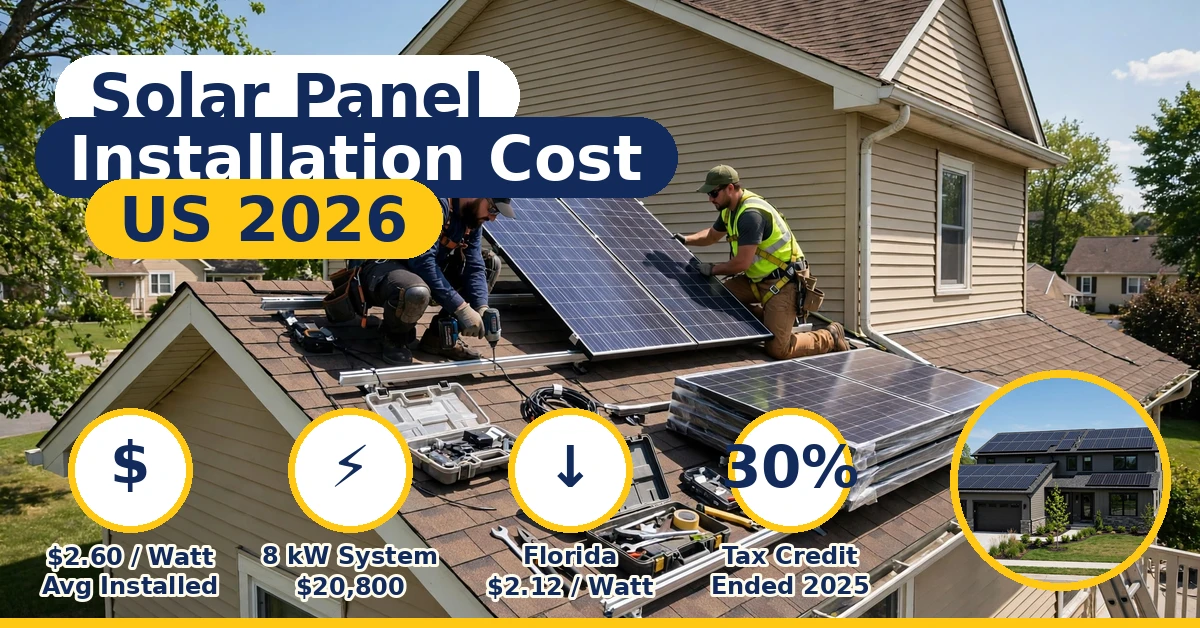
According to EnergySage marketplace data updated in November 2026, the average installed solar price is approximately $2.60 per watt before incentives. Its typical 12 kW residential installation costs approximately $31,135.
SEIA and Wood Mackenzie’s Q2 2026 industry benchmark reports residential system pricing of $3.36 per watt. These figures use different pricing methodologies and should not be treated as directly interchangeable.
For homeowners, actual installer quotations are more useful than a national average. Compare the complete cash price, system capacity, equipment and included services before making a decision.
Solar Panel Price Per Watt Installed in the US
The price per watt is a convenient way to compare solar installation quotations. It represents the total system price divided by the system’s rated DC capacity in watts.
For example, if an installer quotes $20,800 for an 8,000-watt system, the price is $2.60 per watt. Make sure you compare similar systems and cash prices: a quote that includes a battery, roof work or financing charges is not directly comparable with a basic solar-only installation.
Using an illustrative $2.60-per-watt price, the estimated costs are:
| Solar system size | Estimated installed cost |
|---|---|
| 4 kW | $10,400 |
| 5 kW | $13,000 |
| 6 kW | $15,600 |
| 8 kW | $20,800 |
| 10 kW | $26,000 |
| 12 kW | $31,200 |
These are simple estimates, not guaranteed market quotations. EnergySage’s reported average for a 12 kW installation is $31,135, close to the illustration above. Actual prices can be higher or lower depending on the project.
What Is Included in a Solar Installation Quote?
A complete residential solar installation normally includes more than the solar modules. Ask the installer to show the main components and services separately so you can understand what you are paying for.
Solar Panels
Solar panels convert sunlight into direct-current electricity. Their price depends on wattage, efficiency, manufacturer, warranty and product technology. Higher-efficiency panels can be useful when roof space is limited, but the most expensive panel is not automatically the best value.
Inverter Equipment
An inverter converts the electricity produced by the panels into alternating current used by household appliances. A system may use a string inverter, microinverters or power optimisers. The best arrangement depends on roof layout, shading, system design and monitoring requirements.
Mounting and Electrical Materials
Racking and mounting equipment secure panels to the roof. Wiring, connectors, disconnects and other electrical components connect the array to the inverter and home’s electrical system. Correct design and installation are essential for safe operation.
Labor, Permits and Inspection
Installation labor covers the work required to prepare the site, mount the equipment and connect the system. The quotation may also include engineering, local permits, utility interconnection and inspection fees. These soft costs can differ significantly between cities and states.
Solar Installation Costs by State
Solar prices are not the same throughout the United States. Labor rates, permitting requirements, installer competition, roof types, equipment availability and local market conditions all influence the final quotation.
EnergySage marketplace data updated in November 2026 reports the following average prices per watt for selected states:
| State | Reported average price per watt |
|---|---|
| Florida | $2.12 |
| Arizona | $2.25 |
| Texas | $2.26 |
| Oregon | $2.40 |
| North Carolina | $2.44 |
| California | $2.52 |
| Virginia | $2.56 |
| New York | $2.77 |
| Hawaii | $3.44 |
| Alabama | $3.72 |
These are marketplace figures, not official statewide price caps. They may reflect different system sizes and customer or project characteristics. Get local quotes before using a state average to set your budget.
What Factors Affect Solar Panel Installation Costs?
System Size and Electricity Usage
A household with high electricity consumption may need a larger solar array. Larger systems often have a lower price per watt because some design, permitting and mobilization costs are shared across more panels. However, the total project price will normally be higher.
Roof Condition and Installation Complexity
A simple roof with suitable orientation and little shading is generally easier to work on. Steep roofs, multiple roof sections, older roofing materials, structural repairs and difficult access can increase labor and project costs.
Panel Efficiency and Equipment Quality
Premium modules, advanced inverters and monitoring features can raise the upfront price. Compare product warranties, performance specifications and expected output rather than choosing equipment based only on brand recognition.
Battery Storage
A solar battery stores excess electricity for use later, including during the evening or certain power outages. It adds a separate equipment and installation cost. Ask for two quotations—one for solar panels alone and another for solar plus storage—so you can evaluate the additional investment.
Local Permitting and Utility Requirements
Permit fees, inspection rules and utility interconnection procedures vary by jurisdiction. Some projects require additional electrical work or service-panel upgrades. Ask whether these items are included in the quoted price.
Federal Solar Tax Credit and Incentives in 2026
Homeowners should be aware of a major federal policy change. The Residential Clean Energy Credit under Section 25D is not available for residential solar expenditures made after December 31, 2025. The IRS confirms that the 30% homeowner credit ended for qualifying installations completed after that date.
Do not automatically subtract 30% from a 2026 purchase quotation. Instead, check for state, local, utility or other programs that may be available where the property is located. Eligibility, funding and application deadlines can change.
Some third-party ownership arrangements, such as leases or power purchase agreements, may have different tax treatment for the business that owns the equipment. Any claimed benefit passed to a customer should be clearly explained in the contract. Consider independent tax advice before relying on a projected incentive.
How to Get the Best Solar Installation Price
- Request at least three quotes: Compare installers using the same system capacity and similar equipment.
- Check the cash price: Separate the cash purchase price from loan payments, dealer fees and financing charges.
- Review warranties: Check panel, inverter, workmanship and roof-penetration coverage.
- Confirm credentials: Review licensing, insurance, experience and relevant certifications.
- Ask for a production estimate: The proposal should explain expected annual generation and its assumptions about shading and roof orientation.
- Read the contract: Check payment milestones, cancellation terms, exclusions and responsibility for permits and utility approval.
A low price is not always the best deal. Poor workmanship or unsuitable equipment can create expensive problems later.
Conclusion
The solar panel installation cost in the US in 2026 depends on system capacity, local labor, equipment selection and the complexity of the property. EnergySage marketplace data places the average price at about $2.60 per watt, while SEIA and Wood Mackenzie’s industry benchmark uses a higher $3.36-per-watt figure based on a different methodology. A typical 8 kW system at $2.60 per watt would cost about $20,800 before incentives, but homeowners should obtain project-specific quotations. With the federal residential solar tax credit no longer available for new 2026 installations, comparing cash prices, local incentives and contract details is more important than ever.
Frequently Asked Questions
1. How much does solar panel installation cost per watt in the US in 2026?
EnergySage marketplace data updated in November 2026 reports an average of approximately $2.60 per watt before incentives. Other industry benchmarks use different methods and may report higher figures. Local quotes are the best way to estimate your project’s price.
2. How much does an 8 kW solar system cost in the United States?
At an illustrative rate of $2.60 per watt, an 8 kW system would cost approximately $20,800 before incentives. Roof complexity, equipment, labor and local permitting can change the final price.
3. Is the 30% federal solar tax credit available in 2026?
No. The federal Residential Clean Energy Credit under Section 25D does not apply to residential solar expenditures made after December 31, 2025. Check IRS guidance and local programs for current options.
4. Does adding a solar battery increase installation costs?
Yes. A battery adds equipment, installation and sometimes electrical upgrade costs. The amount depends on storage capacity, battery brand, backup requirements and system design. Request a separate battery quotation to see its added cost.
5. What is the cheapest state for solar panel installation?
EnergySage’s November 2026 marketplace data lists Florida at approximately $2.12 per watt among the states shown in this article. Prices vary by installer and project, so homeowners should compare multiple local quotations rather than relying on one state average.
Sources and Further Reading
- EnergySage — Solar Panel Cost in 2026 — EnergySage — Solar Panel Cost in 2026.
- SEIA — Solar Market Insight Report Q3 2026 — SEIA — Solar Market Insight Report Q3 2026.
- Solar.com — Solar Panel Cost in 2026 — Solar.com — Solar Panel Cost in 2026.
- IRS — Residential Clean Energy Credit — IRS — Residential Clean Energy Credit.
- IRS — FAQs on changes to energy credits under Public Law 119-21 — IRS — FAQs on changes to energy credits under Public Law 119-21.
Prices, scheme details and eligibility rules can change. Always check the latest official guidance before applying or signing a contract.
One Comment