Pakistan’s electricity sector could slash its carbon dioxide emissions by 63% by 2035 if the country leans decisively into renewable energy, according to a new study published on 19 October 2026, reported by The Electricity Hub. The research, which appeared in the journal Frontiers in Sustainable Energy Policy, is among the most detailed attempts yet to model where Pakistan’s power-sector emissions are heading — and it puts solar, wind and biomass at the centre of every credible low-carbon pathway.
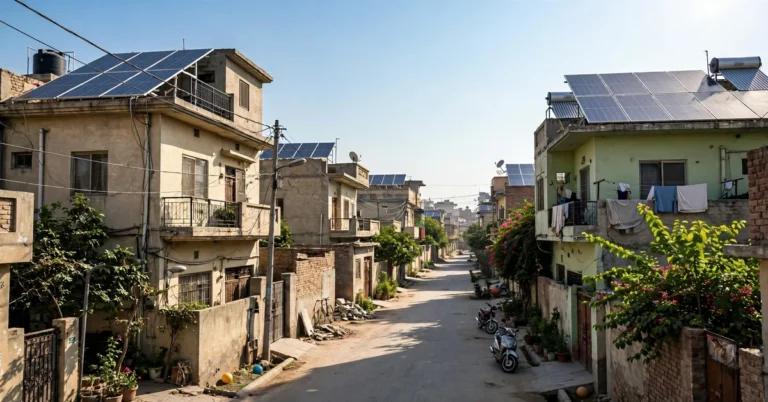
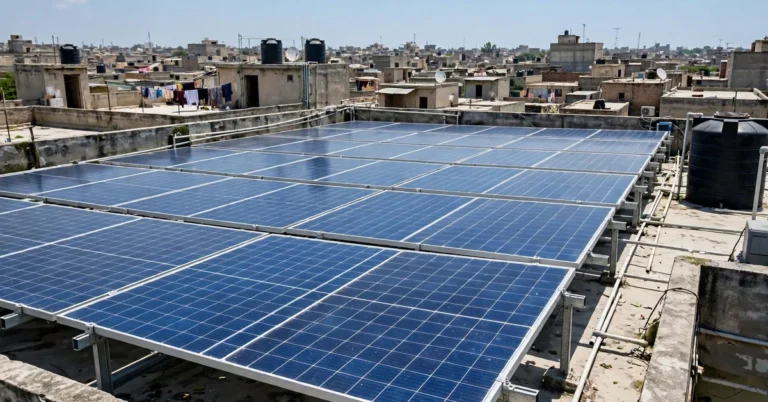
The timing is hard to ignore. Pakistan’s rooftops are already going solar at a record pace, and the government has committed to adding roughly 6,000 MW of photovoltaic solar. The study’s headline finding suggests this momentum is not just good economics — it is the backbone of the country’s climate maths.
The researchers also flag a vulnerability familiar to anyone who has watched Pakistan’s energy bills: the country imports about 88.87% of its fossil fuels from the Gulf region, leaving it exposed to volatile international prices and constant pressure on the import bill. Cutting emissions and cutting fuel imports are, in other words, the same project.
Where Pakistan’s power emissions stand today
The study, by Muhammad Yousaf Raza of the Shandong Technology and Business University, Boqiang Lin of Xiamen University and Qasim Javed of the University of the Punjab, used two established analytical tools: LMDI decomposition, which separates the drivers behind emissions changes, and the LEAP energy-planning model, which projects future scenarios.
Their starting point is stark. In 2024, Pakistan’s electricity sector emitted 155.55 million tonnes of CO2:
| Fuel source | CO2 emissions (million tonnes, 2024) |
|---|---|
| Oil | 65.0 |
| Natural gas | 48.75 |
| Coal | 41.9 |
| Total electricity sector | 155.55 |
The Pakistan Economic Survey 2023-24 records the mix behind those emissions: hydropower 25.4%, nuclear 8.4%, renewables 6.8%, and thermal plants 59.4%. The researchers note the strongest low-carbon growth occurred between 2020 and 2024, driven by mix changes and power projects built under the China-Pakistan Economic Corridor.
During that historical period, renewable electricity from solar, wind and biomass grew by 7.62%. The modelling projects average annual growth of about 0.75% for these sources through 2035.
The 63% figure: how the scenarios work
The researchers modelled three scenarios: business as usual, a low-demand pathway, and a high-demand pathway. The headline result comes from the low-demand scenario, in which emissions fall by 6.45% per year between 2013 and 2035 — even while electricity output keeps growing at 4.34% per year. The cumulative result: a 63.40% reduction in power-sector emissions by 2035, rising to a maximum of 68.551% in the strongest low-carbon configuration.
| Scenario | Modelled outcome by 2035 |
|---|---|
| Business as usual | Continued growth in electricity consumption; thermal share declines as low-carbon sources replace fossil generation |
| Low demand | Emissions fall 6.45% per year to 2035; electricity output still grows 4.34% per year |
| Headline low-carbon result | 63.40% emissions reduction by 2035 |
| Maximum low-carbon configuration | 68.551% emissions reduction |
It is important to read these numbers for what they are: modelled outcomes, not certainties. They are significant because they are calibrated against Pakistan’s actual historical data, including its real emissions drivers and its recent renewables surge — not borrowed assumptions.
What the researchers recommend
The study’s recommendations read like a practical to-do list. First, sustained investment in renewable energy — the variable the modelling identifies as doing the most work. Second, dam reconstruction and water infrastructure: roughly 250 structures are reportedly under consideration, including dams, ponds, spillways and drainage works. Third, better forecasting — using machine-learning techniques to predict renewable output and demand, so the grid can absorb more variable generation without instability.
These recommendations sit alongside existing policy direction. Pakistan has set a target of cutting emissions by 50% by 2030, and the Private Power and Infrastructure Board is facilitating 24 generation projects, of which 22 are renewable. The study’s modelling suggests that this framework, if executed and sustained, could take Pakistan beyond even its own 2030 target in the power sector by 2035.
What it means for solar users
That process is already visible. Households installing rooftop solar with net metering are effectively voting for the study’s low-carbon scenario — each net-metered kilowatt-hour pushes the national mix away from the oil, gas and coal that produced 155.55 million tonnes of CO2 in 2024. Government schemes extending free and subsidised solar panels, from Punjab’s provincial programme to the free solar panel scheme for Gilgit-Baltistan, are pulling the same lever at scale.
For anyone weighing an installation, the economics and the climate argument now point the same way. Grid electricity prices have risen sharply, payback periods on quality systems have compressed, and comparing options like those in our roundup of the best solar panels in Pakistan for 2026 locks in both savings and a share of the emissions cuts the study says are achievable. If your system feeds surplus power back to the grid, our complete net metering guide for 2026 walks through green meters and billing.
There is reassurance in the modelling that deserves emphasis: the low-demand scenario achieves deep emissions cuts while electricity output keeps growing at more than 4% per year. Solar adopters are not being asked to accept a smaller energy system; they are part of a bigger one that emits far less.
FAQs
Can Pakistan really cut power-sector emissions by 63% by 2035?
That is what the modelling finds under the study’s low-demand scenario — a 63.40% reduction, or up to 68.551% in the strongest low-carbon configuration. These are projected outcomes from the LMDI and LEAP models, calibrated on historical Pakistani data, not guarantees. They depend on sustained renewables investment, infrastructure work, and demand management over the next decade.
Why does solar matter so much in the study?
The modelling identifies renewable electricity — solar, wind and biomass — as the variable doing the heavy lifting in every credible low-carbon pathway. Solar is the fastest-growing of these in Pakistan, backed by the government commitment to add about 6,000 MW of photovoltaic capacity and by the rooftop boom already under way.
What are Pakistan’s biggest power-sector emissions sources today?
Oil at roughly 65 million tonnes of CO2 in 2024, followed by natural gas at 48.75 million tonnes and coal at 41.9 million tonnes — 155.55 million tonnes in total. Pakistan imports about 88.87% of its fossil fuels from the Gulf region.
How does this study connect to Pakistan’s 2030 climate target?
Pakistan’s national target is a 50% emissions reduction by 2030. The study’s modelled power-sector cuts — 63.40% by 2035 under the low-carbon pathway — suggest that if renewables policy is executed and sustained, the electricity sector could exceed that ambition. The government is already moving in that direction with the CM Punjab solar panel scheme, extended till December 2026, alongside the 22 renewable projects facilitated by the Private Power and Infrastructure Board.
Conclusion
This study will not surprise anyone watching Pakistan’s energy transition — but it quantifies something that matters. A 63% power-sector emissions cut by 2035 is, on paper, achievable, and the path runs directly through solar and other renewables. The modelling confirms that emissions and electricity output can decouple: more power, much less carbon. It also confirms the economics: every megawatt of domestic solar displaces imported fuel bought at volatile international prices, easing both the climate burden and the import bill.
The caveat is execution. Models do not build panels or pour dam foundations — people and policy do. But Pakistan now has a rigorously modelled number attached to its solar trajectory: 63.40% by 2035, with households’ rooftops doing much of the work.
Source: World Bank — World Bank