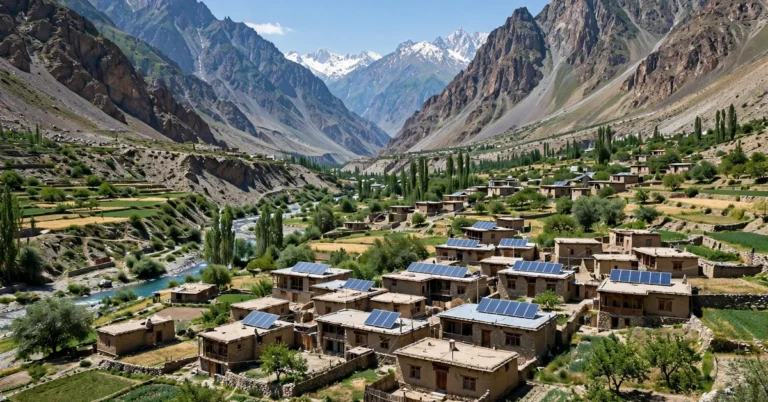
Agriculture remains the backbone of Pakistan’s economy, and in Punjab — the country’s most fertile and productive province — millions of farmers depend on tube wells for irrigation. Rising electricity tariffs, costly and unreliable diesel supply, and frequent power outages have made irrigation steadily more expensive in recent years. The Punjab government’s answer is the CM Punjab Solarization of Tube Wells Program, a flagship initiative converting diesel and electric tube wells to solar-powered systems. In 2026 the programme has entered an advanced implementation phase, and new reporting on its rollout confirms it is now one of the province’s largest clean-energy interventions in agriculture.
This article explains how the scheme works in 2026: the subsidy structure, who is eligible, how farmers can apply, and what the programme means for farming families across Punjab.

Why solarize tube wells?
For decades, Punjab’s irrigation has depended on diesel engines and grid electricity. Both have become costly and unpredictable: escalating fuel prices, inconsistent electricity supply, voltage fluctuations, and load shedding all cut directly into crop productivity and farm income. At the same time, the global cost of photovoltaic panels has fallen sharply while efficiency and lifespan have improved. A solar-powered tube well now offers a reliable, low-maintenance and environmentally friendly alternative — which is exactly the logic the Punjab government used when it designed this large-scale transition.
Pakistan imports billions of rupees’ worth of fuel every year. Every tube well that switches to solar reduces diesel imports, eases pressure on the national grid, and moves the country closer to its renewable-energy targets. The programme also aligns with the national goal of generating 30% of electricity from renewable sources by 2030.
Subsidy structure: 2026 update
The Punjab government has allocated billions of rupees to the programme. After successful pilot phases, the scheme expanded in 2026 with improved vendor management, digital monitoring, and a smoother farmer onboarding process. The subsidy structure remains farmer-friendly:
| System size | Government subsidy |
|---|---|
| 10 kW solar system | Rs. 500,000 |
| 15 kW solar system | Rs. 750,000 |
| 20 kW solar system | Rs. 1,000,000 |
Farmers contribute the remaining cost of the system. This co-financing model is deliberate: shared ownership reduces misuse and encourages owners to maintain their systems properly. In the expanded 2026 phase, over 8,000 tube wells are targeted for solarization, with further phases planned based on groundwater sustainability assessments. If you are considering solar for other purposes on your farm, our 3 kW solar system price guide gives a sense of how system sizing and costs work.
Who is eligible?
To keep distribution transparent and fair, eligibility criteria are strictly defined:
- The applicant must be a permanent resident of Punjab.
- The applicant must own agricultural land, proven by a Fard-e-Malkiat (ownership record).
- Only one tube well per family is allowed.
- Electric tube wells must have three-phase connections installed before the notified cut-off date.
- There must be no outstanding electricity or utility dues against the applicant.
- Groundwater depth must be within operational limits (generally up to 60 feet).
Eligible farmers apply through the official provincial digital portal by submitting verified documents. The programme sits alongside other provincial clean-energy efforts — for instance, Punjab’s 50 MWp rooftop solar tender under the RESCO model, which is currently open for bids, and the province’s free solar panel scheme for households.
How to apply: the application process
The application process is fully online and transparent. Farmers submit:
- CNIC
- Land ownership documents (Fard-e-Malkiat)
- Tube well and electricity connection details
- Recent electricity bills
Applications are verified digitally, followed by a computerized balloting system to ensure fairness. Selected applicants then undergo site surveys and technical feasibility checks, and installation is carried out through government-approved vendors. Monitoring in 2026 has become more structured: each installed system is digitally registered and geo-tagged, and performance is tracked over time.
Training, green jobs and maintenance
A notable feature of the 2026 phase is the investment in people, not just hardware. Working with agricultural universities and renewable energy firms, the Punjab government is expanding farmer training workshops, district-level technical service centres, and solar technician certification programmes. Farmers receive hands-on training in system maintenance, panel cleaning and efficient energy use — generating thousands of green jobs while improving the long-term sustainability of the installations. Similar public-sector solar drives are spreading to other provinces: Khyber Pakhtunkhwa is, for example, converting registered seminaries to solar energy.
Benefits for farmers
Lower costs: eliminating diesel and electricity expenses for irrigation directly raises farm profitability. Reliable water: solar pumping ensures uninterrupted supply during daylight hours, when crops need water most. Cleaner environment: fewer emissions support Pakistan’s climate commitments. Rural modernization: clean-energy adoption brings new skills and employment to rural areas.
Challenges to watch
The programme is not without risks. Zero energy cost can encourage groundwater over-extraction, a genuine concern for Punjab’s aquifers. Administrative coordination delays have affected some districts, and maintenance and spare-parts access remain difficult in remote areas. Subsidy sustainability amid fiscal constraints, and equitable access for small farmers and women landowners, are ongoing concerns. Policy refinements in 2026 are addressing these issues, including smart water-use monitoring, promotion of drip and sprinkler irrigation, and groundwater recharge campaigns.
What it means for 2026 and beyond
By 2026, the CM Punjab Solarization of Tube Wells Program has become a cornerstone of the province’s climate-smart agriculture policy, aligning with UN Sustainable Development Goals 7 (Affordable and Clean Energy) and 13 (Climate Action). Punjab is positioning itself as a regional leader in solar agriculture — a model other provinces and developing countries may follow.
Frequently asked questions
How much subsidy does the programme offer? Rs. 500,000 for a 10 kW system, Rs. 750,000 for 15 kW, and Rs. 1,000,000 for a 20 kW system. The farmer pays the remaining cost.
Who can apply? Permanent Punjab residents who own agricultural land with a Fard-e-Malkiat, have a three-phase tube-well connection, and have no outstanding utility dues — one tube well per family.
How are applicants selected? Through digital verification followed by a computerized balloting system, then site surveys and technical checks.
How many tube wells are covered in 2026? Over 8,000 tube wells are targeted in the expanded 2026 phase, with more phases planned.
For farmers weighing the economics of solar more broadly, our guides to lithium battery prices in Pakistan and current panel rates can help with planning beyond the subsidy window.