Introduction
Choosing solar panels is one of the most important decisions when planning a home solar installation. The panels influence how much electricity your roof can generate, how much space the system needs and what warranty protection you receive.
There is no single solar panel that is best for every UK home. A premium high-efficiency model may be a sensible choice for a small roof, while a competitively priced panel can offer better overall value on a large roof. Warranty terms, the installer, shading, roof direction and the complete installed price also matter.
This guide compares some of the solar panel models and brands appearing in UK residential installations in 2026. It looks at efficiency, power output, product and performance warranties, temperature performance and value. The comparison is based on published specifications and current UK-focused guides, not on independent laboratory testing of every model.
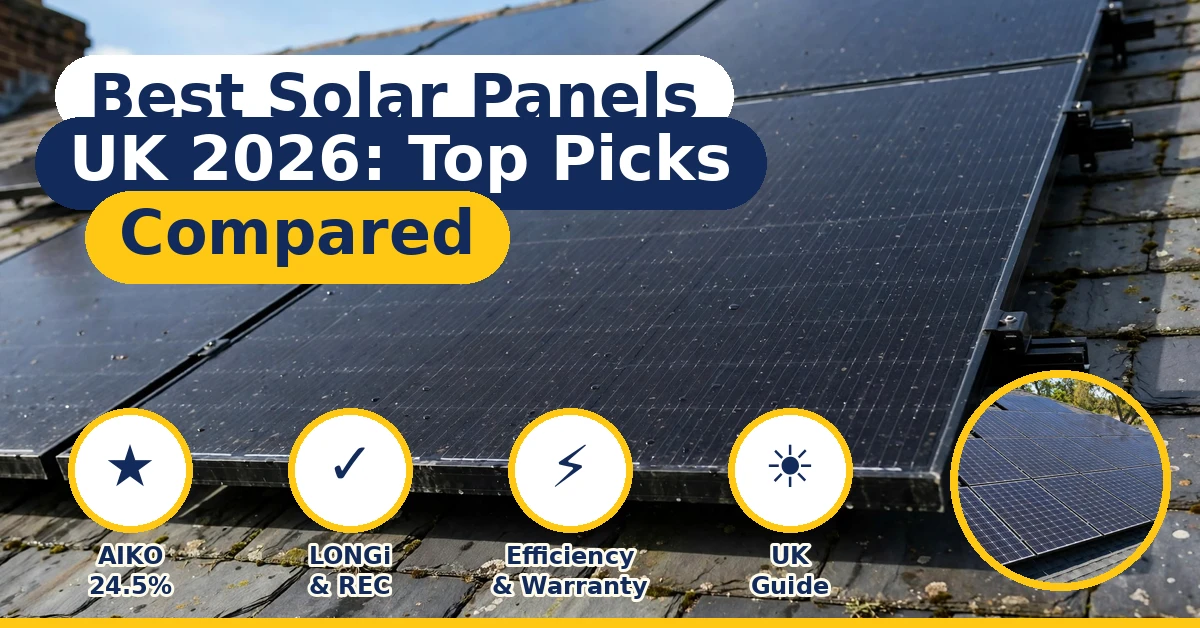
Best Solar Panels in the UK 2026: Quick Picks
| Category | Model or brand to compare | Why consider it? |
|---|---|---|
| Best for limited roof space | AIKO Neostar 3S+ | Very high published efficiency, with selected versions reaching 24.5% |
| Best all-round option | LONGi EcoLife / Hi-MO range | Strong efficiency and long performance warranty options |
| Best value shortlist | JA Solar DeepBlue and DMEGC Infinity | Competitive mainstream specifications; compare installed price |
| Strong mainstream alternative | Jinko Tiger Neo | High efficiency options and long performance warranty |
| Long-term output retention | REC Alpha Pure-RX | Published warranty guarantees 92% output after 25 years |
| Alternative mainstream choice | Trina Vertex S+ | Good efficiency and established UK market presence |
These are shortlist recommendations, not a universal league table. Specifications and warranties can vary by exact model code, wattage, country and date. Always ask for the datasheet and warranty document for the precise panel included in your quotation.
1. AIKO Neostar 3S+: Best for Limited Roof Space
AIKO’s Neostar range is worth considering when roof space is limited and the design needs to generate as much power as possible from each panel. Selected Neostar 3S+ versions are listed with efficiency of up to 24.5%, putting them among the highest-efficiency residential modules in current UK comparisons.
The range uses back-contact cell technology. The 3S+ versions compared in recent UK specification roundups include dual-glass construction and long product and performance warranty terms, although the exact warranty depends on the model code and rated power.
Potential advantages
- Very high published efficiency.
- Useful where the available roof area limits the number of panels.
- Selected 480W-plus versions have a 30-year product warranty and 30-year power warranty.
- Strong published long-term output retention.
Things to check
- Premium panels can increase the equipment cost.
- The 30-year product warranty is not necessarily applicable to every Neostar version.
- Confirm the exact model is listed in the current MCS product directory where MCS certification is needed.
Best suited to: Homes with limited usable roof area, where maximising installed capacity is more important than choosing the lowest panel price.
2. LONGi EcoLife and Hi-MO: Best All-Round Shortlist
LONGi is a major solar manufacturer with several residential panel families. Its newer high-efficiency products, including EcoLife and Hi-MO models, are worth comparing for homeowners looking for a balance of output, efficiency and long-term performance.
Recent UK comparisons list the LONGi EcoLife LR7-54HVBB at up to 23.8% efficiency, with a 30-year product and power warranty under the cited EcoLife warranty terms. The Hi-MO X10 is also commonly featured in UK comparisons, with versions around 485W and efficiency near 23.8%. Warranty terms for Hi-MO products can differ from EcoLife, so do not assume that one model’s warranty applies to another.
Potential advantages
- High efficiency for a mainstream residential panel.
- Several model families and power ratings to compare.
- Selected EcoLife models offer 30-year product and performance warranties.
- Good candidate for a like-for-like comparison with AIKO, Jinko and Trina.
Things to check
- Product warranty length can vary significantly between LONGi ranges.
- Confirm the exact model’s degradation schedule and final-year power guarantee.
- Compare the complete system price, not just the panel price.
Best suited to: Homeowners wanting a high-performance panel from an established manufacturer, provided the quoted model has suitable warranty terms.
3. REC Alpha Pure-RX: Best for Warranted Output Retention
REC’s Alpha Pure-RX is a premium option to consider when long-term output retention is a priority. Published specifications cited in UK comparisons give the panel a power warranty of 25 years and a guarantee of 92% of rated output at the end of that period.
Some REC warranty benefits depend on using an REC-certified installer and registering the installation. The standard product warranty and any enhanced warranty should be checked separately. Do not assume that every installer can provide the same labour or product cover.
Potential advantages
- Strong published output-retention guarantee.
- Heterojunction cell technology.
- Premium residential product positioning.
- May appeal to homeowners who value long-term warranty protection.
Things to check
- Confirm the exact product warranty and registration conditions.
- Check whether enhanced labour cover applies to the installer you choose.
- Compare the premium with the expected benefit for your roof and electricity use.
Best suited to: Buyers who place a high value on documented long-term output retention and can verify the warranty conditions.
4. Jinko Tiger Neo: Best Mainstream Alternative
JinkoSolar’s Tiger Neo range is widely seen in residential solar comparisons. Newer versions use n-type TOPCon cell technology and are available in different power ratings. A recent UK comparison lists the Tiger Neo 3.0 460–485W family with top efficiency of up to 24.3%, although the exact version and MCS listing should be checked.
The cited European warranty for the Tiger Neo 3.0 specifies 25 years of product cover and 30 years of performance cover for the relevant models. Older Tiger Neo products may have different specifications and warranty terms.
Potential advantages
- High-efficiency versions are available.
- A broad product range and established international manufacturer.
- Selected models offer 25-year product and 30-year performance warranties.
- Worth including in quotes for a mainstream high-output system.
Things to check
- Do not apply the latest Tiger Neo 3.0 specifications to older Tiger Neo models.
- Verify the European warranty edition and exact model code.
- Compare the price per installed kWp.
Best suited to: Homeowners seeking a modern mainstream panel and a useful alternative to LONGi, Trina and JA Solar.
5. JA Solar DeepBlue: Best Value Shortlist
JA Solar’s DeepBlue family is a common name in residential solar quotations. It offers a range of panel sizes and technologies, so the exact model matters. Recent UK comparisons include DeepBlue 4.0 Pro models with efficiency around 23% at the top end of the listed range.
JA Solar can be attractive where a homeowner wants to keep the equipment budget under control without automatically choosing a low-specification product. However, product warranty terms have changed across models and warranty editions. Check the current UK or European warranty for the panel being quoted.
Potential advantages
- Competitive option for price-conscious installations.
- Several residential model options.
- Modern versions offer strong published efficiency.
- Can be a useful benchmark when comparing installer quotations.
Things to check
- Product warranty can be shorter than some premium alternatives, depending on model and warranty edition.
- Confirm the exact power warranty and annual degradation rate.
- Compare panel dimensions and total roof layout, not only wattage.
Best suited to: Buyers who want a competitive installed price and are comparing complete system specifications carefully.
6. Trina Solar Vertex S+: Best Established Mainstream Option
Trina Solar’s Vertex S+ range is another panel family to include when requesting UK solar quotations. Recent product information lists versions with efficiency up to approximately 23.8%, depending on the model and wattage.
Warranty terms need particular attention. European warranty supplements and global datasheets may not offer identical product warranty periods. Ask the installer to provide the warranty document that applies to the exact product supplied in the UK.
Potential advantages
- High-efficiency residential options.
- Dual-glass construction on relevant versions.
- Established manufacturer with a broad international presence.
- Useful alternative for comparing price and performance.
Things to check
- Confirm whether the quoted model receives 15 or 25 years of product cover under the applicable regional warranty.
- Check the exact power warranty and degradation schedule.
- Confirm model availability and current MCS status.
Best suited to: Homeowners who want another established mainstream brand in their quotation comparison.
7. DMEGC Infinity: Worth Comparing for Value
DMEGC’s Infinity range appears in recent UK panel comparisons as a competitive option. The Infinity RT models cited in a 2026 comparison reach approximately 23.5% efficiency, with a 25-year product warranty and 30-year performance warranty for the specified model.
As with every manufacturer, the exact datasheet and warranty are more important than the brand name alone. Compare the total price per kWp and the installer support available for the product.
Potential advantages
- Competitive published specifications.
- Useful price comparison against other n-type residential panels.
- Selected models have 25-year product and 30-year performance cover.
- A reasonable candidate for a value-focused shortlist.
Things to check
- Confirm the exact model and power rating.
- Check the manufacturer’s warranty provider and claim process.
- Verify MCS product listing where relevant.
Best suited to: Homeowners looking for a value-focused alternative to better-known mainstream panel families.
Solar Panel Comparison Table: UK 2026

The table below summarises selected models and model families from current UK-focused comparisons. It is not a controlled test ranking. Figures refer to particular versions and should not be assumed to apply to every panel sold under the same brand.
| Brand and model family | Published efficiency (selected versions) | Warranty notes | Main reason to compare |
|---|---|---|---|
| AIKO Neostar 3S+ | Up to 24.5% | Selected 480W-plus versions: 30-year product and power warranties | High efficiency |
| LONGi EcoLife LR7-54HVBB | Up to 23.8% | Cited EcoLife terms: 30-year product and power warranties | Long warranty option |
| LONGi Hi-MO X10 | Around 23.8% | Check exact model; some comparisons list 15-year product and 30-year power cover | All-round performance |
| Jinko Tiger Neo 3.0 | Up to 24.3% | Cited European terms for selected versions: 25-year product and 30-year power cover | Mainstream high efficiency |
| REC Alpha Pure-RX | Around 22.8% in cited datasheet comparison | 20-year product / 25-year power standard; enhanced terms may require certified installer and registration | Output retention |
| JA Solar DeepBlue 4.0 Pro | Up to around 23.0% | Check current warranty edition and exact model | Value shortlist |
| Trina Vertex S+ | Up to around 23.8% | Regional product warranty can differ; verify UK terms | Established alternative |
| DMEGC Infinity RT | Up to around 23.5% | Cited model: 25-year product / 30-year power | Value comparison |
What Do Solar Panel Efficiency Figures Mean?
Efficiency measures the proportion of sunlight falling on a panel that is converted into electricity under standard test conditions. A panel with higher efficiency can produce more power from a given roof area, assuming comparable conditions.
For a roof with plenty of usable space, a slightly less efficient panel may still provide excellent value if it costs less. For a small roof, higher efficiency can help fit more generation capacity into the available area.
Efficiency alone does not tell you how much electricity the system will generate in your home. Orientation, pitch, shading, temperature, inverter design and local weather all affect real-world output.
What Should You Compare Before Buying Solar Panels?
1. Product Warranty
The product warranty covers defects in materials or workmanship, subject to the manufacturer’s terms. It is different from a performance warranty. Check the warranty duration, exclusions, who provides the cover and what happens if the manufacturer or UK distributor changes.
2. Performance Warranty
The performance warranty sets out the minimum power output the manufacturer guarantees over time. Look at the guaranteed percentage at year 25 or year 30 and the degradation schedule, not just the headline warranty length.
3. Temperature Coefficient
Solar panels can produce less power as their cell temperature rises. The temperature coefficient indicates how output changes as temperature increases above the standard test reference. A less negative coefficient is generally preferable, all else being equal, but it should not outweigh price, warranty and roof design.
4. Panel Size and Weight
A high-wattage panel is not automatically the best fit. Larger panels may be harder to position around roof windows, chimneys and other obstacles. Check dimensions, weight and the roof’s structural suitability with the installer.
5. Shading and Roof Layout
A panel’s published efficiency does not remove the effect of shade. Trees, chimneys and nearby buildings can reduce output. Ask for a roof layout and shading assessment, and check whether optimisers or microinverters are appropriate.
6. Manufacturer and Warranty Support
A long warranty is only useful if the warranty provider can honour it and the claim process is clear. Ask who handles a claim, whether labour and removal costs are covered, and whether registration is required.
7. MCS Product Listing and Installer Certification
If you want access to an export tariff under the Smart Export Guarantee, the installation generally needs to meet the applicable eligibility requirements. In Great Britain, this commonly means an MCS-certified installation or an accepted equivalent route. MCS-certified installers must use products that meet the relevant scheme requirements. Check the exact panel model code in the current MCS product directory and confirm the installer’s current certification.
Are Premium Solar Panels Worth the Extra Cost?
Premium panels can be worthwhile when roof space is restricted, when a particular warranty is valuable, or when the design benefits from higher power density. They are not automatically the best financial choice.
For example, if a roof has enough space for a lower-cost panel system to meet the household’s needs, paying more for a small efficiency improvement may not produce enough additional electricity to justify the premium. On a compact roof, the same improvement could allow a larger system capacity and be more valuable.
Ask the installer to price two options: a premium panel and a good-value mainstream panel. Compare the total installed cost, expected annual generation, system capacity, warranty terms and estimated savings.
Which Solar Panels Are Best for Different UK Homes?
Small Roof or Limited Panel Space
Prioritise efficiency, panel dimensions and the number of modules that fit around roof obstructions. AIKO Neostar 3S+ and selected LONGi or Jinko high-efficiency models are worth comparing.
Large Roof With Plenty of Space
Focus on total installed price, warranty quality and expected generation. JA Solar, DMEGC, Trina, Jinko and LONGi models may all be worth considering.
Homeowner Focused on Long-Term Warranty
Compare the exact warranty documents from LONGi EcoLife, selected AIKO Neostar 3S+ models and REC. Look closely at the difference between product cover, power cover and labour cover.
Budget-Conscious Installation
Ask for quotes using a reputable mainstream panel such as a suitable JA Solar, DMEGC, Jinko or Trina model. A lower panel price is only a good deal if the complete installation, warranty and installer support are sound.
Common Solar Panel Buying Mistakes
- Choosing by brand name alone: Model specifications and warranties can differ within the same brand.
- Comparing only panel wattage: Panel dimensions, efficiency and roof layout also matter.
- Assuming every warranty is 25 or 30 years: Product and performance warranties are separate.
- Ignoring the installer: Design, workmanship, electrical protection and aftercare are essential.
- Believing a high efficiency figure guarantees high savings: Household usage, shading and tariffs affect the financial result.
- Not checking the exact model code: A similar model name may have different specifications or certification status.
- Accepting an unrealistic generation forecast: Ask for the assumptions behind the estimate and compare it with your roof details.
Frequently Asked Questions
Which solar panel brand is best in the UK in 2026?
There is no single best brand for every home. AIKO is worth considering for high efficiency, LONGi for selected high-warranty models, REC for strong warranted output retention, and Jinko, JA Solar, Trina and DMEGC for mainstream comparisons. The exact model and warranty matter more than the logo.
What are the most efficient solar panels in the UK?
Recent UK comparisons list selected AIKO Neostar 3S+ models at up to 24.5% efficiency. Other high-efficiency options include selected Jinko Tiger Neo and LONGi models. Check the exact model datasheet because efficiency varies by wattage and product version.
Are LONGi solar panels good?
LONGi is a major manufacturer with several residential panel ranges. Some newer models offer high efficiency and strong performance warranties. However, warranty periods differ between EcoLife, Hi-MO and other products, so review the exact model documentation.
Are REC solar panels worth the money?
REC Alpha Pure-RX panels may appeal to buyers who value long-term output retention. The cited warranty guarantees 92% of rated output after 25 years, but enhanced product or labour cover can depend on installer certification and registration. Compare the premium with other quotations.
Are Jinko solar panels suitable for UK homes?
Jinko Tiger Neo models are included in UK residential comparisons and offer modern high-efficiency options. Confirm the model generation, European warranty, product listing and installer support before choosing.
How long do solar panels last?
Solar panels are designed to operate for decades, and many manufacturers provide performance warranties lasting 25 or 30 years. A warranty is not a promise that a panel will stop working when the period ends. Actual service life depends on product quality, installation and operating conditions.
Should I buy the highest-wattage solar panel?
Not necessarily. Higher wattage may come from a physically larger panel rather than better efficiency. Compare watts, dimensions, efficiency and how many panels can fit safely on your roof.
Do I need MCS-certified solar panels?
The relevant requirement is that the installation and products meet the scheme or export-tariff eligibility rules. If you plan to use the Smart Export Guarantee, ask your installer to confirm the certification route and verify the exact product and installer details.
Conclusion
The best solar panels in the UK in 2026 depend on your roof, budget and priorities. AIKO Neostar 3S+ is a strong option to investigate when roof space is limited. LONGi EcoLife, Jinko Tiger Neo, Trina Vertex S+, JA Solar DeepBlue and DMEGC Infinity provide useful mainstream comparisons. REC Alpha Pure-RX is worth considering if long-term warranted output retention is especially important.
Before choosing, compare at least three complete installation quotations. Check the precise panel model, product and performance warranties, MCS listing where relevant, expected generation and total installed cost. A well-designed system installed by a competent, properly certified installer is more important than choosing a panel solely because it has the highest efficiency figure.
Sources and Further Reading
- The Solar Report – Best Solar Panels UK 2026: Nine Models Compared — model-level specifications and warranty comparisons, updated October 2026.
- Which? – Best Solar Panel Brands — brand information and consumer testing context.
- Home Energy Quotes – Best Solar Panel Brands UK 2026 — published specifications, warranty notes and UK market comparisons.
- The Independent – Best Solar Panels for UK Homes 2026 — comparison methodology and model shortlist.
- Heatable – Best Solar Panels UK 2026 — technical comparison of selected panel families.
- MCS Certified — installer and product scheme information.
Specifications and warranty terms can change. Always request the current datasheet and warranty document for the exact model quoted. This article compares published specifications and does not claim that every listed panel has been independently laboratory-tested.



4 Comments