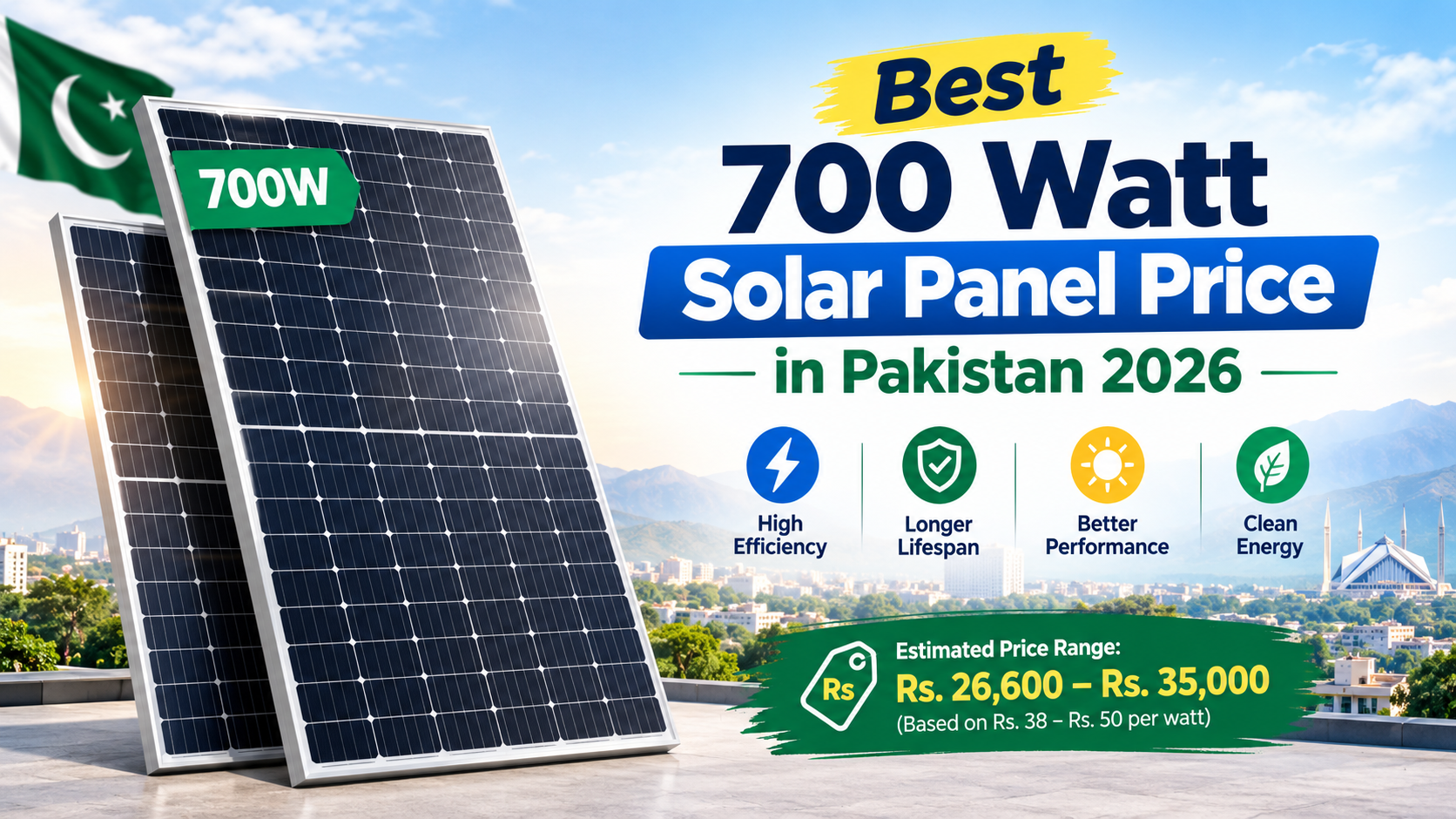
Large solar panels are taking over the Pakistani market, and the 700 watt solar panel price in Pakistan is now one of the most searched numbers among home and business buyers. A single 700W module produces as much as two older 350W panels, so you need fewer plates, fewer mounting parts and less roof space. That is great news if your roof is small or your installer charges per panel for labour.
In this guide we cover the latest approximate rates, the brands that sell in this class, real energy output, pros and cons, a worked example and practical buying tips. Read it before you place your order, and you will avoid the most common mistakes.
EXTRADIONARY SUMMARY
Table of Contents
What Is a 700 Watt Solar Panel?
A 700 watt solar panel is a high-capacity module that delivers up to 700 watts of power under standard test conditions. Most panels in this class use newer cell technology such as N-type TOPCon or HJT, and many are bifacial, which means the back side can also collect reflected light.
Why this size is becoming popular
- Fewer panels are needed for the same system size, which simplifies wiring.
- Less roof area is used, which helps on crowded city rooftops.
- Per-watt prices are often close to smaller panels, so you gain power without a big premium.
Technology you will see on the datasheet
N-type cells generally lose less power over the years and handle heat better than older P-type cells. TOPCon and HJT are two ways of building N-type cells. Both are common in 700W modules, and both are designed for high efficiency and a long service life.
700 Watt Solar Panel Price in Pakistan 2026
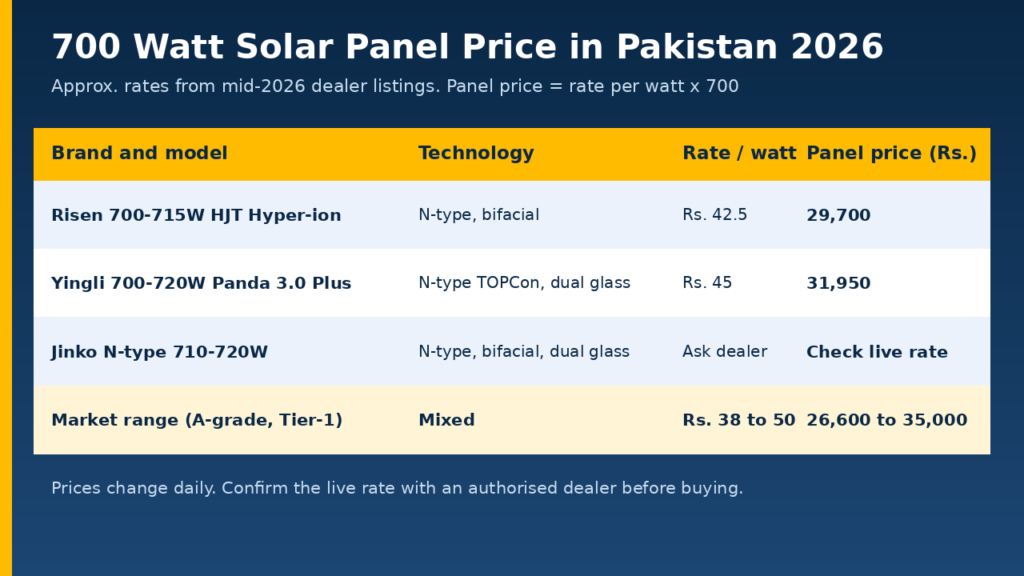
Solar panels are sold per watt in Pakistan, so the easiest way to find the price of a 700W panel is to multiply the per-watt rate by 700. Dealer lists in mid-2026 showed A-grade Tier-1 panels in a wide band of roughly Rs. 38 to Rs. 50 per watt, depending on brand, technology and stock. Applied to a 700W module, that puts one panel at about Rs. 26,600 to Rs. 35,000.
| Brand and model | Technology | Rate per watt | Approx. panel price (Rs.) |
| Risen 700 to 715W HJT Hyper-ion | N-type, bifacial | Rs. 42.5 | 29,700 |
| Yingli 700 to 720W Panda 3.0 Plus | N-type TOPCon, dual glass | Rs. 45 | 31,950 |
| Jinko N-type 710 to 720W | N-type, bifacial, dual glass | Ask dealer | Check live rate |
| Market range (A-grade, Tier-1) | Mixed | Rs. 38 to 50 | 26,600 to 35,000 |
A quick way to calculate the price
Take the rate per watt and multiply by 700. At Rs. 42.5 per watt, the maths is 42.5 x 700 = Rs. 29,750. Some listings round this to Rs. 29,700. If a dealer quotes a much lower figure, ask why. It may be a B-grade or undocumented panel.
Factors That Change the 700W Panel Price
Brand and tier
Well-known Tier-1 brands usually cost more because of stronger warranties, bankability and better quality control. Lesser-known names can be cheaper, but you must check the datasheet and warranty terms carefully.
Grade and documentation
A-grade panels come with proper documentation and warranty. B-grade panels are cheaper, but they may have cosmetic or performance issues and weaker paperwork. For a 25-year investment, the small saving rarely feels worth it.
Technology and glass type
Bifacial dual-glass N-type modules usually cost more than single-glass or P-type panels, but they can give better yield and a longer life.
Exchange rate, freight and demand
Solar panels are imported, so the dollar rate, shipping and customs duties all affect the final rate. Some dealer lists also noted a market increase earlier this year, which shows how quickly rates can shift.
How Much Electricity Does a 700W Panel Produce?
Panel wattage is a peak figure, not a daily output. A simple estimate uses peak sun hours. Assuming about 5 peak sun hours a day and roughly 80 percent real-world efficiency after losses from heat, dust and wiring, one 700W panel gives:
| Step | Result |
| Peak output x sun hours | 700W x 5 hours = 3.5 kWh per day |
| After about 20 percent losses | About 2.8 kWh per day |
| Monthly estimate | About 84 units per month |
These numbers are estimates. Real output depends on your city, tilt angle, shading, season and cleaning habits, but the method gives you a solid starting point.
Pros and Cons of 700 Watt Solar Panels
Pros
- Higher power from a single panel, so fewer panels are needed.
- Less wiring, fewer connectors and a cleaner installation.
- Modern N-type cells offer good efficiency and slower degradation.
- Bifacial designs can add extra energy on reflective surfaces.
- Often a good value per watt compared with smaller modules.
Cons
- Panels are large and heavy, so handling needs two careful people.
- A broken or shaded panel affects a bigger share of your system.
- Not every roof structure or inverter is ready for such high-power modules.
- Rates change often, and low prices may hide B-grade stock.
700W vs 550W vs 600W Panels: Which Size Is Smarter?
Many buyers wonder whether the jump to 700W is worth it. The answer depends on your roof, your inverter and your budget. This simple comparison shows the main differences.
| Point | 550W panel | 600W panel | 700W panel |
| Panels for 5.6 kW | About 10 | About 9 to 10 | 8 |
| Roof space | Highest | Medium | Lowest |
| Wiring and clamps | Most | Medium | Least |
| Handling | Easier | Medium | Heavier, needs care |
| Best for | Small roofs, old inverters | General use | Fewer panels, modern inverters |
If your inverter and structure are ready, 700W panels usually make installation simpler. If you already own an older inverter with a low voltage limit, check compatibility first, because a mismatch can waste the benefit of larger panels.

Are 700W Panels Suitable for Pakistan’s Weather?
Heat
Summer temperatures in many cities push panel surfaces far above air temperature, and every panel loses some output in the heat. N-type modules generally handle high temperatures better, so check the temperature coefficient on the datasheet. A lower number is better.
Dust and storms
Dust is a daily reality across Punjab, Sindh and Balochistan. Dual-glass modules are strong and durable, but they still need regular cleaning. Make sure the frame is firmly clamped, because large panels catch more wind during storms.
Hail and heavy rain
Check the panel’s mechanical load and hail ratings in the datasheet, especially in northern and hilly areas. A good structure, correct tilt and proper earthing protect your investment through the monsoon season.
Smart Buying Tips for 700W Solar Panels
- Ask for A-grade proof: get the invoice, serial numbers and warranty document.
- Read the datasheet: check voltage, current, dimensions and temperature coefficient.
- Match your inverter: confirm the MPPT voltage and current limits support these panels.
- Compare per-watt, not per-panel: this is the fairest way to judge two different wattages.
- Inspect on delivery: look for cracks, scratches or frame damage before signing.
- Plan the structure: large panels need strong mounting and good wind resistance.
Installation and Care Tips
Because 700W panels are bigger than older models, ask your installer to use a sturdy galvanised or aluminium structure, tight clamps and proper earthing. Keep a small gap between rows to avoid shading and to allow airflow.
Clean the surface with soft water and a non-abrasive brush every few weeks, especially after dust storms. Dirty glass can quietly cut output, and regular cleaning is the cheapest way to protect the 700 watt solar panel price you have paid.
Final Verdict
The 700 watt solar panel price in Pakistan in 2026 generally falls between Rs. 26,600 and Rs. 35,000 per panel, depending on brand, grade and technology. For homes and shops that want high power with fewer panels, 700W modules are an excellent choice. Just remember to buy A-grade stock, compare per-watt rates, confirm inverter compatibility and check the live price before paying.
For the latest national trend, see October 2026 solar panel prices as winter demand pushes rates higher.
Frequently Asked Questions (FAQs)
Q1. What is the 700 watt solar panel price in Pakistan?
In mid-2026, a 700W panel generally costs about Rs. 26,600 to Rs. 35,000, based on Rs. 38 to Rs. 50 per watt. Listed examples include Risen at about Rs. 29,700 and Yingli at about Rs. 31,950. Always confirm the live rate.
Q2. How much electricity does a 700W panel produce daily?
With around 5 peak sun hours and typical losses, a 700W panel produces about 2.8 kWh per day, or roughly 84 units per month. Actual output depends on location, tilt, shading and cleaning.
Q3. How many 700W panels do I need for a 5 kW system?
Seven panels give 4.9 kW and eight panels give 5.6 kW, so either is close to a 5 kW system. Your inverter size and roof space decide the best number.
Q4. Is a 700W panel better than a 550W panel?
A 700W panel gives more power per module, so you need fewer panels and less wiring. However, it is larger and heavier, and your inverter and structure must support it. Compare the per-watt price too.
Q5. Are 700W panels A-grade or B-grade?
Both can exist in the market. A-grade panels come with documentation and warranty, while B-grade stock is cheaper but riskier. Ask for the invoice, serial numbers and warranty before you buy.