
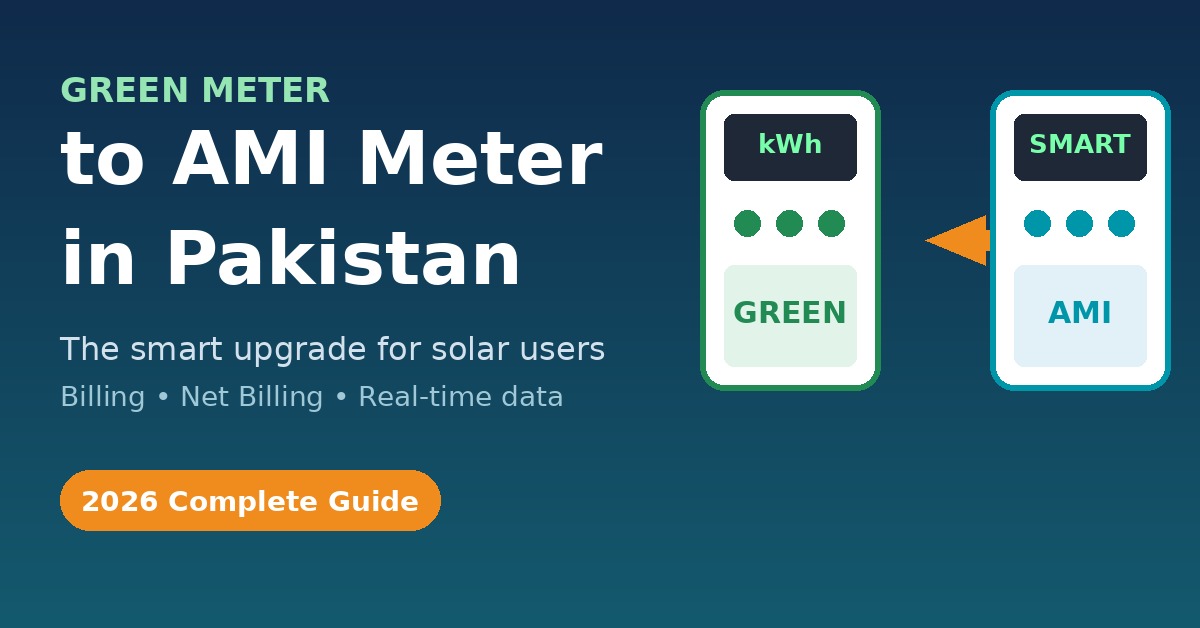
If you run a solar system at home, in your shop or at a small factory, you have probably heard the phrase green meter to AMI meter in Pakistan from your DISCO, your solar installer or a neighbour who just went through it. The old green meter is slowly making way for the AMI meter, a smart meter that reads itself, reports to the utility and keeps an accurate record of every unit you import and export.
The change naturally raises questions. Will the AMI meter cost you money? Will your net metering agreement survive? Is an AMI meter better than a green meter for solar users? In this guide we answer all of that in plain language, with the latest 2026 context, a real-life example, a simple step-by-step process and five FAQs.
COMPLETE SUMMARY
Table of Contents
Green Meter to AMI Meter in Pakistan: What Is the Difference?
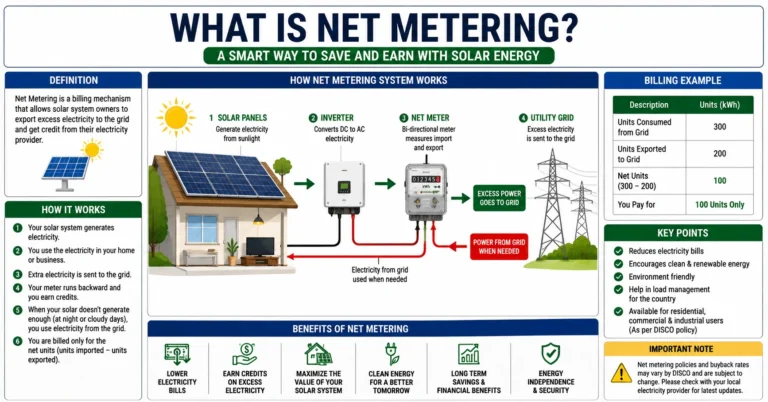
A green meter is the popular name for the bi-directional meter that DISCOs install for net metering customers. Unlike a normal meter, it counts electricity in two directions: the units you take from the grid and the surplus solar units you send back. The net metering policy that started in 2015 made this meter the heart of on-grid solar in Pakistan.
For years the green meter did its job well. Its weakness was everything around it. Readings often depended on a meter reader or a photo, data reached you only through your monthly bill, and disputes over export units were hard to settle because you had no daily record of your own.The shift from green meter to AMI meter in Pakistan is designed to make solar electricity measurement more digital, transparent, and easier to monitor.
What Is an AMI Meter?
AMI stands for Advanced Metering Infrastructure. An AMI meter is a digital smart meter that talks to your electricity company on its own. Nobody needs to knock on your door, climb a ladder or squint at a dial. The meter measures your usage and sends it to a control center through a communication network. In IESCO’s rollout, for example, data travels through power line communication rather than home Wi-Fi.
How an AMI Meter Works
The meter records your consumption and, on solar connections, your export as well. It transmits those readings to the DISCO’s control center, where the billing system picks them up automatically. Many AMI meters also let consumers view usage through a mobile app, which is something a traditional green meter never offered.This is one of the main differences in the Green Meter to AMI Meter in Pakistan transition, as meter data can be collected and transmitted digitally.

Why Pakistan Is Moving From Green Meter to AMI Meter in Pakistan
The shift is not only about solar. It is part of a wider push to digitize electricity distribution. The move from Green Meter to AMI Meter in Pakistan is part of this broader effort to modernize electricity metering and improve digital monitoring.Here are the main reasons behind the green meter to AMI meter transition in Pakistan.
Fewer Billing Disputes
Overbilling and wrong readings are among the most common complaints against DISCOs. Automatic readings take the human hand out of the process, which the government says will improve transparency.
Remote Monitoring for DISCOs
With AMI, a DISCO can see faults, outages and unusual consumption from its control center. It can respond faster and does not have to wait for a customer to call.
Lower Theft and Line Losses
Smart meters make tampering easier to spot. Since line losses raise costs for honest consumers too, better monitoring helps the whole system.
Better Data for Solar Owners
Solar users benefit directly. When you can see how many units you import and export, it becomes far easier to check your bill and adjust your habits.
Benefits of an AMI Meter for Solar Users
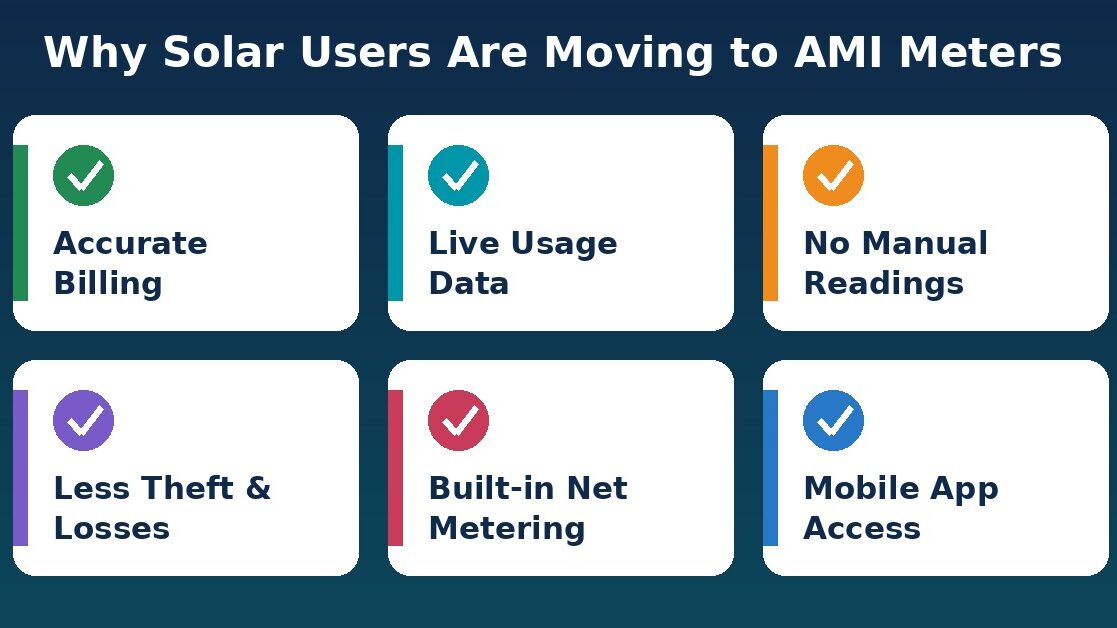
- Accurate billing: readings arrive automatically, so there is less room for estimation or clerical mistakes.
- Clear usage data: you can spot high-consumption hours and shift heavy appliances to sunny hours.
- Built-in net metering: one smart meter handles both import and export.
- Faster problem detection: unusual drops in export can hint at dirty panels or an inverter issue.
- Fewer visits: no waiting for a meter reader and no arguments about a missed reading.
- For solar owners: the Green Meter to AMI Meter in Pakistan transition can make electricity usage and export data easier to monitor.
How Much Does a Green Meter to AMI Meter Switch Cost?
There is no single national price. Reported figures vary widely by DISCO, meter model and timing, from roughly Rs 18,000 to well above Rs 50,000. In late 2025, Dawn reported that some Islamabad solar users were told to pay Rs 52,000 for a new meter, and IESCO later said the implementation was on hold until a clear policy arrived.
The lesson is simple. Do not pay any amount on a verbal request. Ask for a written demand notice and pay only through the official challan.
Green Meter to AMI Meter in Pakistan: Step-by-Step Process
Step 1: Read Your Current Agreement
Find your net metering agreement and note its start date, expiry date and buyback terms. You will want these on hand if there is any confusion later.This is an important first step when moving from a green meter to an AMI meter in Pakistan.
Step 2: Contact Your DISCO
Visit your sub-division office or call the helpline. Ask whether your area is in the AMI rollout and whether your green meter is due for replacement. Your DISCO can also confirm whether the green meter to AMI meter transition in Pakistan has started in your area.
Step 3: Ask for a Written Demand Notice
If a charge applies, request it in writing with the amount, the reason and the payment method. This protects you from informal demands.
Step 4: Pay Through the Official Challan
Pay at the bank listed on the challan and keep the receipt safe. Photograph it as a backup.
Step 5: Meter Installation
The DISCO team replaces the meter. Note the old meter’s final reading and the new meter’s opening reading in the presence of the staff, and take a photo of both.
Step 6: Verify Everything
Check your next bill carefully. Compare import and export units with your inverter’s own monitoring. If you find a mismatch, file a complaint with your DISCO straight away.This final check helps ensure that the transition from a green meter to an AMI meter in Pakistan has not affected your recorded import or export units
Green Meter to AMI Meter: Pros and Cons
No upgrade is perfect, and the green meter to AMI meter switch is no exception. Here is an honest look at both sides so you can decide with a clear head.
Pros of Switching to an AMI Meter
- More accurate billing: automatic readings reduce human error and estimated bills.
- Better visibility: you can track import and export units instead of waiting for the monthly bill.
- Net metering built in: one smart meter handles both directions, as the Power Minister has stated.
- Faster complaint handling: the DISCO can see faults and outages from its control center.
- Fewer disputes: a digital record makes it easier to prove your export units.
- Future-ready: the government is rolling AMI out nationwide, so your connection stays in line with the system.
Cons of Switching to an AMI Meter
- Possible cost: some DISCOs have asked consumers to pay for the new meter, even though many had already bought a green meter earlier.
- Unclear policy: the rules for replacing existing green meters have differed by DISCO, and some replacements were put on hold.
- No change in buyback rate: the meter does not improve what you earn for surplus units. Rates come from your agreement and NEPRA’s net billing rules.
- Contract confusion: if your agreement is close to expiry, renewal may fall under the new five-year net billing structure.
- Dependence on communication networks: remote reading works only when the data link is healthy, so early teething problems are possible.
- Waiting time: installation depends on meter stock and DISCO staff, which can cause delays.
- Data privacy questions: detailed usage data is stored by the utility, and consumers should know how it is used.
Illustrative Example — Not a Verified Customer Case: Green Meter to AMI Meter Upgrade in Lahore
Here is a typical situation, based on the kind of experience many solar owners describe. Kamran, a shop owner in Lahore, installed an 8kW on-grid system in 2022 and got a green meter. For two years he trusted the monthly bill without a second thought. Every so often the export units looked lower than his inverter suggested, but he had no way to prove it.
When his DISCO sent word that his area was moving to AMI meters, Kamran did three things. He asked for the demand notice in writing. He confirmed in writing that his existing agreement would continue until its expiry date. And he photographed the old meter’s reading before the swap.
After the new meter went in, he compared the DISCO’s daily figures with his inverter app. In the second month he noticed export dropping on clear days. It turned out that dust had built up on the panels after a dry spell. A quick cleaning brought the numbers back. With the old setup, he would have found out only when the bill arrived.
The story carries a real-world warning too. As noted earlier, some IESCO consumers reported demand notices of Rs 52,000 with no clear policy behind them. Kamran’s habit of putting everything in writing is exactly what protects a consumer in that kind of confusion.
Final Thoughts: Is the Green Meter to AMI Meter Switch Worth It?
For most solar owners, the answer is yes, with one condition: stay informed and keep your paperwork tidy. The AMI meter in Pakistan brings more accurate billing, real usage data and a smoother link between your solar system and the grid. What it does not do is change your buyback rate on its own. That part depends on your agreement and NEPRA’s regulations.
If your DISCO has already contacted you about the green meter to AMI meter in Pakistan transition, do not panic and do not rush a payment.Ask questions, get everything in writing and treat the upgrade as what it should be: a modern tool that puts you in better control of your electricity.
Frequently Asked Questions (FAQs)
1. Is it compulsory to replace a green meter with an AMI meter in Pakistan?
The government is pushing AMI meters nationwide, with officials targeting December 2026 for the wider rollout. However, how existing green meter consumers are handled has varied by DISCO, and in Islamabad the replacement was reportedly put on hold pending policy. Confirm your own status with your DISCO.
2. Will I lose my net metering agreement after switching to an AMI meter?
The meter change alone does not cancel your agreement. Existing prosumers continue under their current contracts until expiry, and renewals fall under the 2026 net billing rules. Ask your DISCO to confirm this in writing.
3. How much does an AMI meter cost in Pakistan?
There is no fixed national price. Reported amounts range from about Rs 18,000 to over Rs 50,000 depending on the DISCO, the model and the time. Always request an official demand notice.
4. Is an AMI meter better than a green meter for solar users?
For data and accuracy, yes. An AMI meter reads automatically, offers detailed usage records and has net metering built in. It does not, however, change the rate at which your surplus power is bought.
5. How long does the green meter to AMI meter replacement take?
It depends on your DISCO and how many meters are in stock. Many consumers report anything from a few days to a couple of weeks after the paperwork and payment are complete.




One Comment