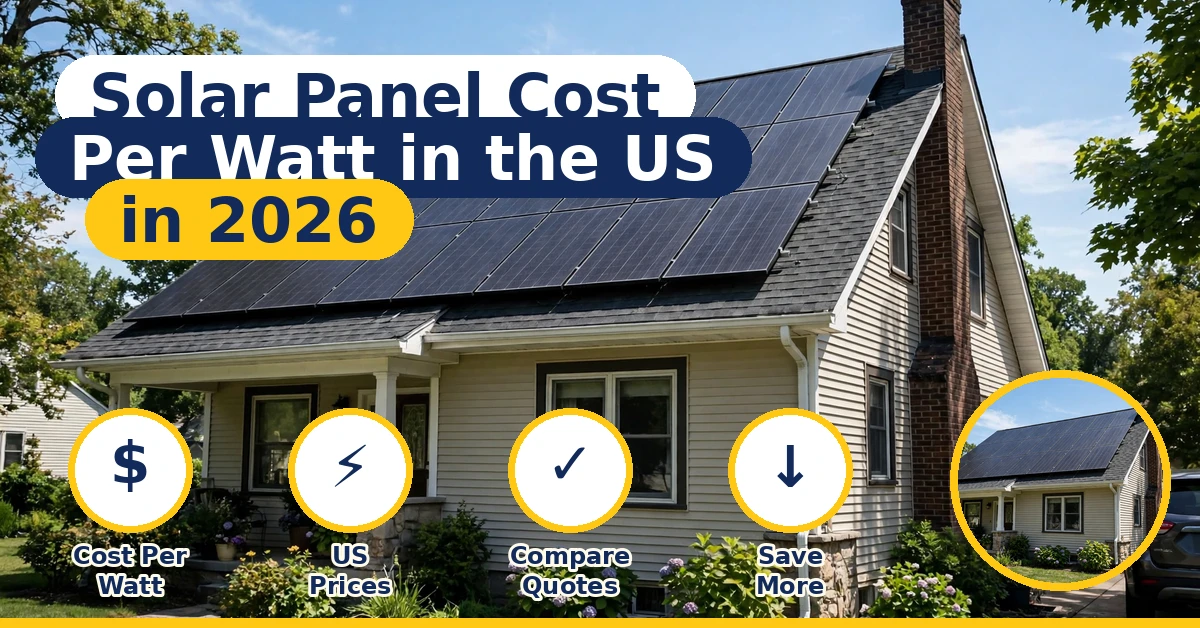
Solar panels in the United States cost roughly $2.70 to $3.50 per watt installed in 2026, before incentives. That means a 6kW system costs around $16,000 to $21,000 before incentives, and a 5kW system costs around $13,500 to $17,500. The exact price per watt depends on where you live, the equipment you choose, your roof, and whether you pay cash or use financing.
This guide explains what cost per watt means, the typical ranges in 2026, what drives the price up or down, and how to use the figure to compare installer quotes fairly.
What Does Cost Per Watt Mean?

Cost per watt is the total installed price of a solar system divided by its size in watts. For example, a 6,000-watt system costing $18,000 works out to $3.00 per watt. It is the standard way to compare solar quotes because it adjusts for system size: a bigger system costs more in total, but its price per watt may be lower.
The figure should cover the whole installed system, not just the panels. A complete quote usually includes the panels, inverter, mounting equipment, wiring, labour, permits and standard electrical work. If a quote looks unusually cheap per watt, check what is excluded. Roof repairs, electrical panel upgrades, trenching and battery storage are often priced separately. Always compare quotes on the same scope of work.
Typical Cost Per Watt in the US in 2026
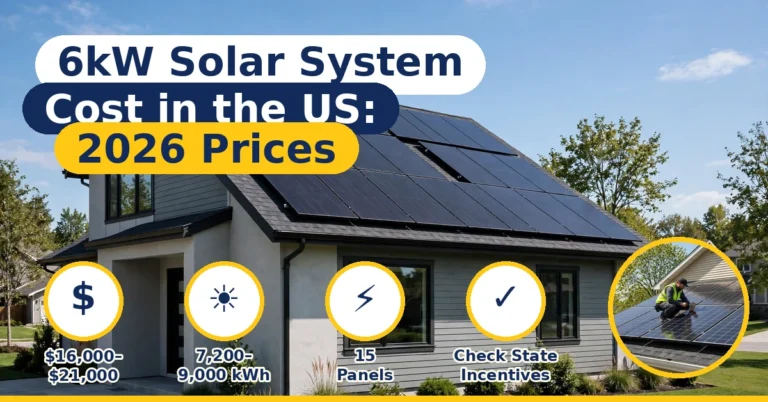
Based on the figures in our 6kW solar system cost guide, a typical installed price in 2026 is around $2.70 to $3.50 per watt. EnergySage reported an average installed price of approximately $16,080 for a 6kW system based on 2026 marketplace data, which works out to about $2.68 per watt, while a separate national benchmark of $3.36 per watt puts the same system at approximately $20,160. Different datasets use different methods, so treat these as estimates rather than fixed prices.
At $3.00 per watt, a typical system costs roughly:
| System size | Cost at $2.70/W | Cost at $3.00/W | Cost at $3.50/W |
|---|---|---|---|
| 4kW | $10,800 | $12,000 | $14,000 |
| 5kW | $13,500 | $15,000 | $17,500 |
| 6kW | $16,200 | $18,000 | $21,000 |
| 8kW | $21,600 | $24,000 | $28,000 |
| 10kW | $27,000 | $30,000 | $35,000 |
These are broad planning estimates before incentives. Your quotes may fall outside this range depending on location, equipment and installation complexity.
Cost Per Watt by State
Installation prices vary across the country because of differences in labour, permitting, competition, roof types and local market conditions. Marketplace data for 2026 shows lower average prices in states such as Texas and Florida, and higher averages in states such as Massachusetts and New York. The difference between the cheapest and most expensive states can be around $0.50 to $1.00 per watt for the same system size.
What Drives the Price Per Watt Up or Down?
Equipment quality. Premium panels with higher efficiency and longer warranties usually cost more per watt. Standard panels cost less but may produce slightly less electricity from the same roof area. The cheapest panel is not always the best value, and the most expensive is not always the best choice either.
Inverter type. A system may use a string inverter, microinverters or power optimisers. Microinverters and optimisers can add cost per watt but may be useful on roofs with multiple directions or partial shading.
Roof condition and complexity. A simple roof with good access is usually cheaper to install on. Steep roofs, multiple roof sections, old roofing materials or required repairs can raise the price per watt. Our roof installation guide explains what installers check before designing a system.
Labour and permits. Permit fees, inspection requirements and labour costs differ by city and state. Areas with more installer competition may have lower quotes, while complex local requirements can increase the price.
Financing. Cash prices are usually the lowest per watt. Solar loans can include dealer fees that raise the total cost, and leases or power purchase agreements use a different pricing structure altogether. Compare the total amount you will pay, not only the headline price per watt.
What Is Included in the Price Per Watt?
A complete installed price per watt normally includes the panels, inverter, mounting, wiring, labour, permits, design and standard electrical work. It does not usually include a battery, roof replacement, electrical panel upgrades, tree removal or trenching. Ask each installer for an itemised proposal so you can see exactly what is covered and what would cost extra.
How to Compare Quotes Using Cost Per Watt
- Get at least three quotes: Compare proposals with similar system sizes, equipment and warranties.
- Divide price by watts: Take the total installed price and divide by the system size in watts to get the price per watt for each quote.
- Check the equipment: Confirm the panel and inverter models, not just the brand names.
- Compare the same scope: Make sure each quote includes the same work, and note anything excluded.
- Look beyond price: Check licensing, insurance, workmanship warranty, references and who handles service if the company stops operating.
- Ask about incentives: State and utility programs vary, so ask what is available in your area and whether the installer will help with the paperwork.
A quote that is far below the typical range deserves extra care. It may exclude necessary work, use lower-quality equipment, or come from a company that will not be around to honour its warranty. A quote far above the range should be justified by premium equipment, a complex roof, or extra work that is clearly listed.
Is Solar Still Worth It at This Price?
Whether solar is worth it depends on your electricity price, how much sun your roof receives, your annual usage and the incentives available to you. A home with high electricity bills and a sunny, unshaded roof usually benefits most. A home with low bills and a shaded roof benefits less.
To judge the value, compare the system’s total cost with the electricity it is expected to produce over its lifetime, and check your local export rules — see our net metering explainer — before deciding.
Conclusion
In 2026, solar panels in the US cost roughly $2.70 to $3.50 per watt installed, before incentives, with a 6kW system typically around $16,000 to $21,000. Location, equipment, roof complexity and financing move the figure up or down. Use cost per watt to compare quotes on the same scope of work, get at least three itemised proposals, and check warranties and installer reputation before you decide.
Frequently Asked Questions
1. What is the average solar panel cost per watt in the US in 2026?
Roughly $2.70 to $3.50 per watt installed, before incentives. Prices vary by state, equipment and roof complexity.
2. How much does a 6kW solar system cost at $3.00 per watt?
About $18,000 before incentives. At $2.70 per watt it would be about $16,200, and at $3.50 per watt about $21,000.
3. Does cost per watt include the inverter and installation?
Yes, in a normal installed quote. It covers panels, inverter, mounting, wiring, labour and permits, but usually not a battery or roof repairs.
4. Why do quotes in the same city have different prices per watt?
Because of different equipment, roof complexity, included work, warranties and financing. Compare itemised quotes on the same scope to find the real difference.
5. Is a lower cost per watt always better?
No. A very low price may exclude necessary work or use lower-quality equipment. Compare warranties, installer reputation and the full scope before choosing on price alone.