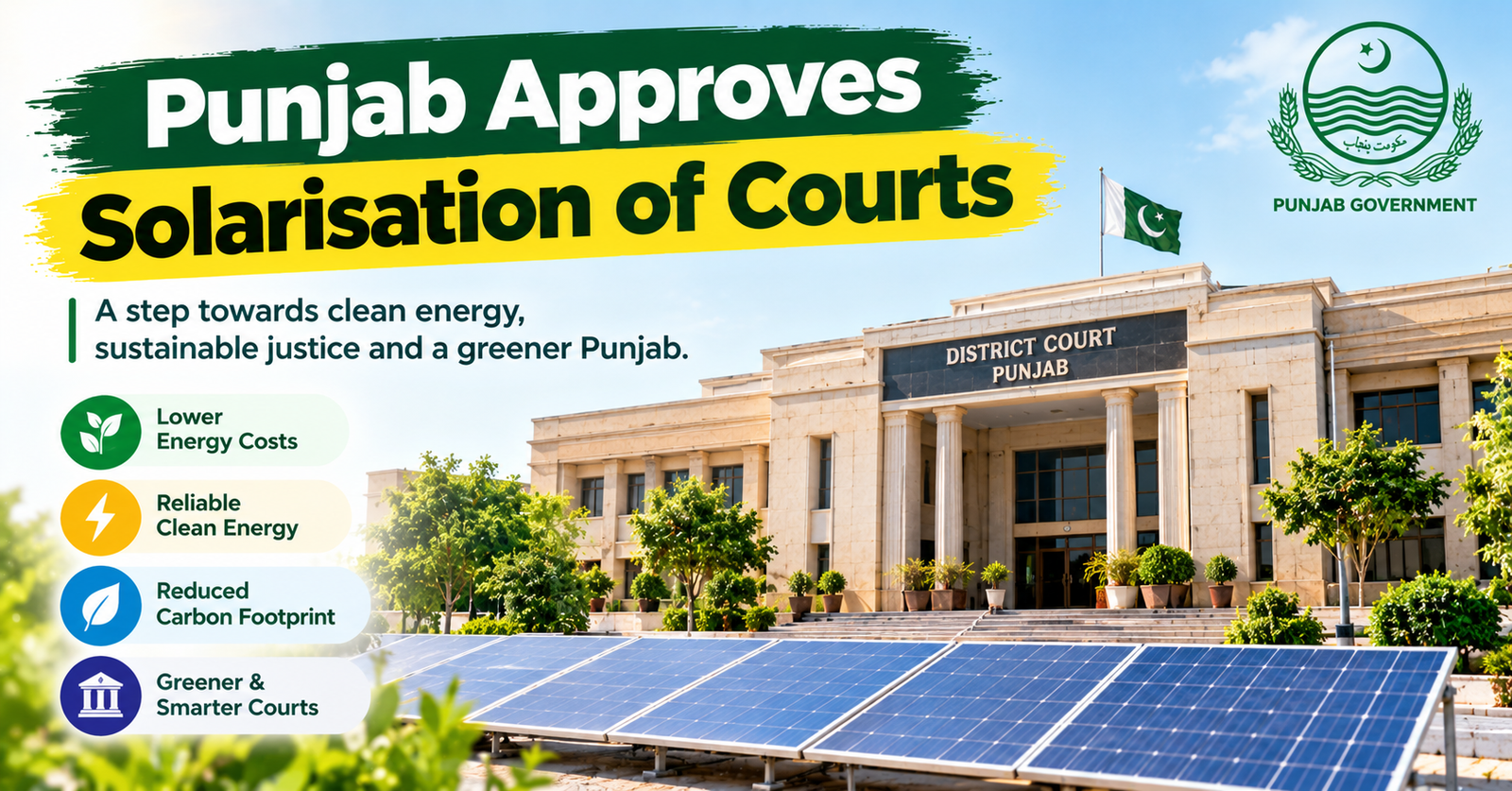
Punjab has approved solar power for its courts and hospitals. At its 11th meeting of the current financial year on Tuesday, 27 October 2026, the Provincial Development Working Party (PDWP) approved ten development schemes worth Rs 60 billion, including the solarization of District and Sessions Courts and High Court Benches across the province, at a revised cost of Rs 2,610 million (Rs 2.61 billion), and the solarization of Tehsil Headquarters (THQ) hospitals. The decisions were reported by UrduPoint, citing the Associated Press of Pakistan, from the Planning and Development Board, Punjab.
The meeting was chaired by Planning and Development Board Chairman Dr Naeem Rauf, with Planning and Development Board Secretary Rafaqat Ali, Chief Economist Dr Farrukh Naveed, and members and officers of various departments in attendance. The solar items were part of a much larger package, but for energy readers they are the most significant part: they extend Punjab’s public-building solar drive from schools, which we covered in our report on Punjab’s shift of 256 higher secondary schools to solar power, into the justice and health systems, where an uninterrupted power supply is not a convenience but a necessity.
What Was Approved for Courts?
The court scheme is listed as “Solarization of District and Sessions Courts and High Court Benches of Punjab”, revised, at a cost of Rs 2,610 million. That wording tells us three things. First, the scheme covers both levels of the court system: the district and sessions courts that handle most everyday litigation across Punjab’s districts, and the High Court benches that sit outside Lahore. Second, it is a revised scheme, meaning an earlier version has been updated, although the published summary does not say what changed in the revision. Third, the cost is the scheme cost as approved by the PDWP, not a per-court figure, and the summary does not break it down by court, district or system size.
What the summary does not give is equally important. It does not list which courts will be solarized first, what capacity each court will receive, whether battery storage is included, or when installation will begin and finish. Those details will matter enormously in practice. A court with only daytime solar and no storage will still face disruption during an evening outage, while a court with storage can keep lights, fans, computers and record systems running through a power cut. Until the implementing department publishes the scheme details, readers should not assume a capacity or a timeline that has not been announced.
What About THQ Hospitals?
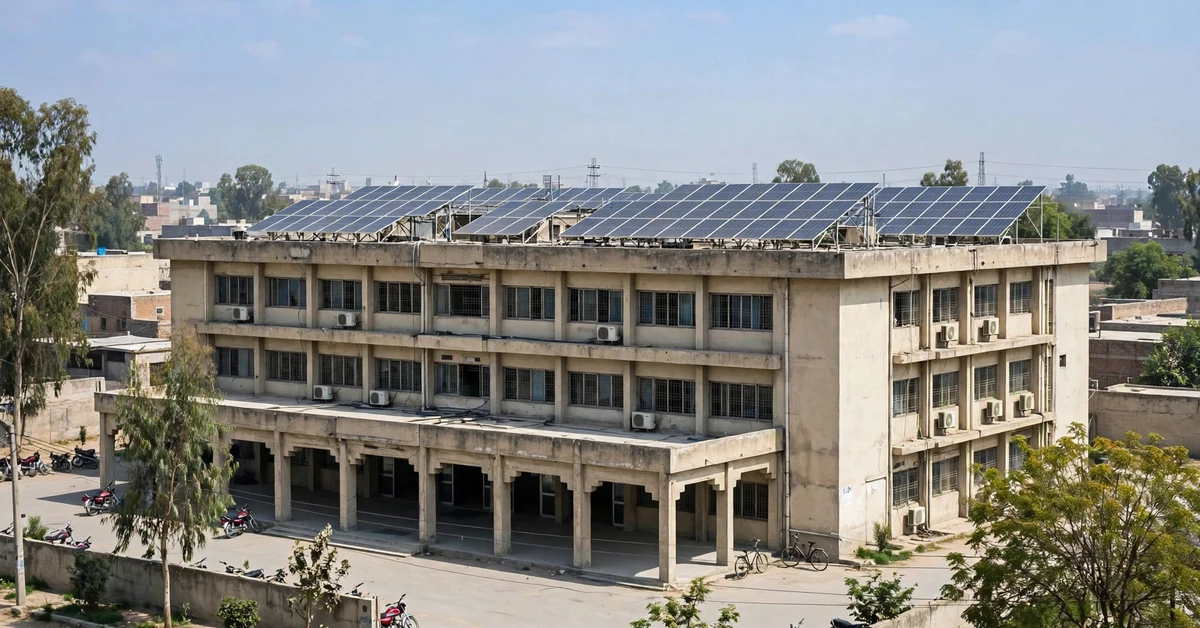
The hospital item is listed as “Solarization of THQ Hospitals in Punjab”, revised, with a position paper for change of type of vehicles approved. That last phrase, as published, is unclear, and the summary gives no cost, capacity or timeline for the hospital scheme. We are therefore not inventing any of those figures here. What can be said is that THQ hospitals, the tehsil-level public hospitals that serve as the first referral point for rural patients, are among the public buildings where solar power makes the most practical sense.
A hospital’s electricity load peaks during the day, when outpatient departments, laboratories, imaging and administrative offices are all running, which matches solar generation well. More importantly, hospitals cannot afford the kind of interruption that a home or even a school can tolerate. Vaccine refrigerators, laboratory equipment, lighting for wards and emergency care all depend on a stable supply. Solar power, especially with battery storage, can reduce both the electricity bill and the vulnerability to grid outages, but only if the system is sized for critical loads and maintained properly. A solar array that powers only non-critical loads, or that fails for want of cleaning and inverter maintenance, will not deliver that benefit.
The Full PDWP Package in Context
The ten approved schemes, as listed in the UrduPoint and APP summary, were:
- Establishment of a Centre of Excellence in Advanced Automotive Technologies at Shahdara, Lahore, at Rs 762 million;
- Establishment of a Centre of Excellence in Modern Woodworking at Shahdara, Lahore, at Rs 1,010 million;
- Establishment of a Centre of Excellence for the Construction Sector at Shahdara, Lahore, at Rs 1,173 million;
- Rehabilitation of Gujrat-Sargodha Road, District Mandi Bahauddin, revised, at Rs 11,989 million;
- Dualization of Lilla Interchange (M-2), Pind Dadan Khan, Jhelum, at Rs 20,809 million, referred to the Public Sector Development Programme;
- Provision of missing facilities and upgradation of Punjab Small Industries Corporation (PSIC) Small Industrial Estates, revised, at Rs 2,750 million;
- Solarization of District and Sessions Courts and High Court Benches of Punjab, revised, at Rs 2,610 million;
- Establishment of Nawaz Sharif Medical District at Lahore, at Rs 18,786 million;
- Solarization of THQ Hospitals in Punjab, revised, with a position paper approved as described above;
- Construction of Mahota Dam Project, revised, with a position paper for extension of the gestation period approved.
The package as a whole is reported at Rs 60 billion, although the published summary does not give a cost for every item, so the individual figures listed above should not simply be added together to reach that total. The point of listing them is context: the solar schemes were not approved in isolation, but as part of a broad provincial development round covering skills training, roads, industry, health and water, as well as energy.
Why Solar for Public Buildings Works
Public buildings are, in many ways, the easiest case for solar power. Unlike a home, where most electricity use may happen in the evening after the sun has set, a court, a school or a hospital outpatient department uses most of its power during working hours, when its own roof is generating. That daytime match means a larger share of the solar output is used on site, rather than exported to the grid at a lower buyback rate, which improves the economics even under the new net-billing framework for new systems.
For private readers, the lesson is transferable. A business or institution with daytime load, a large flat roof and a high electricity bill is the ideal solar candidate, which is why industrial solar has also been growing. Gul Ahmed Textile Mills, for example, recently approved a solar plant of up to 6 MW alongside wind and battery storage at Nooriabad, as covered in our report on Gul Ahmed’s renewable expansion. The scale is different, but the calculation is the same: match generation to daytime use, size storage for the loads that cannot wait, and maintain the system.
What Happens Next?
PDWP approval is the provincial planning step. The next steps, which have not yet been published for these schemes, will typically include detailed design and tendering, selection of installers, and phased installation, starting with the buildings where the grid supply is weakest or the bill is highest. Readers looking for a tender notice or a list of courts and hospitals in the first phase should watch the Planning and Development Board and the relevant provincial departments, rather than social-media lists, which are not official sources.
Two questions in particular are worth following. First, will the court and hospital systems include battery storage, and if so, sized for which loads? A court that can keep its record room and courtroom running through an outage is very different from one that can only run its daytime lighting. Second, who will maintain the systems, and under what warranty? The answers to those questions will determine whether Rs 2.61 billion for courts, and whatever the hospital scheme costs, translate into years of reliable power or into a short-lived headline.
For households and small businesses in Punjab, the public-building drive also carries a practical message. If courts and hospitals, which cannot afford to get their power wrong, are choosing solar, the technology risk is no longer the question it was a decade ago. The questions that remain are the ones every buyer should ask: what size system, from which installer, at what price, and with what after-sales support. Our guide to KP’s seminary solar survey shows another province asking the same questions for its public buildings, and the answers, building by building, will shape how fast solar becomes the default power source for public institutions across Pakistan.
Frequently Asked Questions
Which courts will get solar power in Punjab?
The PDWP approved the solarization of District and Sessions Courts and High Court Benches of Punjab, at a revised cost of Rs 2,610 million. The published summary does not list individual courts or a phasing plan.
Are THQ hospitals included?
Yes. The solarization of THQ Hospitals in Punjab was also approved as a revised scheme at the same PDWP meeting. No cost, capacity or timeline for the hospital scheme was given in the published summary.
When will installation start?
No start date has been published. PDWP approval is the planning approval; detailed design, tendering and phased installation follow.
Will the systems include batteries?
The published summary does not say. Battery storage would be particularly valuable for hospitals, but it has not been confirmed for either scheme.
Is this part of the CM Punjab solar scheme for homes?
No. This is a separate public-building programme for courts and hospitals, approved by the PDWP. It is not a household registration scheme, and no household application process is attached to it.
The bottom line is that Punjab has now put its justice and health buildings on the same solar path as its schools. The court figure, Rs 2.61 billion, is confirmed. The hospital details are not yet published, and that gap should be filled by the province’s next announcement, not by speculation. When it is, we will update this coverage.
Source: NEPRA — National Electric Power Regulatory Authority