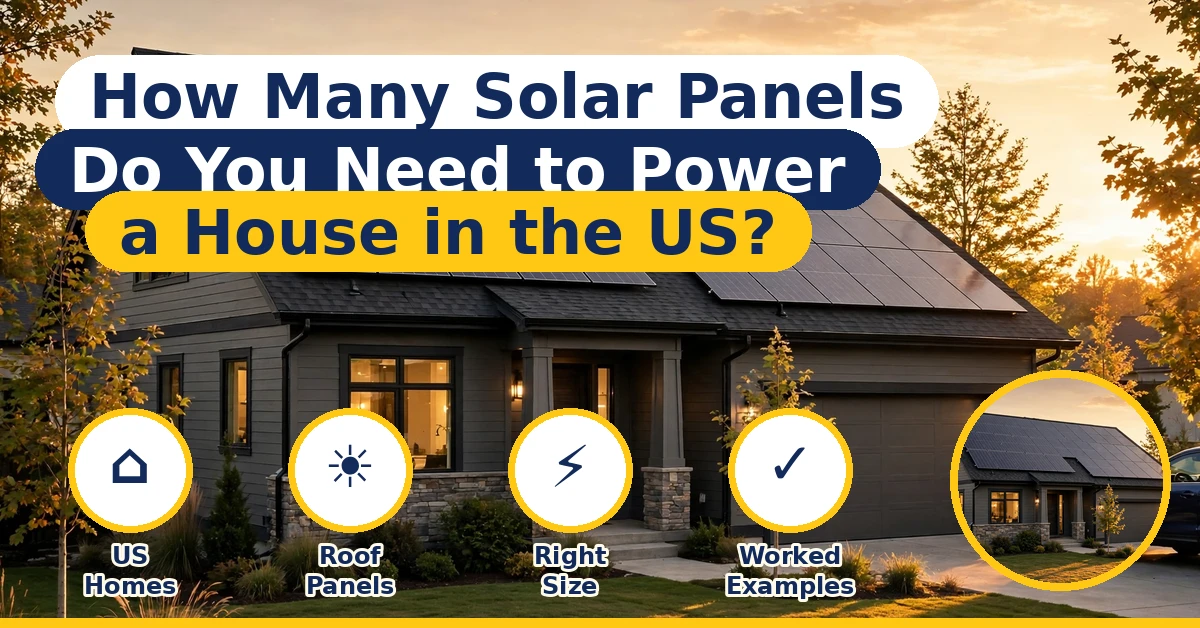
Most American homes need roughly 15 to 25 solar panels to cover a large share of their electricity use, with the typical figure around 18 to 20 panels of 400 watts each. The exact number depends on how much electricity your household uses, how much sun your roof receives, and the wattage of the panels you choose.
This guide explains how to work out the right number of panels for your home, with worked examples for small and large households, and the roof and shading checks that matter before you accept a quote.
How Many Solar Panels Does a Typical US Home Need?
A typical American home uses roughly 10,500 kWh of electricity per year. A 400-watt panel in an average US location produces roughly 480 to 600 kWh per year, so covering the full annual use would need about 18 to 22 panels. In practice, many homeowners install a system that covers part of their use, often 15 to 20 panels, and keep buying some electricity from the grid.
The number also depends on panel wattage. Modern residential panels are usually 350 to 450 watts. Higher-wattage panels produce more electricity each, so you need fewer of them. With 450-watt panels, the same system needs about 16 to 19 panels instead of 18 to 22. The total system size in kilowatts is what matters most; the panel count follows from the panel wattage you choose.
Step 1: Find Your Annual Electricity Use
The starting point is your own usage, not your home’s size. Two houses of the same size can use very different amounts of electricity depending on heating, cooling, appliances and how many people live there.
Find your last twelve months of electricity bills and add up the kWh figures. Divide the annual total by 12 to get your average monthly use.
Step 2: Work Out Your System Size in Kilowatts
Once you know your annual use, divide it by the amount of electricity one kilowatt of solar produces in your area each year. In many US locations, one kilowatt of solar produces roughly 1,200 to 1,500 kWh per year. In very sunny states it may be nearer 1,500 kWh, and in cloudier northern states nearer 1,200 kWh.
For example, a home using 10,500 kWh per year in an average-sun location would need about 7 to 8.5 kW of solar to cover its full annual use: 10,500 divided by 1,400 gives about 7.5 kW. A home using 6,000 kWh per year would need about 4 to 5 kW. These are planning estimates; your installer’s site-specific estimate should use your exact address, roof and shading.
If you want to cover only part of your use, size the system to your goal instead. Many homeowners aim to offset 70 to 80 percent of annual use, which keeps the system affordable while cutting bills substantially. Our guide to how many solar panels you need explains the same sizing method in more detail.
Step 3: Convert System Size to a Panel Count
Divide the system size in watts by the wattage of the panels you plan to use. A 7.5 kW system is 7,500 watts. With 400-watt panels, that is 7,500 divided by 400, or about 19 panels. With 450-watt panels, it is about 17 panels. With 350-watt panels, it is about 21 panels.
| Annual use | System size (approx.) | Panels at 400W |
|---|---|---|
| 6,000 kWh | 4 to 5 kW | 10 to 13 |
| 8,000 kWh | 5.5 to 6.5 kW | 14 to 16 |
| 10,500 kWh | 7 to 8.5 kW | 18 to 21 |
| 14,000 kWh | 9.5 to 11.5 kW | 24 to 29 |
Always round up, because a system cannot include a fraction of a panel, and a little extra capacity covers normal system losses. Your installer will confirm the final count after measuring your roof and checking shading.
Worked Examples
Example 1: Small home, low use. A two-person household uses 6,000 kWh per year in Texas. At about 1,450 kWh per kilowatt per year, it needs about 4.1 kW, or about 11 panels of 400 watts. A 5kW system with 13 panels would cover it comfortably. See our guide to how much a 6kW system costs for a sense of pricing at this size.
Example 2: Average family home. A four-person household uses 10,500 kWh per year in Ohio. At about 1,300 kWh per kilowatt per year, it needs about 8 kW, or about 20 panels of 400 watts. The system would need roughly 360 square feet of suitable roof space.
Example 3: Large home with an electric vehicle. A household uses 14,000 kWh per year, including home charging, in California. At about 1,500 kWh per kilowatt per year, it needs about 9.3 kW, or about 24 panels of 400 watts.
What Else Changes the Panel Count?
Roof direction and tilt. South-facing roofs produce the most per panel over the year. East- and west-facing roofs need slightly more panels for the same total output. A flat roof can work well if panels are tilted on mounting racks.
Shading. Trees, chimneys and nearby buildings reduce output. If part of your roof is shaded, the installer may place panels only on the sunny sections, or use microinverters to limit the effect of partial shade. Our roof installation guide explains what installers check on a roof before designing a system.
Net metering rules. In states with net metering or similar export rules, excess daytime electricity earns credit against evening use, which makes a larger system more useful. Where export rules are less generous, oversizing the system may not pay. Check your utility’s current rules before deciding the final size. Our net metering explainer describes how export crediting works in general.
Conclusion
Most US homes need roughly 15 to 25 solar panels, or about 18 to 20 panels of 400 watts for a typical household using around 10,500 kWh per year. Work out your annual use from twelve months of bills, divide by the output per kilowatt in your area, and convert the result to a panel count using your chosen panel wattage. Then confirm the figure with a site-specific installer estimate that accounts for your roof, shading and future electricity needs.
Frequently Asked Questions
1. How many solar panels do I need for a 2,000 sq ft house in the US?
It depends on electricity use, not floor area. A 2,000 sq ft home using around 10,500 kWh per year typically needs about 18 to 21 panels of 400 watts, but a low-use household may need far fewer.
2. How many solar panels are needed for a 5kW system?
About 13 panels with 400-watt panels, or about 11 to 12 panels with 450-watt panels.
3. Can 10 solar panels power a house?
Ten 400-watt panels make a 4kW system producing roughly 4,800 to 6,000 kWh per year. That may cover a small, efficient home, but not a typical family home.
4. Do I need more panels if my roof faces east or west?
Slightly more, yes. East- and west-facing roofs produce less per panel over the year than south-facing roofs, so you may need one or two extra panels for the same total output.
5. Should I size my system for future electricity use?
Yes, if you plan to buy an electric vehicle or switch to electric heating. Adding panels during the first installation is usually cheaper than expanding later.