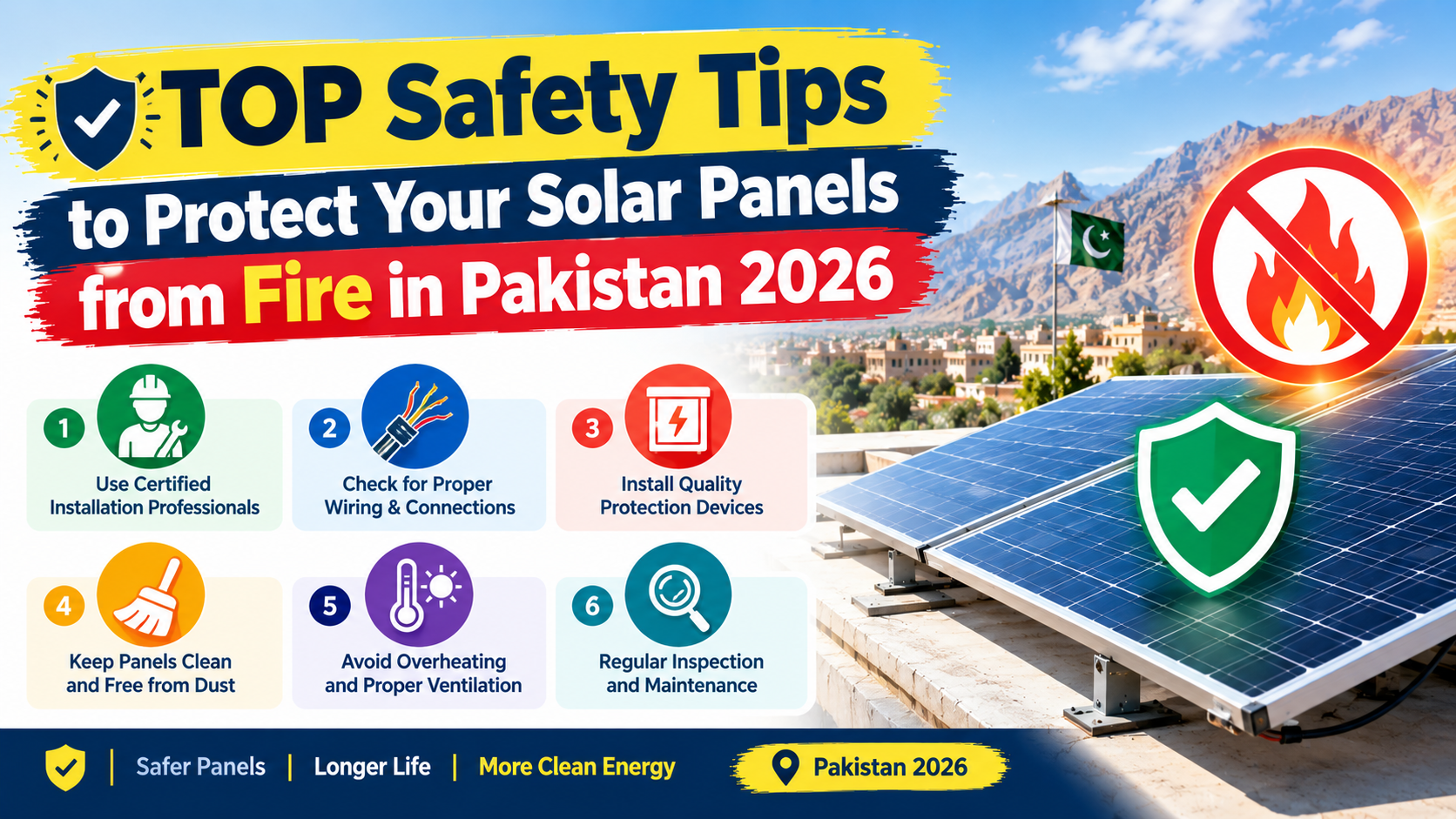
Solar energy has changed the way Pakistani homes and businesses deal with load shedding and high electricity bills. Every year thousands of new systems go up on rooftops from Lahore to Karachi. But with this fast growth comes a serious concern that many owners ignore until it is too late: solar panel fire safety.
The good news is that a well-installed solar system is very safe. The bad news is that many systems in Pakistan are put together in a hurry, with cheap cables, mixed connectors and no proper protection. In this guide you will learn the top safety tips to protect your solar panels from fire in Pakistan in 2026, the most common causes of solar panel fires, a simple maintenance checklist and clear steps to follow if something goes wrong.
INTERESTING SUMMARY
Table of Contents
Why Solar Panel Fire Safety Matters in Pakistan
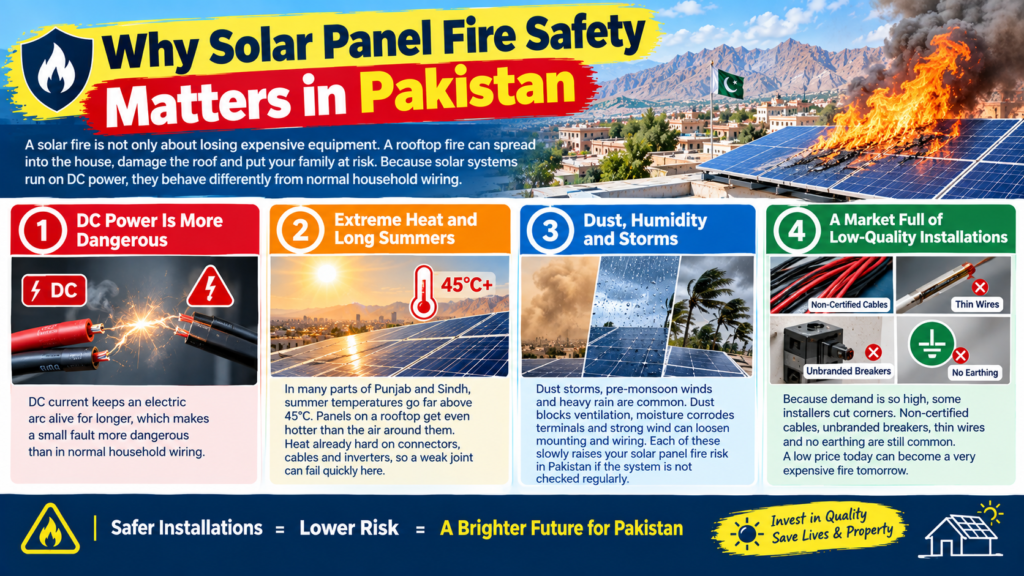
A solar fire is not only about losing expensive equipment. A rooftop fire can spread into the house, damage the roof and put your family at risk. Because solar systems run on DC power, they behave differently from normal household wiring. DC current keeps an electric arc alive for longer, which makes a small fault more dangerous.
Extreme Heat and Long Summers
In many parts of Punjab and Sindh, summer temperatures go far above 45°C. Panels on a rooftop get even hotter than the air around them. Heat is already hard on connectors, cables and inverters, so a weak joint that would survive in a cooler country can fail quickly here.
Dust, Humidity and Storms
Dust storms, pre-monsoon winds and heavy rain are common. Dust blocks ventilation, moisture corrodes terminals and strong wind can loosen mounting and wiring. Each of these slowly raises your solar panel fire risk in Pakistan if the system is not checked regularly.
A Market Full of Low-Quality Installations
Because demand is so high, some installers cut corners. Non-certified cables, unbranded breakers, thin wires and no earthing are still common. A low price today can become a very expensive fire tomorrow.
Common Causes of Solar Panel Fires
Before you can prevent a fire, you need to know where it usually starts. These are the most common causes seen in solar installations.
Loose or Mismatched MC4 Connectors
MC4 connectors join the panels together. If they are not fully clicked in, or if two different brands are forced together, the contact area becomes small. Electricity then squeezes through a tiny space, heats up and slowly melts the plastic. This is one of the leading causes of rooftop solar fires.
Hot Spots and Cracked Panels
A hot spot is a small area of a panel that becomes much hotter than the cells around it. It can be caused by cracked cells, shade from a water tank or wall, bird droppings or a faulty bypass diode. If ignored, the hot spot can burn the back sheet and damage the panel permanently.
Undersized or Poor-Quality Cables
Thin cables carrying high current get hot. Normal household wire is also not made for years of direct sunlight. Cables that are not UV-resistant crack and expose the copper, which can cause short circuits.
Faulty Inverter or Wrong Wiring
An inverter with poor ventilation, loose terminals or wrong wiring can overheat. Placing an inverter in a closed, hot space without airflow makes this worse.
Lightning and Voltage Surges
Without surge protection and good earthing, a nearby lightning strike or a WAPDA grid surge can send a huge spike through your system. This can burn the inverter and the wires connected to it.
Dirt, Leaves and Nesting Birds
Dry leaves, bird nests and trash that collect under and around panels are easy fuel for a spark. Keeping the area clean is a simple and cheap fire prevention step.
Top Safety Tips to Protect Your Solar Panels from Fire
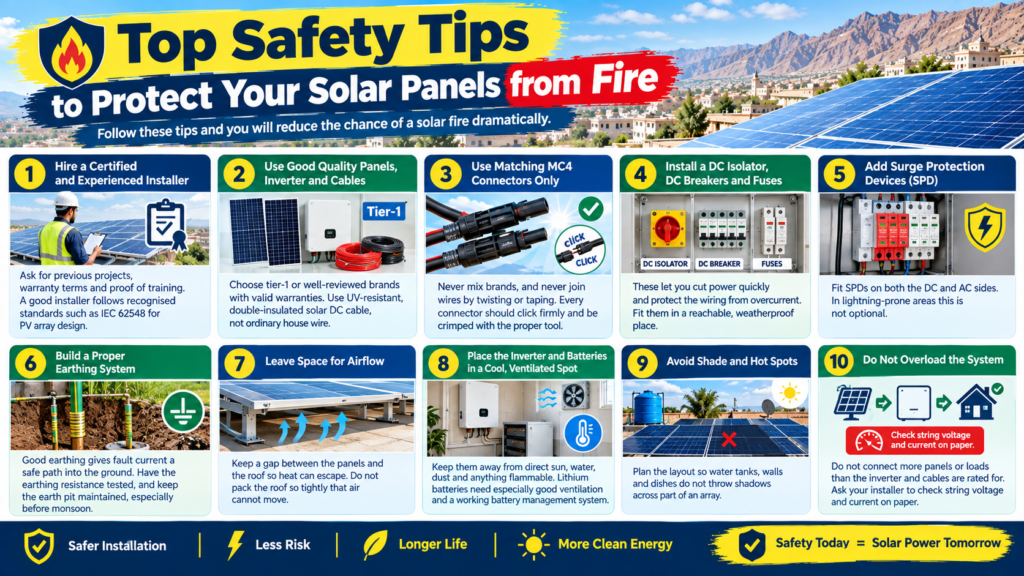
Now for the most important part. Follow these tips and you will reduce the chance of a solar fire dramatically.
- Hire a certified and experienced installer. Ask for previous projects, warranty terms and proof of training. A good installer follows recognised standards such as IEC 62548 for PV array design.
- Use good quality panels, inverter and cables. Choose tier-1 or well-reviewed brands with valid warranties. Use UV-resistant, double-insulated solar DC cable, not ordinary house wire.
- Use matching MC4 connectors only. Never mix brands, and never join wires by twisting or taping. Every connector should click firmly and be crimped with the proper tool.
- Install a DC isolator, DC breakers and fuses. These let you cut power quickly and protect the wiring from overcurrent. Fit them in a reachable, weatherproof place.
- Add surge protection devices (SPD). Fit SPDs on both the DC and AC sides. In lightning-prone areas this is not optional.
- Build a proper earthing system. Good earthing gives fault current a safe path into the ground. Have the earthing resistance tested, and keep the earth pit maintained, especially before monsoon.
- Leave space for airflow. Keep a gap between the panels and the roof so heat can escape. Do not pack the roof so tightly that air cannot move.
- Place the inverter and batteries in a cool, ventilated spot. Keep them away from direct sun, water, dust and anything flammable. Lithium batteries need especially good ventilation and a working battery management system.
- Avoid shade and hot spots. Plan the layout so water tanks, walls and dishes do not throw shadows across part of an array.
- Do not overload the system. Do not connect more panels or loads than the inverter and cables are rated for. Ask your installer to check string voltage and current on paper.
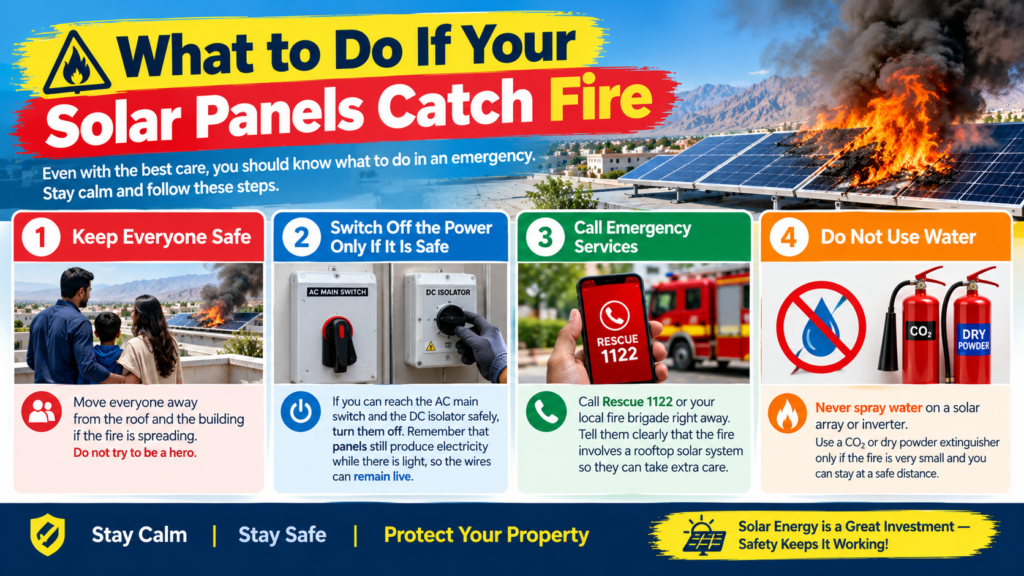
What to Do If Your Solar Panels Catch Fire
Even with the best care, you should know what to do in an emergency. Stay calm and follow these steps.
Step 1: Keep Everyone Safe
Move everyone away from the roof and the building if the fire is spreading. Do not try to be a hero.
Step 2: Switch Off the Power Only If It Is Safe
If you can reach the AC main switch and the DC isolator safely, turn them off. Remember that panels still produce electricity while there is light, so the wires can remain live.
Step 3: Call Emergency Services
Call Rescue 1122 or your local fire brigade right away. Tell them clearly that the fire involves a rooftop solar system so they can take extra care.
Step 4: Do Not Use Water
Never spray water on a solar array or inverter. Use a CO2 or dry powder extinguisher only if the fire is very small and you can stay at a safe distance.
How to Choose a Safe Solar Installer in Pakistan
Most solar fires trace back to workmanship, so your installer matters as much as your panels. Ask these questions before you sign.
- Experience: How many systems have they installed, and can you visit one?
- Brands: Which panels, inverter, cables and breakers will they use, and are warranties valid in Pakistan?
- Protection: Will the quote include a DC isolator, SPD, fuses and earthing?
- Paperwork: Will you get a wiring diagram, invoice and a written warranty for the workmanship?
- After-sales: Do they offer inspection and maintenance visits?
If a quote is much lower than others, ask what has been left out. Missing protection devices are the usual answer.
Illustrative Example — Not a Verified Customer Case: A Small Connector That Nearly Burned a Roof
This is an illustrative case based on the kind of problem often reported by solar owners. A homeowner in a Punjab city installed a 6kW system with the cheapest quote he could find. The installer mixed two different brands of MC4 connectors and did not fit a DC isolator.
For a few months everything worked fine. Then, one hot June afternoon, the owner noticed a burning smell near the roof staircase. On inspection he found that one connector had partly melted and blackened the cable next to it. Luckily he noticed early and switched off the system before the flames spread.
A second, certified technician replaced the connectors with a matching set, changed the damaged cable, added a DC isolator and SPD, and tested the earthing. The repair cost more than the money saved in the first place. The lesson is simple: cheap work is rarely cheap in the end.
Frequently Asked Questions (FAQs)
Can solar panels catch fire in Pakistan?
Yes, although it is uncommon. Solar panels themselves rarely ignite on their own. Most fires start from loose connectors, poor wiring, overloaded cables, faulty inverters or hot spots that were ignored for months. Good installation and regular checks remove most of the risk.
What is the most common cause of solar panel fires?
Loose or mismatched DC connectors and damaged cables are the most common causes. They create resistance, and resistance creates heat. Over time that heat melts insulation and can start a fire on the roof.
How often should I inspect my solar system for fire safety?
Do a quick visual check every month, a proper cleaning and connector check every three months, and a full professional inspection, including thermal imaging if possible, once a year. Check again after every storm or heavy dust event.
Is it safe to put water on a burning solar panel?
No. Solar panels keep producing DC electricity in daylight, even when the main switch is off. Spraying water can cause electric shock. Turn off the isolators from a safe distance, keep everyone away and call the fire department (Rescue 1122).
Do I need surge protection and earthing for my solar system?
Yes. A Surge Protection Device (SPD) and a proper earthing system protect the inverter and wiring from lightning and voltage spikes, which are a real cause of electrical fires. Never skip them to save money.
Does insurance cover solar panel fire damage in Pakistan?
Some home, business and takaful policies cover solar equipment, but terms differ by company. Ask your insurer in writing whether rooftop solar, batteries and inverters are covered, and keep your installation invoices and inspection reports safe.
Conclusion
Solar power is one of the best investments a Pakistani household or business can make, but only when it is installed and maintained with safety in mind. To protect your solar panels from fire, use quality components, hire a certified installer, fit isolators and surge protection, keep the earthing healthy, and inspect the system regularly.
A few small precautions today can save you lakhs of rupees, and possibly a life, tomorrow. Make solar panel fire safety a habit, not an afterthought, and enjoy clean, reliable power for years to come.