
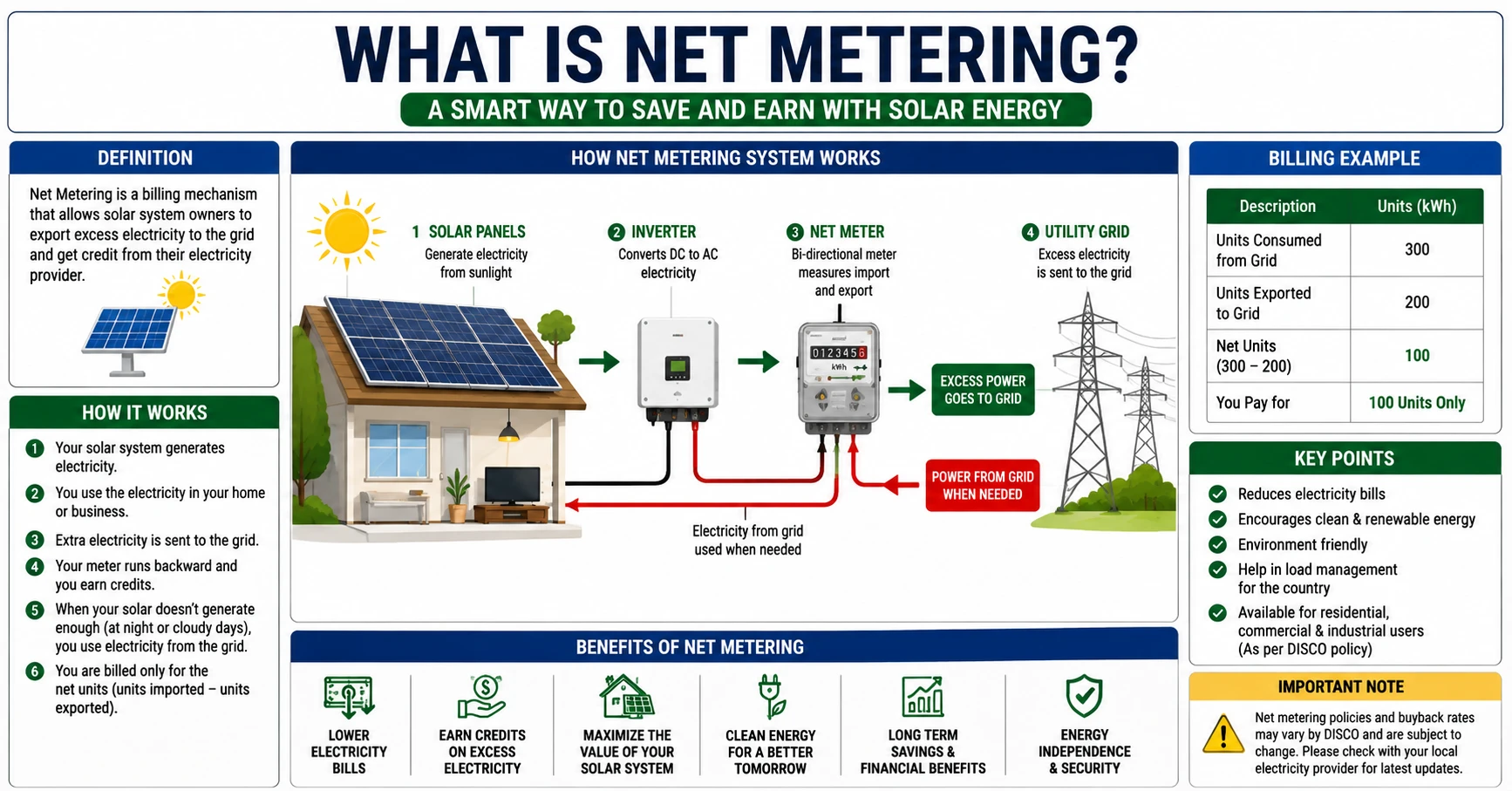
Pakistan’s rooftop-solar billing framework changed in 2026. New prosumer applications are governed by NEPRA’s Prosumer Regulations, 2026, which use a net-billing framework for imported and exported electricity. Existing agreements executed under the earlier rules may be treated differently under the applicable transitional provisions, so consumers should check the date and status of their agreement before estimating export credits or savings.
If you’re researching solar panels, chances are you’ve come across this term everywhere and still aren’t fully sure how it works, whether it’s the same as net billing, or whether it’s disappearing. This guide breaks it all down in plain language.
What Is Net Metering in Solar?
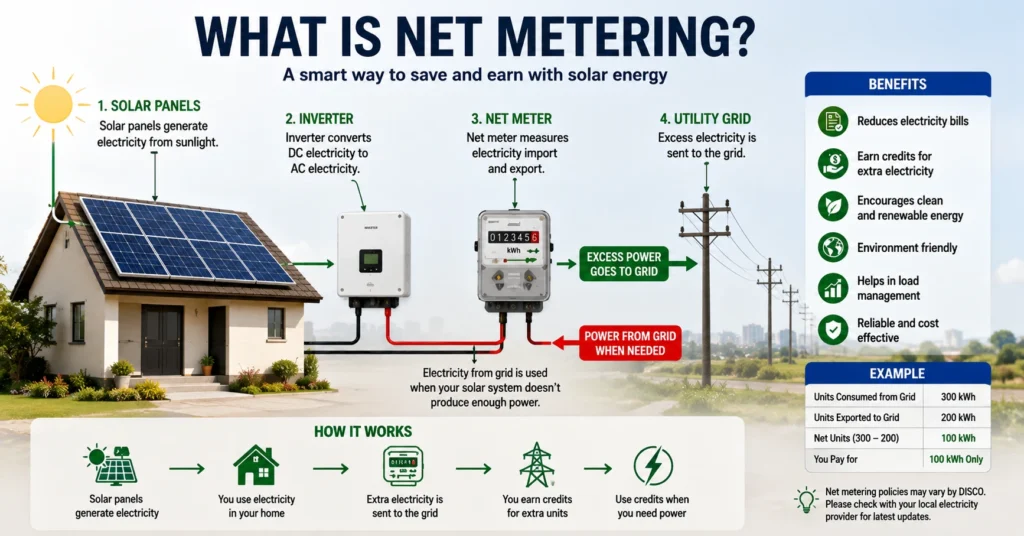
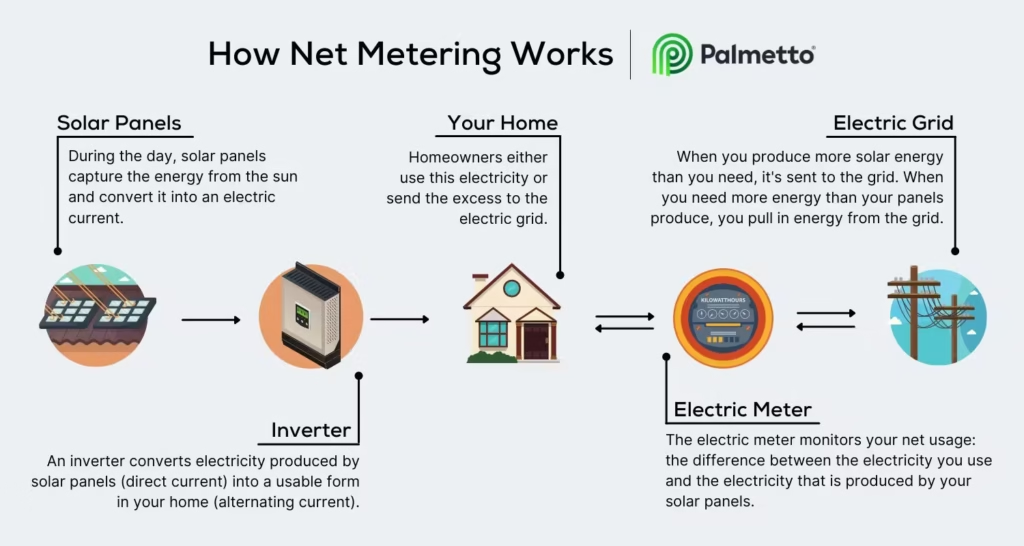
Net metering is a billing system used by utility companies to credit solar owners for the excess electricity their panels send back to the power grid. A special bi-directional meter tracks two things: how much electricity you pull from the grid, and how much your solar system exports to it.
At the end of each billing cycle, the utility calculates the difference — the “net” — between what you consumed and what you contributed. If you sent more to the grid than you used, you receive a credit. If you used more than you sent, you pay for the difference at your normal rate.
This is what makes solar panels practical even though they only generate power during daylight hours. Your system can overproduce at noon and let you draw down those banked credits at night or during winter, when production is lower.
What Is Net Metering and How Does It Work?
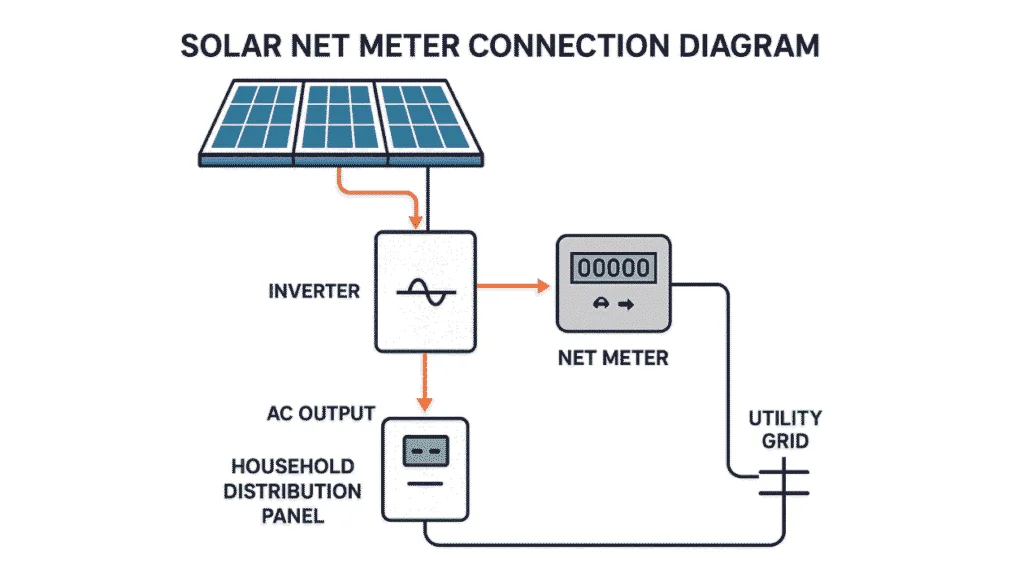
Here’s the step-by-step version of how net metering functions in practice:
- Generation – Your solar panels convert sunlight into electricity throughout the day.
- Home use first – Your household’s appliances and devices draw from that solar electricity before pulling anything from the grid.
- Export – Once your home’s demand is met, any leftover solar power flows out to the local grid.
- Metering – The bi-directional meter separately records energy imported from the grid and energy exported to it.
- Billing – Your utility nets the two figures against each other. Excess generation becomes a credit; extra consumption becomes a charge.
Because solar production usually peaks in summer and dips in winter, most programs let credits roll over from month to month, so a homeowner can effectively “bank” summer surplus and spend it down during darker months. Some utilities settle accounts monthly, others annually, and unused credits at the end of a settlement period may be paid out at a reduced rate, carried forward, or forfeited — depending on local rules.
A Simple Net Metering Example
Say a household’s solar system produces 1,000 kWh in a sunny month while the home only consumes 800 kWh. The extra 200 kWh is exported to the grid, and the homeowner earns a 200 kWh credit.
The following month is cloudier: the system generates only 550 kWh, but the home uses 800 kWh. The 250 kWh shortfall is covered using the credit banked from the previous month, so the homeowner is billed only for whatever the credit doesn’t cover.
This back-and-forth is the core mechanic behind why net metering is considered such a strong solar incentive — it smooths out the mismatch between when solar is produced and when electricity is actually needed.
What Is Net Metering and Net Billing? Understanding the Difference
Net billing is often confused with net metering, but the two work quite differently, and the distinction matters a lot for how much you’ll actually save.
Net metering values every exported kilowatt-hour at (or close to) the same retail rate you’d pay to buy electricity from the grid. In many programs, it’s a true one-to-one exchange.
Net billing compensates exported electricity at a separate, usually lower, rate than the retail price — sometimes tied to wholesale value, sometimes adjusted by time of day. You still get credited for what you send back, but the value of that credit is smaller than what you’d pay to import the same amount.
Net Billing vs Net Metering: Quick Comparison
| Factor | Net Metering | Net Billing |
|---|---|---|
| Export credit value | Same as retail rate (often 1:1) | Lower than retail rate |
| Backup incentive | Battery storage optional | Battery storage strongly encouraged |
| Bill savings | Generally higher | Generally lower |
| Common trend | Being phased out in some states | Increasingly the replacement policy |
Because export credits are worth less under net billing, homeowners in these regions often add a home battery so they can store solar power and use it themselves during expensive evening hours, rather than selling it back cheaply and buying it back at a premium later.
Benefits of Net Metering
- Supports renewable energy adoption – It’s one of the strongest financial incentives driving homeowners toward solar.
- Lower electricity bills – You only pay for your net usage, not your gross consumption.
- Faster payback on your solar investment – Credits reduce the time it takes for panels to pay for themselves.
- No battery required in most cases – The grid effectively functions as a free storage system.
- Protection against rising utility rates – Every credit locked in today shields you from future price hikes.
- Grid-wide advantages – Electricity generated close to where it’s used can ease strain on transmission infrastructure and support the wider grid, benefiting the community even beyond individual solar owners.
Disadvantages of Net Metering
Net metering isn’t without its downsides and controversies:
- Credit expiration – Depending on your utility, unused credits may expire monthly, annually, or roll over indefinitely — so it pays to understand your provider’s specific true-up policy.
- Not available everywhere – Coverage depends on your local DISCO (electricity distribution company) and NEPRA’s net metering regulations.
- No direct cash payment – You typically receive bill credits, not money in hand, for the energy you produce.
- Limited value without time-of-use adjustments – Standard net metering doesn’t always account for when energy is produced versus when it’s most valuable to the grid.
- “Cost-shift” debate – Some utilities argue that non-solar customers end up covering a larger share of fixed grid maintenance costs, since solar households pay less overall. This claim is disputed by solar advocates, who point to broader grid and environmental benefits that often get left out of such cost calculations.
Is Net Metering Worth It?
For most homeowners with access to a solid net metering program, yes — it remains one of the most effective ways to shorten the payback period on a solar investment and meaningfully cut long-term electricity costs. The value depends heavily on your local policy, though: a program offering full retail-rate credit is far more valuable than a reduced-rate net billing successor tariff.
Before installing solar, it’s worth checking your utility’s specific net metering or net billing rules, since these vary widely and directly affect how much you’ll actually save over the system’s lifetime.
Is Net Metering Going Away?
In some regions, yes — traditional, full-retail-rate net metering is gradually being replaced by successor programs, most commonly net billing. California is the most widely discussed example, having transitioned to a net billing structure that significantly reduced the value of export credits compared to its earlier program. Other states and utilities have made similar shifts, though many still maintain strong, retail-rate net metering.
That said, net metering hasn’t disappeared everywhere. A number of states continue to support it, and even where it has been replaced, newer programs still offer some form of compensation for exported solar energy — just structured differently. Policies continue to evolve, so it’s worth checking current rules for your specific location before making solar decisions based on outdated information.
Net Metering vs Gross Metering
It’s also worth knowing how net metering differs from gross metering, another billing model used in some regions:
- Net metering only credits the surplus energy left over after your own consumption is met.
- Gross metering credits all the solar energy your system produces, regardless of how much you use yourself, typically at a separate feed-in tariff rate.
Net metering tends to be more favorable for households with high daytime energy use, while gross metering can work better for those primarily investing in solar as a generation asset rather than for self-consumption.
Alternatives to Net Metering
Where net metering isn’t available, a few other billing arrangements are commonly used:
- Net billing – Exported energy is credited at a separate (usually lower) rate than the retail price.
- Buy-all, sell-all – You purchase all your electricity from the utility while separately selling 100% of your solar production, often at a lower feed-in rate.
- Solar self-consumption – You use, store, or lose your solar power without exporting it to the grid at all, typically relying on batteries to maximize usage.
Frequently Asked Questions
What is the purpose of net metering?
Its purpose is to make solar power financially practical for everyday consumers by crediting them fairly for the electricity they contribute to the grid, encouraging wider adoption of renewable energy.
What is net metering and how does it work?
It’s a billing system that tracks and offsets the electricity you draw from the grid against the electricity your solar system exports to it, so you’re billed only for your net consumption.
What are the disadvantages of net metering?
Limited availability, lack of direct cash payouts, potential credit expiration, and the “cost-shift” debate between solar and non-solar customers are the most commonly cited drawbacks.
What is net metering in Pakistan?
In Pakistan, the current framework for new grid-connected rooftop-solar applicants is governed by NEPRA’s Prosumer Regulations, 2026. The rules provide for prosumer interconnection, concurrence and billing of imported and exported electricity. Older valid agreements may fall under transitional provisions, so applicants and existing solar users should confirm the rules that apply to their specific agreement with NEPRA and their DISCO.
What is the cost of net metering?
Costs typically include the price of a bi-directional meter, an application or interconnection fee, and sometimes inspection charges — generally a small fraction of the overall solar installation cost.
Which is better, net metering or gross metering?
It depends on your usage pattern. Net metering usually benefits households that consume a large share of their own solar power, while gross metering can suit those focused purely on generation income.
How to calculate net metering bill?
Subtract your total exported solar units from your total grid-imported units for the billing period; you’re charged (or credited) for the remaining difference at your applicable tariff rate.
How many solar panels for 1 ton AC?
A 1-ton air conditioner typically requires roughly 3 to 4 solar panels (around 1.2–1.5 kW of capacity), depending on panel wattage, AC efficiency, and daily run-time.
How many meters do you use in net metering?
Net metering requires only a single bi-directional meter, which tracks both imported and exported electricity — unlike some alternative programs that require two separate meters.
What is the difference between net metering and behind-the-meter?
Net metering involves exporting surplus solar power to the grid for credit, while “behind-the-meter” generation refers to power that’s generated and consumed entirely on-site, without ever crossing the utility meter.
Which is better for solar electricity, net metering or net billing?
Net metering generally offers greater savings because it credits exported energy closer to the retail rate, while net billing usually pays a lower rate for exports, making batteries more valuable under that system.
What is the 20% rule for solar?
This commonly refers to utility guidelines that cap the total amount of net-metered solar capacity allowed on a local grid circuit often around 15–20% of that circuit’s peak demand — to maintain grid stability before upgrades are required.otect utility workers. If you need power during an outage, you need battery backup and a hybrid inverter system that can island your home from the grid.
Can renters access net metering benefits?
Not typically with rooftop panels—you need to own the property. However, community solar programs let renters subscribe to a share of a shared solar farm and receive bill credits, usually at 10-20% discount off retail. These programs often don’t require net metering, though individual state rules vary. [INTERNAL-LINK: community solar vs. rooftop solar → comparison guide for renters]
The Bottom Line
Net metering remains one of the most powerful financial drivers for residential solar, but the policy landscape is evolving quickly. Thirty-eight states still offer some form of net metering, and in most cases, the economics are compelling. A typical 6 kW system generates 20-50% higher savings under net metering than without it, reducing payback periods from 10+ years to 5-7 years.
But if you’re considering solar, don’t delay. In Pakistan, net metering is governed by NEPRA’s net metering regulations, and the current buyback terms remain attractive for early adopters. Some DISCOs are revising their net billing rates, so the window to lock in today’s terms may narrow soon. The window to lock in today’s retail rates via grandfathering may narrow soon.
Get a quote from a qualified solar installer in your area. Ask them specifically about NEPRA’s current net metering policy and your DISCO’s buyback rate, and whether either is changing. Then run the numbers yourself. For most homeowners in states with strong net metering, solar still makes excellent financial sense—and the credits you earn are real money reducing your power bills for decades to come.





3 Comments